Wednesday, April 15, 2009

The "Byronesque" Dylan

BB NOTE: Here is Part V of Bill Flanagan's interview with Bob Dylan, published in the Huffington Post. Dylan talks about his favorite songwriters, comments on whether he's a cult figure, as well as his thoughts on nostalgia and says "I'm no mainstream artist." What kind of artist is he? His answer will remind anyone of Scorsese's No Direction Home. He defines himself in this interview as Byronesque, which of course, makes my day:

Bill Flanagan: Going back to that song you wrote for the movie that you mentioned earlier, "Life is Hard," has the formality of an old Rudy Vallee or Nelson Eddy ballad right down to the middle eight ("Ever since the day..."). Do you figure that if you start a song in that style, you stick with the rules right down the line?

Bob Dylan: Sure, I try to stick to the rules. Sometimes I might shift paradigms within the same song, but then that structure also has its own rules. And I combine them both, see what works and what doesn't. My range is limited. Some formulas are too complex and I don't want anything to do with them.

BF: "Forgetful Heart" - how do you decide to put an Appalachian banjo on a minor key blues? Is it something you think of ahead of time or does it come up in the session?

Bob Dylan: I think it probably came up at the studio. A banjo wouldn't be out of character though. There is a minor key modality to "Forgetful Heart." It's like Little Maggie or Darling Cory, so there is no reason a banjo shouldn't fit or sound right.

BF: You wrote a lot of these songs with Robert Hunter. How does that process work?

Bob Dylan: There isn't any process to speak of. You just do it. You drive the car. Sometimes you get out from behind the wheel and let someone else step on the gas.

BF: You must have known Hunter a long time. Do you remember where you first met?

Bob Dylan: It was either back in '62 or '63 when I played in the Bay area. I might have met him in Palo Alto or Berkley or Oakland. I played all those places then and I could have met Hunter around that time. I know he was around.

BF: Didn't Hunter play in a bluegrass band with Jerry Garcia?

Bob Dylan: Yeah, it was either that or a jug band.

BF: Have you ever thought about composing anything with those Nashville songwriters?

Bob Dylan: I've never thought about that.

BF: Neil Diamond did an album years ago where he co-wrote with different Nashville songwriters.

Bob Dylan: Yeah, that might have worked for him. I don't think it would work for me.

BF: You don't think it would work for you?

Bob Dylan: No. I'm okay without it. I'm not exactly obsessed with writing songs. I go back a ways with Hunter. We're from the same old school so it makes it's own kind of sense.

BF: Do you listen to a lot of songs?

Bob Dylan: Yeah - sometimes.

BF: Who are some of your favorite songwriters?

Bob Dylan: Buffett I guess. Lightfoot. Warren Zevon. Randy. John Prine. Guy Clark. Those kinds of writers.

BF: What songs do you like of Buffett's?

Bob Dylan: "Death of an Unpopular Poet." There's another one called "He Went to Paris."

BF: You and Lightfoot go way back.

Bob Dylan: Oh yeah. Gordo's been around as long as me.

BF: What are your favorite songs of his?

Bob Dylan: "Shadows," "Sundown," "If You Could Read My Mind." I can't think of any I don't like.

BF: Did you know Zevon?

Bob Dylan: Not very well.

BF: What did you like about him?

Bob Dylan: "Lawyers, Guns and Money." "Boom Boom Mancini." Down hard stuff. "Join me in L.A." sort of straddles the line between heartfelt and primeval. His musical patterns are all over the place, probably because he's classically trained. There might be three separate songs within a Zevon song, but they're all effortlessly connected. Zevon was a musician's musician, a tortured one. "Desperado Under the Eaves." It's all in there.

BF: Randy Newman?

Bob Dylan: Yeah, Randy. What can you say? I like his early songs, "Sail Away," "Burn Down the Cornfield," "Louisiana," where he kept it simple. Bordello songs. I think of him as the Crown Prince, the heir apparent to Jelly Roll Morton. His style is deceiving. He's so laid back that you kind of forget he's saying important things. Randy's sort of tied to a different era like I am.

BF: How about John Prine?

Bob Dylan: Prine's stuff is pure Proustian existentialism. Midwestern mindtrips to the nth degree. And he writes beautiful songs. I remember when Kris Kristofferson first brought him on the scene. All that stuff about "Sam Stone" the soldier junky daddy and "Donald and Lydia," where people make love from ten miles away. Nobody but Prine could write like that. If I had to pick one song of his, it might be "Lake Marie." I don't remember what album that's on.

BF: A lot of the acts from your generation seem to be trading on nostalgia. They play the same songs the same way for the last 30 years. Why haven't you ever done that?

Bob Dylan: I couldn't if I tried. Those guys you are talking about all had conspicuous hits. They started out anti-establishment and now they are in charge of the world. Celebratory songs. Music for the grand dinner party. Mainstream stuff that played into the culture on a pervasive level. My stuff is different from those guys. It's more desperate. Daltrey, Townshend, McCartney, the Beach Boys, Elton, Billy Joel. They made perfect records, so they have to play them perfectly ... exactly the way people remember them. My records were never perfect. So there is no point in trying to duplicate them. Anyway, I'm no mainstream artist.

BF: Then what kind of artist are you?

Bob Dylan: I'm not sure, Byronesque maybe. Look, when I started out, mainstream culture was Sinatra, Perry Como, Andy Williams, Sound of Music. There was no fitting into it then and of course, there's no fitting into it now. Some of my songs have crossed over but they were all done by other singers.

BF: Have you ever tried to fit in?

Bob Dylan: Well, no, not really. I'm coming out of the folk music tradition and that's the vernacular and archetypal aesthetic that I've experienced. Those are the dynamics of it. I couldn't have written songs for the Brill Building if I tried. Whatever passes for pop music, I couldn't do it then and I can't do it now.

BF: Does that mean you create outsider art? Do you think of yourself as a cult figure?

Bob Dylan: A cult figure, that's got religious connotations. It sounds cliquish and clannish. People have different emotional levels. Especially when you're young. Back then I guess most of my influences could be thought of as eccentric. Mass media had no overwhelming reach so I was drawn to the traveling performers passing through. The side show performers - bluegrass singers, the black cowboy with chaps and a lariat doing rope tricks. Miss Europe, Quasimodo, the Bearded Lady, the half-man half-woman, the deformed and the bent, Atlas the Dwarf, the fire-eaters, the teachers and preachers, the blues singers. I remember it like it was yesterday. I got close to some of these people. I learned about dignity from them. Freedom too. Civil rights, human rights. How to stay within yourself. Most others were into the rides like the tilt-a-whirl and the rollercoaster. To me that was the nightmare. All the giddiness. The artificiality of it. The sledge hammer of life. It didn't make sense or seem real. The stuff off the main road was where force of reality was. At least it struck me that way. When I left home those feelings didn't change.

BF: But you've sold over a hundred million records.

Bob Dylan: Yeah I know. It's a mystery to me too.

Bob Dylan's 33rd album, Together Through Life, will be released April 28.

Monday at the Cafe: What do you believe?

The Colbert ReportMon - Thurs 11:30pm / 10:30c
The De-Deification of the American Faithscape
colbertnation.com
Colbert Report Full EpisodesPolitical HumorNASA Name Contest


Tip of the tinfoil to Matt Kennedy at SF.

Tuesday, April 14, 2009

Do you hear The People sing?

The Litigation March goes on: The Episcopal Church files more lawsuits

They haven't actually been served yet, apparently, but Katharine Jefferts Schori - through her "shadow diocese" set up precisely for this litigious purpose in Ft. Worth, Texas - has filed yet another lawsuit. The Diocese of Ft. Worth is being sued for voting to separate from The Episcopal Church and join the Anglican Province of the Southern Cone. Expect the papers to be served to the leadership of the Episcopal Diocese of Ft. Worth tomorrow. This could be at least the 58th Lawsuit filed by The Episcopal Church against bishops, clergy, and laity who have voted overwhelmingly to move to another Anglican province.

Here is Katharine Jefferts Schori's statement on her lawsuit against the people and clergy of the Episcopal Diocese of Ft. Worth:

The Episcopal Church, with the *Episcopal Diocese of Fort Worth and the *Corporation of the Episcopal Diocese of Fort Worth, filed in court today for a declaratory judgment as the rightful owners of all diocesan property, real and personal, including funds and endowments. We feel sorrow that the former diocesan leaders took such actions that led us to this time. However, this is a necessary step in order for the Episcopal Diocese of Fort Worth, comprised of Episcopalians of the full theological spectrum, to continue its gospel work in Texas. In other court venues, the courts have ruled in favor of the Episcopal Church and we anticipate a favorable outcome in this case and to a continuation of The Episcopal Church's mission priorities.

The Most Rev. Katharine Jefferts Schori,
Presiding Bishop, the Episcopal Church


*Entities created by the Presiding Bishop's office following the overwhelming vote by the Episcopal Diocese of Ft. Worth to leave The Episcopal Church. However, dioceses are canonically formed to petition General Convention for membership (they are not handpicked and formed by the Presiding Bishop herself, which is why the Communion Partners released this), but according to an 815 litigious "roach motel" strategy, dioceses may check in but they may never check out.


UPDATE: Get thee hence to Anglican Curmudgeon and read his most excellent commentary. Following the comments on our post here, we offer this inspiring music to read by and a shout-out to the Gang in the New York:

TLC: North American Bishops Meeting with GAFCON Primates in London

George Conger reports in The Living Church:
Eight archbishops are meeting in closed-door session at a London hotel this week to review plans for the creation of a new Anglican Communion province to be known as the Anglican Church in North America (ACNA).
Seven primates: Archbishop Benjamin Nzimbi of Kenya, Archbishop Peter Akinola of Nigeria, Archbishop Emmanuel Kolini of Rwanda, Presiding Bishop Gregory Venables of the Southern Cone, Archbishop Henry Orombi of Uganda; along with the Most Rev. Peter Jensen, Archbishop of Sydney (Australia) began talks on April 14 at hotel near Heathrow airport.

Joining the archbishops in the three-day meeting are the Rt. Rev. Robert Duncan, Bishop of Pittsburgh in the Anglican Church of the Southern Cone and the archbishop-designate of the ACNA; the Rt. Rev. Jack L. Iker, Bishop of Fort Worth in the Anglican Church of the Southern Cone; the Rt. Rev. Charles Murphy; the leader of the Anglican Mission in the Americas (AMiA); the Rt. Rev. Martyn Minns, Bishop of the Convocation of Anglicans in North America and one of his bishops suffragan, the Rt. Rev. David Anderson; the Rt. Rev. John Guernsey, Provincial Bishop Suffragan for the Anglican Church of Uganda; the Rt. Rev. Bill Atwood, Bishop of All Saints Diocese in the Anglican Church of Kenya; and the Rt. Rev. Don Harvey, leader of the Anglican Network in Canada.

Details of the meeting will be made public at a press conference on April 16, according to a spokesman for the archbishops, but participants told The Living Church the group, which is meeting as the GAFCON (Global Anglican Futures Conference) primates’ council, will discuss the formation and strengthening of the Fellowship of Confession Anglicans (FCA), the formation of the ACNA, the Archbishop of Canterbury’s proposed Anglican Covenant, and the on-going divisions within the Anglican Communion.

Read it all here.

Why did Jesus die, Giles Fraser?

Giles Fraser has written a commentary published in the London Guardian where he takes issue with that whole "Jesus died on the cross for our sins" thingy and illustrates in a rather stark and blatant way that the core divisions in the Anglican Communion are indeed profoundly theological.

"For too long, Christians have put up with a theory of salvation that has at its core the idea that God requires the sacrifice of his own son so that human sin can be cancelled," Giles Fraser complains. "The fact this is a disgusting idea, and morally degenerate, is obvious to all but those indoctrinated into a very narrow reading of the cross." "Disgusting" and "morally degenerate" Canon Fraser says of Christ's atonement. And anyone who disagrees with him, including "the present pope" and "evangelical Christians" is, well, "indoctrinated."

The yearly observance of Good Friday is such a cross to bear. In fact, it is.

For Giles Fraser, vicar of Putney - he says Holy Week observances "brings home to me quite how important it is for Christians to insist upon a non-sacrificial reading of the death of Christ."

Read it all here.

Then why did Jesus die?

Monday, April 13, 2009

Part Four: Interview with Bob Dylan

Here's Part Four of Bob Dylan's interview with Bill Flanagan, this time published in the London Telegraph:
Bill Flanagan: Getting back to politics, what did you think of Jesse Ventura, being a Minnesotan and all?

Bob Dylan: He did some good things or tried to. I never met him. All I know about the governor is that he’s a Rolling Stones fan.

BF: Your old cohorts?

Bob Dylan: I hear from Keith once in a while but that’s about it.

BF: What do you think of the Stones?

Bob Dylan: What do I think of them? They’re pretty much finished, aren’t they?

BF: They had a gigantic tour last year. You call that finished?

Bob Dylan: Oh yeah, you mean Steel Wheels. I’m not saying they don’t keep going, but they need Bill. Without him they’re a funk band. They’ll be the real Rolling Stones when they get Bill back.

Bob Dylan: Bob, you’re stuck in the 80’s.

Bob Dylan: I know. I’m trying to break free.

BF: Do you really think the Stones are finished?

Bob Dylan: Of course not. They’re far from finished. The Rolling Stones are truly the greatest rock and roll band in the world and always will be. The last too. Everything that came after them, metal, rap, punk, new wave, pop-rock, you name it …. you can trace it all back to the Rolling Stones. They were the first and the last and no one’s ever done it better.

Bob Dylan: This Dream of You has this wonderful South of the Border feel, but at the same time, I detect echoes of Sam Cooke, the Coasters, the Brill Building, and Phil Spector. Were those records from the 50's and 60's important to you? Did you try to capture some of that flavor in This Dream of You?

Bob Dylan: Those fifties and sixties records were definitely important. That might have been the last great age of real music. Since then or maybe the seventies it's all been people playing computers. Sam Cooke, the Coasters, Phil Spector, all that music was great but it didn’t exactly break into my consciousness.

Back then I was listening to Son House, Leadbelly, the Carter family, Memphis Minnie and death romance ballads. As far as songwriting, I wanted to write songs like Woody Guthrie and Robert Johnson. Timeless and eternal. Only a few of those radio ballads still hold up and most of them have Doc Pomus’ hand in them. Spanish Harlem, Save the Last Dance for Me, Little Sister … a few others. Those were fantastic songs. Doc was a soulful cat. If you said there was a little bit of him in This Dream of You I would take it as a compliment.

BF: Even though many of the tracks on the album are about love, the album is full of pain – sometimes in the same song. In Beyond Here Lies Nothing, the song is underscored by a feeling of foreboding. You’re moving down "boulevards of broken cars.” You’re going to love "as long as love will last.” Is pain a necessary part of loving?

Bob Dylan: Oh yeah, in my songs it is. Pain, sex, murder, family - it goes way back. Kindness. Honour. Charity. You have to tie all that in. You’re supposed to know that stuff.

BF: Getting back to This Dream of You , the character sings, “How long can I stay in this nowhere café?” Where is that café?

Bob Dylan: It sounds like it’s south of the border or close to the border.

BF: You’re not saying?

Bob Dylan: Well, no, it’s not like I’m not saying. But if you have those kind of thoughts and feelings you know where the guy is. He’s right where you are. If you don’t have those thoughts and feelings then he doesn’t exist.

BF: The character in the song reminds me a lot of the guy who is in the song Across The Borderline.

Bob Dylan: I know what you’re saying, but it’s not a character like in a book or a movie. He’s not a bus driver. He doesn’t drive a forklift. He’s not a serial killer. It’s me who’s singing that, plain and simple. We shouldn’t confuse singers and performers with actors. Actors will say, “My character this, and my character that.” Like beating a dead horse. Who cares about the character? Just get up and act. You don’t have to explain it to me.

BF: Well can’t a singer act out a song?

Bob Dylan: Yeah sure, a lot of them do. But the more you act the further you get away from the truth. And a lot of those singers lose who they are after a while. You sing, “I’m a lineman for the county,” enough times and you start to scamper up poles.

BF: What actor could you hear singing This Dream of You?

Bob Dylan: Gosh I don’t know, James Cagney, Mickey Rooney

BF: How about Humphrey Bogart?

Bob Dylan: Yeah, sure, him too. Funny thing about actors and that identity thing. Every time I run into Val Kilmer, I can’t help myself. I say, “Why, Johnny Ringo - you look like somebody just walked on your grave.” Val always says, “Bob, I’m not Johnny Ringo. That’s just a role I played in a movie." He could be right, he could be wrong. I think he’s wrong but he says it in such a sincere way. You have to think he thinks he’s right.

BF: Do you think actors have to be sincere?

Bob Dylan: Not at all. Mae West wasn’t. She was just who she was on the screen. Just like Jimmy Stewart and Burt Lancaster.

BF: And Johnny Weissmuller.

Bob Dylan: Yeah, Lon Chaney, too.

BF: Could that mean that Alec Guinness is Hitler?

Bob Dylan: Well sure, a part of him is. But of course he’s not Hitler. And neither is anybody else. Hitler was Hitler.

BF: Do you remember images of Hitler from growing up?

Bob Dylan: No, not growing up. He was dead by the time I was four or five. I never had a real understanding of that.

BF: Never had an understanding of what?

Bob Dylan: How you take a failed landscape painter and turn him into a fanatical mad man who controls millions. That’s some trick. I mean the powers that created him must have been awesome.

BF: Well, the social and economic conditions of the Weimar Republic were so different than now.

Bob Dylan: Yeah sure, looking back in hindsight, you can see that someone would have to take control. But still, it’s so perplexing. Like why him? You could see that the man’s a total mutt. No Aryan characteristics whatsoever. You couldn’t guess his ancestry. Brown hair, brown eyes, pasty complexion, no particular type of stature, Hitler mustache, raincoat, riding whip, the whole works. He knew something. He knew that people didn’t think. Look at the faces of the millions who worshipped him and you see that he inspired love. It’s scary and sad. The torch of the spoken word. They were glad to follow him anywhere, loyal to the bone. Then of course, he filled up the cemeteries with them.

BF: It brings to mind Hitler talking to the crowd in Triumph of the Will by Leni Riefenstahl.

Bob Dylan: Yeah, it’s clear as day.

Read the whole thing at the London Telegraph.

Monday at the Cafe

Friday, April 10, 2009

Good Friday

Just went to a very moving, powerful Good Friday service at Ascension & St. Agnes on Mass. Avenue in Washington, D.C. Last night at Truro we had a Maundy Thursday Eucharist that also included an instructed Seder led by Stephen Katz of Jews for Jesus. It was interesting to compare the two events, last night's Seder at Truro with the service I just went to at Ascension & St. Agnes. One of the things that struck me was how similar the vestments Stephen wore last night compared to what Fr. Lane and Fr. Sam wore at Ascension - they were so similar in design it was hard not to notice seeing them so close to each other. We evangelicals talk about wanting to get back to the first century of the faith, but do we always understand what that might actually mean when it comes to worship?

Though I am an evangelical - in theology and polity - I did some thinking as I participated in the service at Ascension and that right there was a clue of what I find so intriguing about a service at Ascension. It's theatre, but it's Spirit-filled theatre. It can be life-transforming theatre if it is raised from ritual to reality. And if the drama that is being played out is allowed to enter not just one's mind, but one's spirit, one's life - one's very soul - it has the power to transform. Shakespeare believed that and that's what gives his plays power. When this kind of theatre is filled with Jesus and His Spirit, it is powerful. It's like finding the Afikoman.

Both the Seder and Ascension's service were theatre, an acting out of events that happened long ago that we've been instructed not to forget. To be able to participate in the event through drama, it seems to me it opens us up to the power of mystery and what we mean by the incarnation. What I loved about both events though is that they both were so centered on Jesus, on Him. Not the idea of Him or the Inner Cosmic Christ that is the All in All, or that prophet teacher guy who pointed the way - but the one who is The Way, Jesus.

He's such a problem, even now.

LATER: Sang in the Truro Choir this evening Rutter's Requiem for Truro's evening Good Friday service - another kind of theatre. With the instruments it all just blew me away. What a privilege. To God be the glory!

"It is finished."

The American Anglican Council gives thanks for the Communion Partners and the Anglican Communion Institute

via e-mail

“When the foundations are being destroyed, what can the righteous do?” (Psalm 11:3)


On behalf of the Episcopal Desk of the American Anglican Council, we extend thanks to the Communion Partners group and the Anglican Communion Institute for their efforts to develop an Anglican Covenant that will establish doctrinal and disciplinary boundaries for those who wish to remain in the Anglican Communion—especially for those in TEC who continue to affirm the uniqueness and universality of Jesus Christ as Savior and Lord of all, the authority of His word and the faith once delivered to the apostles.

In the face of unprecedented departures from that faith by the leadership of TEC, the abuse of canon law by the Presiding Bishop and her House of Bishops, continued violations of the Communion moratoria on same-sex blessings, and accelerating litigation against the faithful, we affirm the right of individual Bishops and Dioceses to sign a Covenant—even over the objections of TEC’s leadership and General Convention.

We note with sadness the Presiding Bishop’s statement from Quincy just five days ago, where she denied both John 14:6 and the uniqueness and universality of Jesus Christ yet again, saying that to insist Jesus Christ is the only way to God is “to limit God.”

Despite our differences in strategy, Communion Partners has more in common with the American Anglican Council than the Presiding Bishop and the leadership of TEC.

Orthodox Episcopalians face unprecedented challenges at General Convention 2009, just a few months away. Of the 49 resolutions filed by dioceses or provinces that the AAC has reviewed, 21 advance the agenda of activists in TEC who both deny Communion teaching on Human Sexuality and the foundations of our faith. One resolution adds gender identity or the expression of gender identity to “protected categories” for ordination (C001).

Nine resolutions conform the marriage canons to the language of civil laws permitting same sex unions (C019, C025, C028, C041, C042) or remove restrictions and/or authorize the development of liturgies for same sex blessings (C004, C009, C017, C031).

Nine resolutions (C007, C010, C015, C024, C033, C036, C039, C045, C046) repudiate and reverse Resolution B033 from GC 2006, which asked TEC to observe the Communion moratorium on any further consecrations of non-celibate homosexuals as Bishops in the Church.

In response to the 2008 elections in states where the traditional definition of marriage was affirmed, one resolution (C023) calls for Episcopalians to reject and work against Defense of Marriage statutes, and another (C014) authorizes and new Theological Study (i.e. revision) of Christian Marriage.

There are no resolutions filed to support the consideration of the Anglican Covenant.

On that very first Good Friday, our Lord spoke a gracious word of invitation to Mary and John to care for each other (John 19:26-27). In the midst of suffering and dying, in the heart of darkness, our Lord and Savior built bridges instead of walls, and formed community at the foot of the cross.

Mindful of our Lord and Savior’s example, we therefore renew our invitation to the leadership of Communion Partners to meet with the leadership of the American Anglican Council and its Episcopal Desk, to work together to ensure a hope and future for orthodox Episcopalians in TEC.
Under God’s mercy and faithfulness,

The Right Rev. David C. Anderson
President

The Rev. J. Philip Ashey, J.D.
Chief Operating Officer

Thursday, April 09, 2009

"Remember Me"

Thursday at the Cafe: Singing about his hero


When they came for Him in the garden, did they know?
Did they know He was the Son of God, did they know that He was Lord?
Did they hear when He told Peter, "Peter, put up your sword"?
When they came for Him in the garden, did they know?

When He spoke to them in the city, did they hear?
Nicodemus came at night so he wouldn't be seen by men
Saying, "Master, tell me why a man must be born again."
When He spoke to them in the city, did they hear?

When He healed the blind and crippled, did they see?
When He said, "Pick up your bed and walk, why must you criticize?
Same thing My Father do, I can do likewise."
When He healed the blind and crippled, did they see?

Did they speak out against Him, did they dare?
The multitude wanted to make Him king, put a crown upon His head
Why did He slip away to a quiet place instead?
Did they speak out against Him, did they dare?

When He rose from the dead, did they believe?
He said, "All power is given to Me in heaven and on earth."
Did they know right then and there what that power was worth?
When He rose from the dead, did they believe?

When He rose from the dead, did they believe?
He said, "All power is given to Me in heaven and on earth."
Did they know right then and there what that power was worth?
When He rose from the dead, did they believe?

-B. Dylan

Wednesday, April 08, 2009

To bow or not to bow, that is the question?


White House says it wasn't a bow (at 53 seconds), the President is just tall. Earlier, he also did a slight bow to the Queen of England:


Of course, he's way-taller than her as well. But, no, I'd say the that was a full-fledged bow to King Abdullah of Saudi Arabia. Well, maybe it'll keep the gas prices low.

Anglican Covenant "Ridley Draft" Released

FIRST THOUGHTS: Um, where's the part about the Book(s) of Common Prayer?

Isn't it our Anglican understanding that we pray our theology? Our liturgy is our Covenant. Our Covenant lives and breathes in our worship. This is not even mentioned. What's up with that?

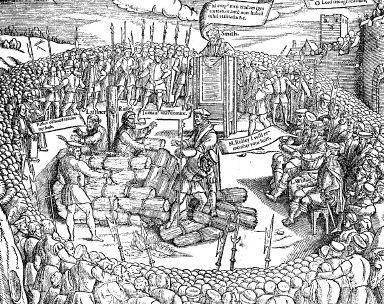
Here we have the Anglican Design Group meeting at Ridley, of all places. Ridley is named after Nicholas Ridley, the Bishop of Rochester (now where have we heard that name lately?) who was part of the committee that drew up the first English Book of Common Prayer.

If we can't agree on the theology of our liturgy, enough that we can't even mention the Book of Common Prayer, why do we think a Covenant is going to solve that problem?

Of course, look what happened to Ridley.

One interesting section is this:
It shall be open to other Churches to adopt the Covenant. Adoption of this Covenant does not bring any right of recognition by, or membership of, the Instruments of Communion. Such recognition and membership are dependent on the satisfaction of those conditions set out by each of the Instruments. However, adoption of the Covenant by a Church may be accompanied by a formal request to the Instruments for recognition and membership to be acted upon according to each Instrument's procedures.
That opens the door for the Anglican Church of North America (or - as it should be - it's dioceses with elected bishops) to sign the Covenant as what may be a first step to being granted full communion (as opposed to partial communion). If The Episcopal Church by manner of avoidance does not sign the Covenant, what will the Archbishop of Canterbury do about that? Is there any sort of deadline, or is when hell freezes over good enough?

Finally, I had always understood that the Church is the Diocese, not the Province. The Episcopal Church is a group of churches that meet every three years in General Convention. That's what I was taught in Virginia. The Church of Virginia (like the Church of England before her) was made up of parishes with a bishop. That's the Church.

Rowan Williams had said at Lambeth that Provinces would sign the Covenant and his view was that the Church was the Anglican Communion, a catholic view. I would dare say that Bishop Schori would say that the Church is the Episcopal Church (in fact, she maintains that the Communion is The Episcopal Church as well!) and the Episcopal Church in General Convention will not sign the Covenant as long as she is Presiding Bishop.

Yet in a letter to the Bishop of Central Florida from the Archbishop of Canterbury, Rowan Williams spells out that the "organ of union with the wider Church is the Bishop and the Diocese rather than the Provincial structure as such." I agree with that.

So what is the Church here?

Just in time for the Anglican Communion Consultative Council next month in Jamaica, the Anglican Covenant Design Committee releases the "Ridley Draft" of the Anglican Covenant:

The Ridley Cambridge Documents are also avalable as a PDF document

Preamble

We, as Churches of the Anglican Communion, under the Lordship of Jesus Christ, solemnly covenant together in these following affirmations and commitments. As people of God, drawn from "every nation, tribe, people and language" (Rev 7.9), we do this in order to proclaim more effectively in our different contexts the grace of God revealed in the gospel, to offer God's love in responding to the needs of the world, to maintain the unity of the Spirit in the bond of peace, and together with all God's people to attain the full stature of Christ (Eph 4.3,13).


Section One: Our Inheritance of Faith

1.1 Each Church affirms:

(1.1.1) its communion in the one, holy, catholic, and apostolic Church, worshipping the one true God, Father, Son, and Holy Spirit.

(1.1.2) the catholic and apostolic faith uniquely revealed in the Holy Scriptures and set forth in the catholic creeds, which faith the Church is called upon to proclaim afresh in each generation[2]. The historic formularies of the Church of England[3], forged in the context of the European Reformation and acknowledged and appropriated in various ways in the Anglican Communion, bear authentic witness to this faith.

(1.1.3) the Holy Scriptures of the Old and New Testaments as containing all things necessary for salvation and as being the rule and ultimate standard of faith[4].

(1.1.4) the Apostles' Creed, as the baptismal symbol; and the Nicene Creed, as the sufficient statement of the Christian faith[5].

(1.1.5) the two sacraments ordained by Christ himself - Baptism and the Supper of the Lord - ministered with the unfailing use of Christ's words of institution, and of the elements ordained by him[6].

(1.1.6) the historic episcopate, locally adapted in the methods of its administration to the varying needs of the nations and peoples called of God into the unity of his Church[7].

(1.1.7) the shared patterns of our common prayer and liturgy which form, sustain and nourish our worship of God and our faith and life together.

(1.1.8) its participation in the apostolic mission of the whole people of God, and that this mission is shared with other Churches and traditions beyond this Covenant.

1.2 In living out this inheritance of faith together in varying contexts, each Church, reliant on the Holy Spirit, commits itself:

(1.2.1) to teach and act in continuity and consonance with Scripture and the catholic and apostolic faith, order and tradition, as received by the Churches of the Anglican Communion, mindful of the common councils of the Communion and our ecumenical agreements.

(1.2.2) to uphold and proclaim a pattern of Christian theological and moral reasoning and discipline that is rooted in and answerable to the teaching of Holy Scripture and the catholic tradition.

(1.2.3) to witness, in this reasoning, to the renewal of humanity and the whole created order through the death and resurrection of Christ, and to reflect the holiness that in consequence God gives to, and requires from, his people.

(1.2.4)to hear, read, mark, learn and inwardly digest the Scriptures in our different contexts, informed by the attentive and communal reading of - and costly witness to - the Scriptures by all the faithful, by the teaching of bishops and synods, and by the results of rigorous study by lay and ordained scholars.

(1.2.5) to ensure that biblical texts are received, read and interpreted faithfully, respectfully, comprehensively and coherently, with the expectation that Scripture continues to illuminate and transform the Church and its members, and through them, individuals, cultures and societies.

(1.2.6) to encourage and be open to prophetic and faithful leadership in ministry and mission so as to enable God's people to respond in courageous witness to the power of the gospel in the world.

(1.2.7) to seek in all things to uphold the solemn obligation to nurture and sustain eucharistic communion, in accordance with existing canonical disciplines, as we strive under God for the fuller realisation of the communion of all Christians.

(1.2.8) to pursue a common pilgrimage with the whole Body of Christ continually to discern the fullness of truth into which the Spirit leads us, that peoples from all nations may be set free to receive new and abundant life in the Lord Jesus Christ.

Section Two: The Life We Share with Others: Our Anglican Vocation

2.1 Each Church affirms:

(2.1.1) communion as a gift of God given so that God's people from east and west, north and south, may together declare the glory of the Lord and be both a sign of God's reign in the Holy Spirit and the first fruits in the world of God's redemption in Christ.

(2.1.2) its gratitude for God's gracious providence extended to us down through the ages: our origins in the Church of the apostles; the ancient common traditions; the rich history of the Church in Britain and Ireland reshaped by the Reformation, and our growth into a global communion through the expanding missionary work of the Church; our ongoing refashioning by the Holy Spirit through the gifts and sacrificial witness of Anglicans from around the world; and our summons into a more fully developed communion life.

(2.1.3) in humility our call to constant repentance: for our failures in exercising patience and charity and in recognizing Christ in one another; our misuse of God's gracious gifts; our failure to heed God's call to serve; and our exploitation one of another.

(2.1.4) the imperative of God's mission into which the Communion is called, a vocation and blessing in which each Church is joined with others in Christ in the work of establishing God's reign. As the Communion continues to develop into a worldwide family of interdependent churches, we embrace challenges and opportunities for mission at local, regional, and international levels. In this, we cherish our mission heritage as offering Anglicans distinctive opportunities for mission collaboration.

(2.1.5) that our common mission is a mission shared with other Churches and traditions beyond this Covenant. We embrace opportunities for the discovery of the life of the whole gospel, and for reconciliation and shared mission with the Church throughout the world. We affirm the ecumenical vocation of Anglicanism to the full visible unity of the Church in accordance with Christ's prayer that "all may be one". It is with all the saints in every place and time that we will comprehend the fuller dimensions of Christ's redemptive and immeasurable love.

2.2 In recognition of these affirmations, each Church, reliant on the Holy Spirit, commits itself:

(2.2.1) to answer God's call to undertake evangelisation and to share in the healing and reconciling mission "for our blessed but broken, hurting and fallen world"[8], and, with mutual accountability, to share our God-given spiritual and material resources in this task.

(2.2.2) to undertake in this mission, which is the mission of God in Christ[9]:

(2.2.2.a) "to proclaim the Good News of the Kingdom of God" and to bring all to repentance and faith;
(2.2.2.b) "to teach, baptize and nurture new believers", making disciples of all nations (Mt 28.19) through the quickening power of the Holy Spirit[10] and drawing them into the one Body of Christ whose faith, calling and hope are one in the Lord (Eph 4.4-6);
(2.2.2.c) "to respond to human need by loving service", disclosing God's reign through humble ministry to those most needy (Mk 10.42-45; Mt 18.4; 25.31-45);
(2.2.2.d) "to seek to transform unjust structures of society" as the Church stands vigilantly with Christ proclaiming both judgment and salvation to the nations of the world[11], and manifesting through our actions on behalf of God's righteousness the Spirit's transfiguring power[12];
(2.2.2.e) "to strive to safeguard the integrity of creation and to sustain and renew the life of the earth" as essential aspects of our mission in communion[13].

(2.2.3) to engage in this mission with humility and an openness to our own ongoing conversion in the face of our unfaithfulness and failures in witness.

(2.2.4) to revive and renew structures for mission which will awaken and challenge the whole people of God to work, pray and give for the spread of the gospel.

(2.2.5) to order its mission in the joyful and reverent worship of God, thankful that in our eucharistic communion "Christ is the source and goal of the unity of the Church and of the renewal of human community" [14].

Section Three: Our Unity and Common Life

3.1 Each Church affirms:

(3.1.1) that by our participation in Baptism and Eucharist, we are incorporated into the one body of the Church of Jesus Christ, and called by Christ to pursue all things that make for peace and build up our common life.

(3.1.2) its resolve to live in a Communion of Churches. Each Church, with its bishops in synod, orders and regulates its own affairs and its local responsibility for mission through its own system of government and law and is therefore described as living "in communion with autonomy and accountability"[15]. Trusting in the Holy Spirit, who calls and enables us to dwell in a shared life of common worship and prayer for one another, in mutual affection, commitment and service, we seek to affirm our common life through those Instruments of Communion by which our Churches are enabled to be conformed together to the mind of Christ. Churches of the Anglican Communion are bound together "not by a central legislative and executive authority, but by mutual loyalty sustained through the common counsel of the bishops in conference"[16] and of the other instruments of Communion.

(3.1.3) the central role of bishops as guardians and teachers of faith, as leaders in mission, and as a visible sign of unity, representing the universal Church to the local, and the local Church to the universal and the local Churches to one another. This ministry is exercised personally, collegially and within and for the eucharistic community. We receive and maintain the historic threefold ministry of bishops, priests and deacons, ordained for service in the Church of God, as they call all the baptised into the mission of Christ.

(3.1.4) the importance of instruments in the Anglican Communion to assist in the discernment, articulation and exercise of our shared faith and common life and mission. The life of communion includes an ongoing engagement with the diverse expressions of apostolic authority, from synods and episcopal councils to local witness, in a way which continually interprets and articulates the common faith of the Church's members (consensus fidelium). In addition to the many and varied links which sustain our life together, we acknowledge four particular Instruments at the level of the Anglican Communion which express this co-operative service in the life of communion.

I. We accord the Archbishop of Canterbury, as the bishop of the See of Canterbury with which Anglicans have historically been in communion, a primacy of honour and respect among the college of bishops in the Anglican Communion as first among equals (primus inter pares). As a focus and means of unity, the Archbishop gathers and works with the Lambeth Conference and Primates' Meeting, and presides in the Anglican Consultative Council.

II. The Lambeth Conference expresses episcopal collegiality worldwide, and brings together the bishops for common worship, counsel, consultation and encouragement in their ministry of guarding the faith and unity of the Communion and equipping the saints for the work of ministry (Eph 4.12) and mission.

III. The Anglican Consultative Council is comprised of lay, clerical and episcopal representatives from our Churches[17]. It facilitates the co-operative work of the Churches of the Anglican Communion, co-ordinates aspects of international Anglican ecumenical and mission work, calls the Churches into mutual responsibility and interdependence, and advises on developing provincial structures[18].

IV. The Primates' Meeting is convened by the Archbishop of Canterbury for mutual support, prayer and counsel. The authority that primates bring to the meeting arises from their own positions as the senior bishops of their Provinces, and the fact that they are in conversation with their own Houses of Bishops and located within their own synodical structures[19]. In the Primates' Meeting, the Primates and Moderators are called to work as representatives of their Provinces in collaboration with one another in mission and in doctrinal, moral and pastoral matters that have Communion-wide implications.

It is the responsibility of each Instrument to consult with, respond to, and support each other Instrument and the Churches of the Communion[20]. Each Instrument may initiate and commend a process of discernment and a direction for the Communion and its Churches.

3.2 Acknowledging our interdependent life, each Church, reliant on the Holy Spirit, commits itself:

(3.2.1) to have regard for the common good of the Communion in the exercise of its autonomy, to support the work of the Instruments of Communion with the spiritual and material resources available to it, and to receive their work with a readiness to undertake reflection upon their counsels, and to endeavour to accommodate their recommendations.

(3.2.2) to respect the constitutional autonomy of all of the Churches of the Anglican Communion, while upholding our mutual responsibility and interdependence in the Body of Christ[21], and the responsibility of each to the Communion as a whole[22].

(3.2.3) to spend time with openness and patience in matters of theological debate and reflection, to listen, pray and study with one another in order to discern the will of God. Such prayer, study and debate is an essential feature of the life of the Church as its seeks to be led by the Spirit into all truth and to proclaim the gospel afresh in each generation. Some issues, which are perceived as controversial or new when they arise, may well evoke a deeper understanding of the implications of God's revelation to us; others may prove to be distractions or even obstacles to the faith. All such matters therefore need to be tested by shared discernment in the life of the Church.

(3.2.4) to seek a shared mind with other Churches, through the Communion's councils, about matters of common concern, in a way consistent with the Scriptures, the common standards of faith, and the canon laws of our churches. Each Church will undertake wide consultation with the other Churches of the Anglican Communion and with the Instruments and Commissions of the Communion.

(3.2.5) to act with diligence, care and caution in respect of any action which may provoke controversy, which by its intensity, substance or extent could threaten the unity of the Communion and the effectiveness or credibility of its mission.

(3.2.6) in situations of conflict, to participate in mediated conversations, which involve face to face meetings, agreed parameters and a willingness to see such processes through.

(3.2.7) to have in mind that our bonds of affection and the love of Christ compel us always to uphold the highest degree of communion possible.

Section Four: Our Covenanted Life Together

Each Church affirms the following procedures, and, reliant on the Holy Spirit, commits itself to their implementation.

4.1 Adoption of the Covenant

(4.1.1) Each Church adopting this Covenant affirms that it enters into the Covenant as a commitment to relationship in submission to God. Participation in the covenant expresses a loyalty grounded in mutuality that one Church freely offers to other Churches, in whom it recognises the bonds of a common faith and order, a common inheritance in worship, life and mission, and a readiness to live in an interdependent life, but does not represent submission to any external ecclesiastical jurisdiction.

(4.1.2) In adopting the Covenant for itself, each Church recognises in the preceding sections a statement of faith, mission and interdependence of life which is consistent with its own life and with the doctrine and practice of the Christian faith as it has received them. It recognises these elements as fundamental to the life of the Anglican Communion and to the relationships among the covenanting Churches.

(4.1.3) The Covenant operates to express the common commitments which hold each Church in the relationship of communion one with another. Recognition of, and fidelity to, the text of this Covenant, enables mutual recognition and communion. Nothing in this Covenant of itself shall be deemed to alter any provision of the Constitution and Canons of any Church of the Communion, or to limit its autonomy of governance. Under the terms of this Covenant, no one Church, nor any agency of the Communion, can exercise control or direction over the internal life of any other covenanted Church.

(4.1.4) Every Church of the Anglican Communion, as recognised in accordance with the Constitution of the Anglican Consultative Council, is invited to adopt this Covenant in its life according to its own constitutional procedures. Adoption of the Covenant by a Church does not in itself imply any change to its Constitution and Canons, but implies a recognition of those elements which must be maintained in its own life in order to sustain the relationship of covenanted communion established by this Covenant.

(4.1.5) It shall be open to other Churches to adopt the Covenant. Adoption of this Covenant does not bring any right of recognition by, or membership of, the Instruments of Communion. Such recognition and membership are dependent on the satisfaction of those conditions set out by each of the Instruments. However, adoption of the Covenant by a Church may be accompanied by a formal request to the Instruments for recognition and membership to be acted upon according to each Instrument's procedures.

(4.1.6) This Covenant becomes active for a Church when that Church adopts the Covenant.

4.2 The Maintenance of the Covenant and Dispute Resolution

(4.2.1) The Joint Standing Committee of the Anglican Consultative Council and of the Primates' Meeting, or any body that succeeds it, shall have the duty of overseeing the functioning of the Covenant in the life of the Anglican Communion. The Joint Standing Committee may nominate or appoint another committee or commission to assist in carrying out this function and to advise it on questions relating to the Covenant.

(4.2.2) If a question relating to the meaning of the Covenant, or of compatibility to the principles incorporated in it, should arise, the Joint Standing Committee may make a request to any covenanting Church to defer action until the processes set out below have been completed. It shall further take advice from such bodies as its feels appropriate on the nature and relational consequences of the matter and may make a recommendation to be referred for advice to both the Anglican Consultative Council and the Primates' Meeting.

(4.2.3) If a Church refuses to defer a controversial action, the Joint Standing Committee may recommend to any Instrument of Communion relational consequences which specify a provisional limitation of participation in, or suspension from, that Instrument until the completion of the process set out below.

(4.2.4) On the basis of advice received from the Anglican Consultative Council and the Primates' Meeting, the Joint Standing Committee may make a declaration concerning an action or decision of a covenanting Church that such an action or decision is or would be "incompatible with the Covenant". A declaration of incompatibility with the Covenant shall not have any force in the Constitution and Canons of any covenanting Church unless or until it is received by the canonical procedures of the Church in question.

(4.2.5) On the basis of the advice received, the Joint Standing Committee may make recommendations as to relational consequences to the Churches of the Anglican Communion or to the Instruments of the Communion. These recommendations may address the extent to which the decision of any covenanting Church to continue with an action or decision which has been found to be "incompatible with the Covenant" impairs or limits the communion between that Church and the other Churches of the Communion. It may recommend whether such action or decision should have a consequence for participation in the life of the Communion and its Instruments. It shall be for each Church and each Instrument to determine its own response to such recommendations.

(4.2.6) Each Church undertakes to put into place such mechanisms, agencies or institutions, consistent with its own Constitution and Canons, as can undertake to oversee the maintenance of the affirmations and commitments of the Covenant in the life of that Church, and to relate to the Instruments of Communion on matters pertinent to the Covenant.

(4.2.7) Participation in the processes set out in this section .shall be limited to those members of the Instruments of Communion who are representatives of those churches who have adopted the Covenant, or who are still in the process of adoption.

4.3 Withdrawing from the Covenant

(4.3.1) Any covenanting Church may decide to withdraw from the Covenant. Although such withdrawal does not imply an automatic withdrawal from the Instruments or a repudiation of its Anglican character, it raises a question relating to the meaning of the Covenant, and of compatibility with the principles incorporated within it, and it triggers the provisions set out in section 4.2.2 above.

4.4 The Covenant Text and its amendment

(4.4.1) The Covenant consists of the text set out in this document in the Preamble, Sections One to Four and the Declaration. The Introduction to the Covenant Text, which shall always be annexed to the Covenant text, is not part of the Covenant, but shall be accorded authority in understanding the purpose of the Covenant.

(4.4.2) Any covenanting Church or Instrument of Communion may submit a proposal to the Joint Standing Committee for the amendment of the Covenant. The Joint Standing Committee shall send the proposal to the Anglican Consultative Council, to the Primates' Meeting and any other body as it may consider appropriate for advice. The Joint Standing Committee shall make a recommendation on the proposal in the light of advice offered, and submit the proposal with any revisions to the constitutional bodies of the covenanting Churches. The amendment is operative when ratified by three quarters of such bodies. The Joint Standing Committee shall adopt a procedure for promulgation of the amendment.

Our Declaration

With joy and with firm resolve, we declare our Churches to be partakers in this Anglican Communion Covenant, offering ourselves for fruitful service and binding ourselves more closely in the truth andlove of Christ, to whom with the Father and the Holy Spirit be glory for ever. Amen.

"Now may the God of Peace, who brought again from the dead our Lord Jesus, the great shepherd of the sheep, by the blood of the eternal covenant, make you complete in everything good so that you may do his will, working among us that which is pleasing in his sight, through Jesus Christ, to whom be the glory forever and ever. Amen." (Hebrews 13.20, 21)

Notes

2. Cf. The Preface to the Declaration of Assent, Canon C15 of the Church of England.

3. The Thirty-nine Articles of Religion, the 1662 Book of Common Prayer, and the Ordering of Bishops, Priests, and Deacons

4. The Chicago-Lambeth Quadrilateral of 1886/1888

5. The Chicago-Lambeth Quadrilateral of 1886/1888

6. cf. The Chicago-Lambeth Quadrilateral 1886/1888, The Preface to the Declaration of Assent, Canon C15 of the Church of England.

7. cf. The Chicago-Lambeth Quadrilateral 1886/1888

8. IASCOME Report, ACC-13

9. The five Marks of Mission are set out in the MISSIO Report of 1999, building on work at ACC-6 and ACC-8.

10. Church as Communion n26

11. WCC 1954 Evanston, Christ the Hope of the World

12. Moscow Statement, 43

13. IARCCUM, Growing Together in Unity and Mission,118

14. Baptism, Eucharist and Ministry, WCC,

15. A Letter from Alexandria, the Primates, March 2009

16. Lambeth Conference 1930

17 Constitution of the ACC, Article 3 and Schedule

18. cf. the Objects of the ACC are set out in Article 2 of its Constitution.

19. Report of the Windsor Continuation Group, 69.

20. cf IATDC, Communion, Conflict and Hope, paragraph 113.

21. Toronto Congress 1963, and the Ten Principles of Partnership.

22. cf. the Schedule to the Dar es Salaam Communiqué of the Primates' Meeting, February 2007

For more on the background of the development of an Anglican Covenant, click here.

New Anglican Church in Virginia opens its doors

FAIRFAX, Va. (April 8, 2009) – The Anglican District of Virginia welcomes its newest member congregation, Restoration Anglican Church in Arlington, Va. The new church will open its doors on Easter Sunday for public worship. Restoration Anglican, led by the Rev. David M. Hanke, is a church plant of The Falls Church in Falls Church, Va.

“We are pleased to welcome Restoration Anglican Church to the ADV family. There is no question that planting new churches is the most effective way to reach the unchurched and Rev. Hanke is an exceptional leader who already has demonstrated his gift for building a community of faith through friendship. This new church underscores our shared goal of fostering orthodox Anglicanism throughout the area,” said ADV Vice-Chairman Jim Oakes.

“So many people have come together to help build the foundation for Restoration Anglican Church. We’ve already begun to create a community that connects people to God, to others, and to the needs around us, but our most important benchmark will be whether there are people who are far from Christ that have come into our community and been transformed by the Gospel. We’re excited to see what the Lord has in store for our congregation,” Rev. Hanke said.

Restoration Anglican Church is located at 1815 North Quincy Street in Arlington, Va. The church offers contemporary Anglican worship, small groups, children’s ministry and outreach opportunities. On April 12, Easter services will be held at 9:00 am and 11:00 am. To learn more about Restoration Anglican Church and access the church blog, sermons and a full worship schedule, visit: restorationarlington.org.

Here's a video from Restoration Anglican Church:


And here's a recent sermon: