Monday, July 17, 2006

Lex Luther returns - and he looks like Giles Frasier

When Giles Frasier hates Superman he shows not only his loathing for Americans, but his disdain for evangelicals as well in one fell swoop. Click the headline above to read his tirade against truth, justice, and the rest of it - if you can.

I lost my head after reading the diatribe on T19 and posted the following (go to http://titusonenine.classicalanglican.net/?p=14249):

I love Superman.

I love that he is “super” and he is a “man.” I love that he knows he has a calling and he follows his calling, even though it’s costly. I love that he has a heart and will sacrafice his own desires and wants for the good of others. I love that he is funny. I love that he knows the difference between good and evil and that good and evil exist - and good must be defended and evil must be defeated. I love that he has compassion for humans, despite how we mess up the planet and each other. I love that he declines to live selfishly and instead lives selflessly. I love that he is not afraid to fight - but doesn’t go looking for a fight. I love that he loves Lois Lane. I love that he loves truth and justice (which is a fasinating combination - truth and justice). I love that he believes that there is an American way, a vision, an experiment that he wants to see succeed - and that it’s a good thing.

And he’s awfully cute too. especially when he’s Clark Kent.

bb

-----

MEMORANDUM

DATE: JULY 17, 2006
TO: The Rev. Dr. Giles Fraser
FROM: Your Worst Nightmare
RE: Would you rather be speaking German?

Sir, you write in today's edition of the BBC's "Thought for the Day": "Superman is a refusal to accept that we are complicated creatures. It's a fantasy of salvation ... presuming that salvation is achieved when the goodies have destroyed the baddies. The problem is: I don't know which one of those is me."

Thank you for sharing. Hmm ... let's investigate further, shall we?


The Rev. Dr. Giles Fraser


Mr. Lex Luthor


No wonder you don't like Superman.

Sunday, July 16, 2006

BabyBlueView - Columbus 2006

"Walking with a friend in the dark is better than walking alone in the light." H. Keller.

Here is the video montage of Columbus 2006. This should download faster for those who were having challenging download times (I mean, how many rooms can you vacuum?) as well as solve the QuickTime issues for others. You can watch it here or click on the headline above to go to YouTube.com and see the video there. Even now looking at the photos - I will never forget that this was one of the most difficult things I've ever done - and the most rewarding. God bless you.

Here is another video as well - created right after the morning press briefing in the official General Convention newsroom. It features many of the folks who were covering General Convention, one way or the other. You may recognize a few. All I can say is - watch out for the Canadians.

Another rare Dylan video from 1980: What can I do for you?

Bob's playing of the harp at the end of this performance is such a contrast to how he plays the harp in the 1966 Manchester concert.

You have given everything to me.
What can I do for You?
You have given me eyes to see.
What can I do for You?

Pulled me out of bondage and You made me renewed inside,
Filled up a hunger that had always been denied,
Opened up a door no man can shut and You opened it up so wide
And You've chosen me to be among the few.
What can I do for You?

You have laid down Your life for me.
What can I do for You?
You have explained every mystery.
What can I do for You?

Soon as a man is born, you know the sparks begin to fly,
He gets wise in his own eyes and he's made to believe a lie.
Who would deliver him from the death he's bound to die?
Well, You've done it all
and there's no more anyone can pretend to do.
What can I do for You?

You have given all there is to give.
What can I do for You?
You have given me life to live.
How can I live for You?

I know all about poison, I know all about fiery darts,
I don't care how rough the road is, show me where it starts,
Whatever pleases You, tell it to my heart.
Well, I don't deserve it but I sure did make it through.
What can I do for You?

Dylan 1980

Friday, July 14, 2006

Watch This Space! New "EpiscoTwister" Game Release Coming Soon!

Watch this space for exciting developments of the new "EpiscoTwister" game soon to be released. Need something to occupy your time or work out your issues before the next meeting of the Global South Primates and Lambeth? Just in time: EpiscoTwister!

Stay tuned for more info - coming soon!

Track List Released for Dylan's Modern Times - includes epic-length songs

"Thunder on the Mountain"
"Spirit on the Water"
"Rollin' and Tumblin'"
"When the Deal Goes Down"
"Someday Baby"
"Workingman's Blues #2"
"Beyond the Horizon"
"Nettie Moore"
"The Levee's Gonna Break"
"Ain't Talkin'"

Here's what one article says:

Four of the 10 cuts on the Columbia release push the six-minute mark, including the nearly eight-minute Spirit on the Water and the nearly nine-minute closer, Ain't Talkin'.

Modern Times was recorded earlier this year with Dylan's touring band of bassist Tony Garnier, drummer George G Receli, guitarists Stu Kimball and Denny Freeman and multi-instrumentalist Donnie Herron.

The album will also be available in a special edition with a bonus DVD featuring four additional songs, details of which have yet to be announced. Dylan will support Modern Times with his third annual tour of minor league baseball stadiums, which gets underway August 12 in Comstock Park, Mich.

His last album, Love and Theft, was released on September 11, 2001.

Tuesday, July 11, 2006

BabyBlue's Official Guide to The Episcopal Church: Awfully Small Boxes Need Not Apply


There are some articles going around that divide Episcopalians up into four food groups, with the orthodox bunch divided into two groups - the Federalist Conservatives (think Thomas Jefferson) and the Communion Conservatives (think John Adams). I read through them and thought, well, hmmmm .... perhaps it's better shaken and not stirred.

Here is BabyBlue's Official Guide: Introducing the Seven Major Groups That Make Up The Episcopal Church (TEC, formally known at ECUSA, formally known as PECUSA):

1. The Brand New Leopardskin Pillbox Hat Group - These are the tea cups and little pinkies subset of the Episcopal Church. They are the "beautiful people," where East Hampton meets Andy Warhol. Tom Wolfe and John Cheever books are filled with them. Drink of Choice: Gin and Tonic.

2. The Haight/Ashbury Summer of Love Group - These are the aging hippies who love bright colors, blessed sex, and groovin to the Beatles "All ya need is love ..." Enjoys revising the liturgy for latest trends, but don't mess with the canons. Writer of choice: Lytton Strachey. A second cousin to ...

3. The Use to be a Jesus Freak But Then Found Walmart Group - Knew the "HASL Group" at Woodstock, but then went south to Pasadena and met the Cool Jesus Who Saves. Liturgy is helpful but not necessary. Likes to raise hands in the air and use overheads. Knows what happens at 9:00 in the Morning. Song of choice: Majesty.

4. The Three Dips and a Dive Group - Will mysteriously stop in mid-sentence to tip hat towards Oxford. Prefers 1892 Prayer Book over 28 - and 79 Doesn't Even Exist Thank You Very Much. Observes Lesser Feasts and Fasts, including the lesser known Feast of John Keble. Prefers marble for tables and wood for pews. Took the "P" out of PECUSA. Saint of Choice: John Henry Newman.

5. The John Stott is the Greatest Theologian That Ever Lived Group - Has closets full of cassette tapes from Bible teachings from the seventies and eighties. Has been in at least seven Bible Studies and taught seven more. Knows more about the Scriptures than the Dean of Virginia Theological Seminary. Preacher of choice: Who else?

6. The Bono is the Greatest Theologian That Ever Lived Group - Was only a gleam in mom's eye at Woodstock. Has actually lived in Africa. Wears ONE bracelet and likes swinging incense and the Newsboys. Cool on both Justice and Jesus. Reads CS Lewis and Ron Sider. Gets latest sermons from iTunes. If clergy, either wears black cassock or black t-shirt. Poet of choice: Paul Hewson.

7. The Pew-Sitting-Fence-Sitting Still-Thinking-There's-a-Center Group - Just placed on Endangered Species List. You know who you are. If not, we do.

bb

Monday, July 10, 2006

Post-Columbus: Great rare video of Dylan singing"I Believe in You" on Saturday Night LIve in 1979


Alas, the video is no longer available. Hope you were able to see it - it was fantastic.

They ask me how I feel
And if my love is real
And how I know I'll make it through.
And they, they look at me and frown,
They'd like to drive me from this town,
They don't want me around
'Cause I believe in you.

They show me to the door,
They say don't come back no more
'Cause I don't be like they'd like me to,
And I walk out on my own
A thousand miles from home
But I don't feel alone
'Cause I believe in you.

I believe in you even through the tears and the laughter,
I believe in you even though we be apart.
I believe in you even on the morning after.
Oh, when the dawn is nearing
Oh, when the night is disappearing
Oh, this feeling is still here in my heart.

Don't let me drift too far,
Keep me where you are
Where I will always be renewed.
And that which you've given me today
Is worth more than I could pay
And no matter what they say
I believe in you.

I believe in you when winter turn to summer,
I believe in you when white turn to black,
I believe in you even though I be outnumbered.
Oh, though the earth may shake me
Oh, though my friends forsake me
Oh, even that couldn't make me go back.

Don't let me change my heart,
Keep me set apart
From all the plans they do pursue.
And I, I don't mind the pain
Don't mind the driving rain
I know I will sustain
'Cause I believe in you.

Dylan 1979

Saturday, July 08, 2006

From Chaplin to Dylan - Modern Times to Modern Times

So Bob Dylan's new release will be called "Modern Times." It does call to mind the "other" Modern Times - that of the last film by Charlie Chaplin as "the Tramp" in 1936 - exactly seventy years ago. I don't think there is any accident at all that Dylan's "last" album (say it isn't so!) as "Bob Dylan" and Chaplain's "last" film as "The Tramp" are both called "Modern Times."

I look forward to seeing how these two great performers contrast and compare - they do have so much in common. What do we know all ready about Dylan's "Modern Times?" We have lyrics from the title song:

Thunder on the mountain,
fires on the moon,
There's a ruckus in the alley
and the sun will be here soon,

I was thinking about Alicia Keys,
couldn't help from crying
When she was born in Hell's Kitchen,
I was living down the line
I'm wondering where in the world Alicia Keys could be
I been looking for her even clean through Tennessee.

From Modern Times, by Bob Dylan 2006

What bit I do know about Dylan, one does wonder if he's following his tradition here with meaning "Son" for "sun." And what is the reference to Alicia Keys (except reportedly sending her over the moon since she's a huge Bob Dylan fan). Other songs listed on the album include "When The Deal Goes Down," "Spirit on the Water," and "Workingman's Blues." How much will it be in the spirit of Chaplin's Modern Times?

One thought - is this why he's been wearing that funny little mustache for the past few years???

LATER NOTE FROM BB: SOMEONE HAS A "CHAPLIN/DYLAN PAGE." You can visit it by clicking the headline above.

Here is a synopsis of the 1936 Chaplin film to get us ready, from "The Greatest Films" website at: http://www.filmsite.org/mode.html:

In Modern Times (1936), the still-silent Tramp, with his familiar small Derby hat, mustache, large boots, baggy pants, tight jacket and cane makes his last screen appearance. Filmed between 1932 and 1936, it was directed, written, scored, and produced by Chaplin himself - and he also starred in his own 'one-man show' with his current wife and kindred spirit Paulette Goddard. This was Chaplin's first film after his successful City Lights (1931), released nine years after the advent of 'talkies.'

This social protest film is Charlie Chaplin's final stand against the synchronized sound film - and it is also his last full-length "silent film" - although it must be noted that it is a quasi-silent film. There is no traditional, synchronized voice dialogue in the film - but voices and sounds do emanate from machines (e.g., the feeding machine), television screens (i.e., the Big Brother screen - pre-dating George Orwell's book 1984, written/published in 1949), and Chaplin's actual voice is heard singing an imaginary, nonsense song of gibberish. Special sound effects and an original musical score (by composer Chaplin, including various musical themes from "Hallelujah, I'm a Bum," "Prisoner's Song," "How Dry I Am," and "In the Evening By the Moonlight") enhance the pantomime.

Set in the 1930s during the Great Depression era, the film's main concerns (and those of the oppressed Tramp) echo those of millions of people at the time - unemployment, poverty, and hunger. It has a number of wonderfully inventive and memorable routines and scenes that proclaim the frustrating struggle by proletarian man against the dehumanizing effects of the machine in the Industrial Age (at the time of Henry Ford's assembly line), and various social institutions.

The scenes of the Tramp find him alternating between scenes as an assembly-line factory worker (where he is literally fed by a machine and then - when the monotony overtakes him - becomes the 'food' in the cogs and gears of another machine), a shipyard worker, a department store night watchman, an overstressed singing waiter, or an occupant in jail. The Tramp also finds himself dealing with various authority figures during his exploits: a 'Big Brother' factory boss, a minister, juvenile child-care authorities, a sheriff, a shipyard foreman, a department store manager, etc.


Under the superimposed credits, a clock face approaches 6 o'clock. The foreword explains the film's theme: "'Modern Times.' A story of industry, of individual enterprise - humanity crusading in the pursuit of happiness." The film opens with an overhead shot of a flock of sheep jostling in their sheep pen, and rushing through a chute. Instantly, the sheep dissolve into a similar overhead shot of industrial workers pushing out of a subway station at rush hour on their way to work in a factory.

In an upper executive office level of a steelworks factory, the Electro Steel Corp., a "Big Brother" manager/President (Allan Garcia) works on a boring puzzle, reads the comics in the newspaper, and is served by his secretary. He switches on a two-way TV screen with on-line audio and video transmission (when practical TV was only a dream) where he can view all parts of the plant operation. He orders one of his foremen, in the first synchronized speech in the film to hurry production on the line: "Section 5 - speed 'er up - 41."

In one of the film's great opening scenes, the conveyor belt sequence, a masterpiece of choreography, the Tramp is a factory worker (Charlie Chaplin) whose job it is to tighten bolts on an endless series of machine parts - he is a small cog in the factory that exploits its workers. The key to successful nut-tightening is to perform his movements and tasks with clock-like tempo and precision. [This scene illustrates the American factory's obsession with time and automation.] From his work station on the assembly-line, he holds wrenches in both hands to tighten nuts on a long stream of steel plates carried on the conveyor belt production line. Above him in the hierarchy of jobs, the foreman urges him all the time to keep up with the belt, and bullies him. When he pauses and itches for a moment, makes a gesture, or brushes away a troublesome fly, he causes tremendous, disruptive chaos for fellow workers down the production line, and frantically rushes to catch up and restore order. The results of his innocent, personal behavior have much larger consequences. [The popular TV series I Love Lucy revived the hilarious assembly line scene in the episode titled "Job Switching" (aka "The Candy Factory"), aired in the show's second season in mid-September 1952.]

During a short break, he cannot stop the jerky, rhythmic movements of his nut-tightening - the trauma of work has left him with a nervous tick. A "Big Brother" screen of his employer in the men's room reprimands him when he sneaks a cigarette: "Hey, quit stalling. Get back to work. Go on."

In his office, the President is shown a new aid to productivity - a method to shorten the lunch hour break and improve worker productivity. The sales pitch for a feeding machine is delivered by a mechanical salesman on a phonograph record:


a practical device which automatically feeds your men while at work. Don't stop for lunch. Be ahead of your competitor...the feeding machine will eliminate the lunch hour, increase your production, and decrease your overhead.
The device is a mechanical, automated, aerodynamically-styled, silent feeding machine which features a revolving table, an automaton soup plate, an automatic food pusher, a revolving low and high gear corncob feeder, and a hydro-compressed sterilized mouth wipe.

At lunch time, the break is sounded and the line stops, but the Tramp is so programmed that he starts tightening buttons on a woman's bottom. And he cannot control jerky arm movements that cause him to spill his co-worker's soup. He is chosen as a guinea pig to test and demonstrate the feeding device. Naturally, the mechanized meal machine shorts out and goes haywire - making the food inedible in an unforgettable scene. The spinning corn cob server goes wild, the soup is tipped and dumped down his front and hurled in his face, metal bolts are shoved into his mouth instead of food, a dessert shortcake is forced into his face, and the mouth wipe repeatedly pummels him in the mouth. The President is unhappy with the demonstration: "It's no good - it isn't practical."

Back at the job in the late afternoon after his disastrous, nightmarish lunch, he rejoins his co-workers on the assembly line. The boss has ordered production increases: "Section 5 - give 'em the limit," so the conveyor belt is sped up - a hilarious, frenzied scene as the Tramp makes an heroic effort to keep up. Under the strain of the job, he finally goes beserk, slowly driven insane and engulfed by the assembly line. He literally lies prone on the belt and is dragged, swallowed and eaten up by the whizzing wheels, gears, and cogs of the monstrous machine. His body snakes its way through the gears until the production line's direction is reversed and he finally emerges free of the machine. He has gone completely crazy and insane.

In a trance-like state, with wrenches aloft, he demonically tightens everything in sight, including people's noses. With arms aflutter, he dances a beautiful but mad ballet. He chases the woman with the buttons on her bottom through the factory to the outdoors. There, he eagerly pursues a large-breasted woman with two buttons on her front. Back in the factory's control room, he pulls all the levers and switches in sight, causing explosions in the equipment. He continues his mad ballet with an oil can. He is hustled off in a car by a white-coated attendant, to be treated in a psychiatric ward for a nervous breakdown - he has become a "nut" himself.

"Cured of a nervous breakdown but without a job, he leaves the hospital to start life anew." The doctor offers some last-minute advice: "Take it easy and avoid excitement." The Tramp, now wearing his familiar outfit, joins a large number of people who are unemployed, since the economy is depressed, and factories are closed. On the street, he obligingly picks up and waves a red warning flag that has fallen off a passing construction truck. Again, his small personal action has greater consequences than expected - he is mistaken for the rally leader of a flag-waving demonstration of Communist agitators who have just rounded the corner behind him. In the comedy of errors, he is promptly arrested by club-wielding police and hauled off to jail in a police patrol wagon.

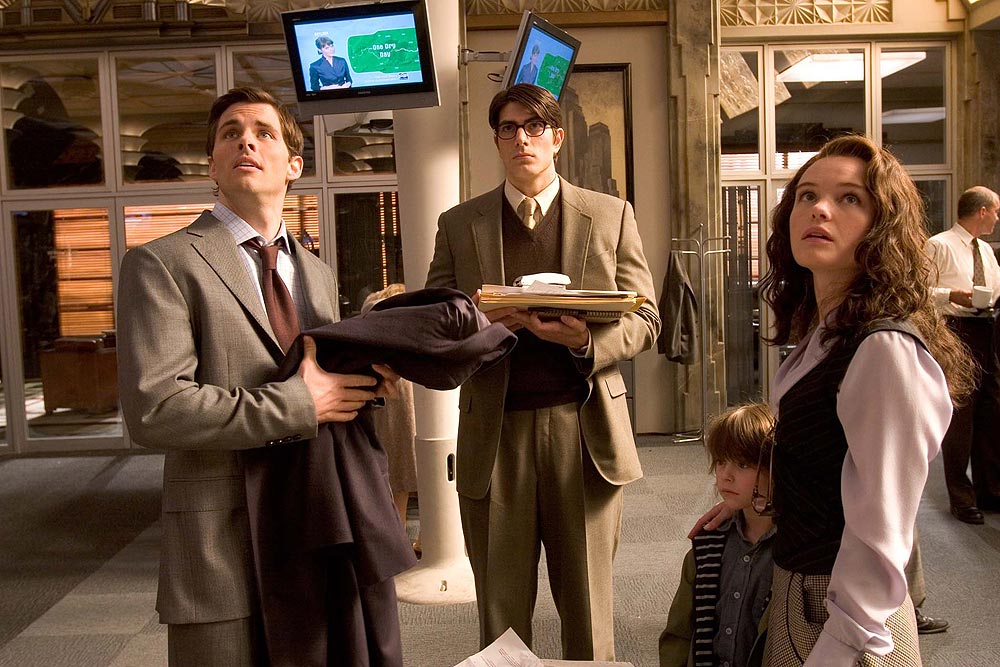
New Dylan Album Cover Revealed

Now Online: A BabyBlueView - "Remembering Columbus 2006"

Click on the headline above.

Here is a slide video remembering Columbus 2006. It was absolutely one of the most challenging experiences of my life - and certainly one of the most memorable.

The greatest gift the Lord has given us is Himself. And the second greatest is one another. My prayer - as I watch this video - is that we remain (the scriptures call it "abiding") in the love of Jesus. As we do that, may we continue to love one another. This is not the sentimental unreal utopian view of love. It's real. It's messy. It shows up and shows ourselves mirrored in one another. There is nothing like smashing all the china in the tea shop and being forgiven and laughing together as you get out the glue. God seems to have a liking for old pots. He makes them new. "If anyone be in Christ, they are a new creation - the old has passed away, behold! All things become new." (IICor.5:17).

Friendships are like that - smashing and restoration, brokenness and healing, weeping and laughing your head off. No wonder Jesus stored a lot by friendship.

As Helen Keller said, it is better to walk in the dark with friends then alone in the light.

That was Columbus.

So here you go - snapshots of memories. If you weren't there - you were there with your prayers. You can see the work of your prayers on the people's faces. God bless you. I mean it, God bless you.

Make sure you've download the FREE QuickTime Player (here's the website: http://www.apple.com/quicktime/download/mac.html

Give it some time to load. Go vacuum the livingroom.

bb

Friday, July 07, 2006

Rowan Williams addresses General Synod of the Anglican Communion

Archbishop of Canterbury: address to General Synod on the Anglican Communion

I am glad to have the opportunity of offering in these few minutes a very brief update on the current situation in the Anglican Communion, particularly in the light of the recent session of the Episcopal Church's General Convention – which was, of course, attended by my brother Archbishop, who made an outstanding contribution to its discussions. The first thing to say is that the complex processes of Convention produced – perhaps predictably – a less than completely clear result. The final resolution relating to the consecration of practising gay persons as bishops owed a great deal to some last-minute work by the Presiding Bishop, who invoked his personal authority in a way that was obviously costly for him in order to make sure that there was some degree of recognisable response to the recommendations of the Windsor Report in this regard. I think that he – and his successor-elect – deserve credit and gratitude for taking the risk of focusing the debate and its implications so sharply.

However, as has become plain, the resolutions of Convention overall leave a number of unanswered questions, and there needs to be some careful disentangling of what they say and what they don't say. This work is to be carried forward by a small group already appointed before Convention by the Joint Standing Committee of the Primates and the ACC. And I have also written directly to every Primate to ask for a preliminary reaction from their province. The next Primates' Meeting in February next year will digest what emerges from all this.

You will be aware of a number of developments in the public arena in the last couple of weeks, notably the request from several US dioceses for some sort of direct primatial oversight from outside the US, preferably from Canterbury. This raises very large questions indeed; various consultations are going forward to clarify what is being asked and to reflect on possible implications. There has also been an announcement from Nigeria of the election by the Nigerian House of Bishops of an American cleric as a bishop to serve the Convocation of Nigerian Anglican congregations in the US. I have publicly stated my concern about this and some other cross-provincial activities.

A working party is also being established in consultation with the Anglican Communion Office and others to look more fully at the question of what sort of ‘Covenant’ could be constructed to fulfil another significant recommendation of the Windsor Report.

Mention of this leads me to say a word about my own published reflections in the wake of General Convention. In spite of some interesting reporting and some slightly intemperate reaction, this contained no directives (I do not have authority to dictate policy to the provinces of the Communion) and no foreclosing of the character and content of such a covenant. Were any such arrangement to be proposed, it would of course have to be owned by the constitutional bodies governing Provinces. The proposal has already been dismissed in some quarters as a capitulation to fundamentalism and in others as a cunning plan to entrench total doctrinal indifferentism.

Both characterisations are nonsense. Perhaps you will allow me a word or two of clarification and further thought on all this. When I said, as I did in my reflections, that the Communion cannot remain as it is, I was drawing attention to some unavoidable choices. Many have said, with increasing force of late, that we must contemplate or even encourage the breakup of the Communion into national churches whose autonomy is unqualified and which relate only in some sort of loose and informal federation. This has obvious attractions for some. The problem is that it is unlikely to bear any relation to reality. Many provinces are internally fragile; we cannot assume that what will naturally happen is a neat pattern of local consensus. There are already international alliances, formal and informal, between Provinces and between groups within different Provinces. There are lines of possible fracture that have nothing to do with provincial boundaries. The disappearance of an international structure – as, again, I have observed in recent months – leaves us with the possibility of much less than a federation, indeed, of competing and fragmenting ecclesial bodies in many contexts across the world.

A straw in the wind: in Sudan, there is a breakaway and very aggressive Anglican body that has had support, in the past, from government in Khartoum. Among the varied grounds advanced for its separation is the ludicrous assertion that the Episcopal Church of Sudan is unorthodox in its teaching on sexual ethics. Some mischievous forces are quite capable of using the debates over sexuality as an alibi for divisive action whose roots are in other conflicts. And churches in disadvantaged or conflict-ridden settings cannot afford such distractions – I speak with feeling in the light of what I and others here in Synod know of Sudan. It helps, to put it no more strongly, that there is a global organisation which can declare such a separatist body illegitimate and insist to a local government that certain groups are not recognised internationally.

So I don't think we can be complacent about what the complete breakup of the Communion might mean - not the blooming of a thousand flowers, but a situation in which vulnerable churches suffer further. And vulnerable churches are not restricted to Africa... But if this prospect is not one we want to choose, what then? Historic links to Canterbury have no canonical force, and we do not have (and I hope we don't develop) an international executive. We depend upon consent. My argument was and is that such consent may now need a more tangible form than it has hitherto had; hence the Covenant idea in Windsor.

But if there is such a structure, and if we do depend on consent, the logical implication is that particular churches are free to say yes or no; and a no has consequences, not as ‘punishment’ but simply as a statement of what can and cannot be taken for granted in a relationship between two particular churches. When I spoke as I did of 'churches in association', I was trying to envisage what such a relation might be if it was less than full eucharistic communion and more than mutual repudiation. It was not an attempt to muddy the waters but to offer a vocabulary for thinking about how levels of seriously impaired or interrupted communion could be understood.

In other words, I can envisage – though I don’t in the least want to see – a situation in which there may be more divisions than at present within the churches that claim an Anglican heritage. But I want there to be some rationale for this other than pure localism or arbitrary and ad hoc definitions of who and what is acceptable. The real agenda – and it bears on other matters we have to discuss at this Synod – is what our doctrine of the Church really is in relation to the whole deposit of our faith. Christian history gives us examples of theologies of the Church based upon local congregational integrity, with little or no superstructure – Baptist and Congregationalist theologies; and of theologies of the national Church, working in symbiosis with culture and government – as in some Lutheran settings. We have often come near the second in theory and the first in practice. But that is not where we have seen our true centre and character. We have claimed to be Catholic, to have a ministry that is capable of being universally recognised (even where in practice it does not have that recognition) because of its theological and institutional continuity; to hold a faith that is not locally determined but shared through time and space with the fellowship of the baptised; to celebrate sacraments that express the reality of a community which is more than the people present at any one moment with any one set of concerns. So at the very least we must recognise that Anglicanism as we have experienced it has never been just a loose grouping of people who care to describe themselves as Anglicans but enjoy unconfined local liberties. Argue for this if you will, but recognise that it represents something other than the tradition we have received and been nourished by in God's providence. And only if we can articulate some coherent core for this tradition in present practice can we continue to engage plausibly in any kind of ecumenical endeavour, local or international.

I make no secret of the fact that my commitment and conviction are given to the ideal of the Church Catholic. I know that its embodiment in Anglicanism has always been debated, yet I believe that the vision of Catholic sacramental unity without centralisation or coercion is one that we have witnessed to at our best and still need to work at. That is why a concern for unity – for unity (I must repeat this yet again) as a means to living in the truth – is not about placing the survival of an institution above the demands of conscience. God forbid. It is a question of how we work out, faithfully, attentively, obediently what we need to do and say in order to remain within sight and sound of each other in the fellowship to which Christ has called us. It has never been easy and it isn't now. But it is the call that matters, and that sustains us together in the task.

Tuesday, July 04, 2006

The Future of Anglicanism after General Convention 2006 with former Archbishop of Canterbury Lord Carey and Bishop Bob Duncan, ACN Moderator

Saturday, July 15
10am — 5pm
All Saints’ Church
3 Chevy Chase Circle
Chevy Chase, MD
www.allsaintschurch.net

To attend, please call Leslie Atkin at (301) 654-2488
$15 donation requested for box lunch & event.
Childcare available upon request.

~ Sponsored by ~

All Saints’ Church ~ Chevy Chase, MD
The Falls Church ~ Falls Church, VA
St. Francis Church ~ Potomac, MD
Truro Church ~ Fairfax, VA

Monday, July 03, 2006

Someone get George Orwell on the phone - it's not even 2050 yet


"If we insist that particular words have only one meaning and the way we understand those words is the only possible interpretation, we have elevated that text to an idol."

Katherine Jefferts Schori, Presiding Bishop-Elect, 2006

"Don't you see that the whole aim of Newspeak is to narrow the range of thought?… Has it ever occurred to your, Winston, that by the year 2050, at the very latest, not a single human being will be alive who could understand such a conversation as we are having now?…The whole climate of thought will be different. In fact, there will be no thought, as we understand it now. "

George Orwell, 1984

Episcopal Crisis hits front page of the Washington Post

NOTE FROM BB: As a writer, the "money quote" for me in this article is from Bishop Schori: "All language is metaphorical, and if we insist that particular words have only one meaning and the way we understand those words is the only possible interpretation, we have elevated that text to an idol. I'm encouraging people to look beyond their favorite understandings."

Off to get an icebag for my head. More later.

Until then, this is a very good article by Alan Cooperman at the Washington Post.

Episcopal Protest of Top Bishop Increases
More Dioceses Reject New Female Leader
By Alan Cooperman
Washington Post Staff Writer
Monday, July 3, 2006; A01

To visit Episcopal parishes across her huge but sparsely populated Nevada diocese, Bishop Katharine Jefferts Schori pilots a small airplane. She often bumps down on tiny airstrips, but wherever her single-engine Cessna 172 lands, she is welcome.

That's about to change.

On June 18, the Episcopal Church's General Convention elected Jefferts Schori to a nine-year term as the denomination's presiding bishop, making her the first woman to head any branch of the Anglican Communion, the worldwide family of churches descended from the Church of England.

Although she will not take up her new role until November, six U.S. dioceses already have rejected her authority, and that number is rising. Many church leaders expect that by the time she takes office, about five more, for a total of 10 percent of the nation's 111 Episcopal dioceses, will have joined the rejectionist camp.

Moreover, conservative Anglicans overseas have made no secret of their hope that the archbishop of Canterbury, the spiritual leader of the Anglican Communion, will not invite Jefferts Schori to the next gathering of the heads of the 38 constituent churches in 2008.

Gender is only part of the reason that some conservatives in the church are unhappy about her election. Jefferts Schori, 52, is also firmly planted in the U.S. church's dominant liberal wing. Three years ago, she voted with the majority of Episcopal bishops to approve the New Hampshire Diocese's election of V. Gene Robinson, the first openly gay bishop in the Anglican Communion. She has allowed the blessing of same-sex couples in her Nevada diocese.

Most recently, she irritated some conservatives by speaking about "Mother Jesus" in a sermon.

Trained as a scientist as well as a theologian, she entered the priesthood relatively late in life, 12 years ago, after an initial career as an oceanographer specializing in octopuses and squids. Her husband is a retired professor of theoretical mathematics, and they have a daughter serving in the Air Force.

The Rev. Ian T. Douglas, a professor at the Episcopal Divinity School in Cambridge, Mass., said Jefferts Schori edged out six other candidates for presiding bishop because she is not only "whip smart" but also "very methodical, clear and measured" in her thinking.

To those who accuse her of heresy for referring to a female Jesus, she responds with a typically learned disquisition on medieval mystics and saints who used similar language, including Julian of Norwich and St. Teresa of Avila. "I was trying to say that the work of the cross was in some ways like giving birth to a new creation," she said. "That is straight-down-the-middle orthodox theology."

Yet she acknowledged that she likes to shake people up a bit.

"All language is metaphorical, and if we insist that particular words have only one meaning and the way we understand those words is the only possible interpretation, we have elevated that text to an idol," she said in a telephone interview. "I'm encouraging people to look beyond their favorite understandings."

Jefferts Schori's "all language is metaphorical" approach is a giant red flag to traditionalists at home and abroad who believe that the Episcopal Church is heading toward schism because it has departed from the plain words of the Bible.

"The incoming presiding bishop has made her positions very clear -- that she is committed to the new agenda, committed to same-sex blessings, committed to having same-sex partners in the leadership in the church -- which means she is also not committed to the faith as delivered to the saints," said Bishop Robert W. Duncan of Pittsburgh.

Pittsburgh was among the first dioceses to reject Jefferts Schori's authority, along with South Carolina; central Florida; San Joaquin, Calif.; Fort Worth; and Springfield, Ill.

Her election may also hasten the departure of individual congregations. Two large congregations in Northern Virginia, the Falls Church and Truro Church, announced last week that they will go through "40 days of discernment" this fall to consider their status.

"We prayed and hoped that the General Convention would really turn around and change direction, but obviously it didn't," said the Rev. Martyn Minns, who is retiring as Truro Church's rector and has been named a bishop in the conservative Anglican Church of Nigeria.

Virginia Bishop Peter J. Lee said he hopes to persuade both congregations to stay. He declined to say whether he would fight to keep control of their buildings and property if they left the denomination -- one of the main disincentives for congregations to break away.

Duncan, of Pittsburgh, said none of the dioceses that have spurned Jefferts Schori are quitting the Episcopal Church. Instead, they are asking Archbishop of Canterbury Rowan Williams for "alternative primatial oversight" -- the naming of a conservative primate from some other country to oversee them temporarily, he said.

Jefferts Schori called the request "an anxious response" that was "quite predictable." "Most of the bishops who protested have been protesting for years about the presence of ordained women in the church," she said.

Thirty years after the Episcopal Church began ordaining women, three U.S. dioceses -- Fort Worth, San Joaquin and Quincy, Ill. -- refuse to allow female priests. Elsewhere in the Anglican Communion, change has come even more slowly: 13 of the communion's 38 churches have no female priests, and besides the United States, the only countries with female bishops are Canada and New Zealand.

Raised as a Roman Catholic in Oregon, Jefferts Schori switched to the Episcopal Church with her parents when she was 9. But her deeper turn to faith came at 22, when a close friend died in a plane crash.

At the time, she was taking a graduate course in the philosophy of science and "reading Heisenberg and Bohr and Einstein and the great physicists who talk about mystery," she recalled. "Both things were, I think, a great nudge to send me off looking for spiritual answers."

In her study of marine invertebrates, she said, she saw "the great wonder and variety of creation." And when federal research funds began to dry up in the 1980s, three members of her congregation in Corvallis, Ore., suggested she become a priest.

Cathy Roskam, the suffagran bishop of New York and a friend of Jefferts Schori, said women hold 3 percent of the leadership positions in the Anglican Communion.

"Many women feel that were we represented even close to the percentage we have in the pews, we would not be having these divisions over human sexuality," she said of the hierarchy. "Of course, women differ over sexuality. We just wouldn't be dividing over it."

Jefferts Schori agreed. The message of her election, she said, is not that Episcopalians don't care what other Anglicans think, but "that we're more interested in feeding hungry people and relieving suffering than we are in arguing about what gender someone is or what sexual orientation someone has."

© 2006 The Washington Post Company

Sunday, July 02, 2006

Civil War? London Telegraph reports that COE liberal clergy are preparing to turn to TEC bishops for "leadership"


NOTE FROM BB: This looks like a political threat to Rowan Williams. But would British clergy "really" want Americans telling them what to do? I don't think so. I mean really. British clergy answering to American bishops? This looks to me like an old-fashioned neo-trotskyish game aimed at Lambeth Palace. However, note how it's the Canadian primate that is the only one identified, rather than a TEC one. That's interesting. Clearly they aren't stupid.

From the London Telegraph
By Jonathan Wynne-Jones

Liberal clergy in Britain are preparing to turn to America's Anglican bishops for leadership in a move that could produce "civil war" and destroy the Church of England, The Sunday Telegraph has learned.

They are considering the drastic action after the Archbishop of Canterbury, Rowan Williams, delivered a strong warning to liberals that they could be marginalised from the Anglican Church if they are unable to subscribe to more traditional doctrine over the issue of homosexuality. A delegation of influential liberals flew out to the American Church's General Convention in Ohio last month to discuss building closer ties with their counterparts in the United States.

Leading figures from both sides of the Atlantic, including the Canadian primate, Archbishop Andrew Hutchinson, then held talks last week to discuss their reaction to Mr Williams's comments.

The Rev Philip Chester, vicar of St Matthew's, Westminster, disclosed that they had met senior bishops in the American Church to explore ways of establishing a stronger network between liberal parishes. "Building closer ties with the American Church is the way forward," he said.

Among ideas discussed were the twinning of English and American parishes, and inviting more clergy from the US to come to England on placements.

There is also the radical possibility of an American bishop "overseeing" a liberal parish in this country, whose members feel marginalised by the imposition of traditional beliefs.

The Very Rev Colin Slee, the Dean of Southwark, said that there would be "civil war" in the Church of England if Mr Williams pushed through his plans for a biblically conservative "covenant" that excluded the liberal wing of the Anglican communion.

"We are on the brink of a breaking point in the Church of England," said Mr Slee. "Liberals have been tolerant and permissive of other points of view and what

they have to realise is that their liberality must be defended.

"I think we'll see over the next three or four years liberals worldwide beginning to work together to defend the true Anglican heart, which is broad, tolerant and generous and is under attack."

America's Episcopal Church has been criticised for its support of homosexual priests in active relationships, but many parishes in England agree with this stance.

Rowan Williams predicted that the Anglican communion might have to split into a looser federation of churches, which would give a greater role to those able to agree to a covenant of shared beliefs.

Under his blueprint for a two-tier Church, many parishes that could not sign a biblically conservative covenant could be forced to look to liberal Anglican provinces, such as American and Canadian, for "oversight".

The Rev Jonathan Clatworthy, the general secretary of the Modern Churchpeople's Union, an Anglican theological society, said: "If we're going to be pushed to the margins and excluded, then that's what we'll have to do."

While conservatives are keen for Rowan Williams to act swiftly in censoring the Episcopal Church for defying calls to repent for appointing the openly homosexual cleric, Gene Robinson, as bishop, it could be years before a covenant is drawn up. A spokesman for Lambeth Palace said: "People are bound to want to work out what the changing situation in the Anglican communion will mean. However, many years of hard work lie ahead and it is far too early to come to any developed conclusions."

Saturday, July 01, 2006

"Light Bulb Moment" for leading TEC progressive


"Everyone's running off in different directions claiming authority." said the Rev. Dr. Ian T. Douglas of Episcopal Divinity School in Cambridge, MA and a leading progressive voice in the Episcopal Church.

From the Pittsburgh Post-Gazette, July 1.

Introducing New "Anglican Alert" System

BabyBluePodcast #5 Now Online - Out of the Vaults: Amazing sermon by John W. Howe at Martyn Minns installation as Rector of Truro in 1991

Back to the Future!

Fifteen years ago, Martyn Minns was installed as rector of Truro Church, Fairfax. John W. Howe, now the Bishop of Central Florida, was the preacher. Bishop Howe takes a look back to the past and then takes a look at the future.

It is amazing to hear the sermon now, especially in these most interesting times. It is still as timely as it was when it was first preached in June 1991. The message is as much for now - and perhaps more for now - then it was even then.

You can click on the headline above to hear it at the BabyBlueCafe or go to the iTunes Music Store, click on podcasts, and search for BabyBlueOnline. You can subscribe from there - and it's free!

bb

NOTE: Make sure you've downloaded QuickTime so you can hear the podcast. It's available at: http://www.apple.com/quicktime/mac.html or you can subscribe through the iTunes Music Store.