Saturday, July 29, 2006

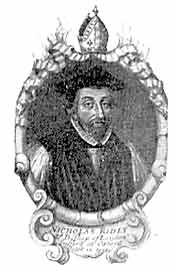
What would Bishop RIdley say? Bishop Schofield confirms: Four liberal California bishops charge him with "abandoning the Communion"

Episcopal bishop confirms he is under investigation

By Frank Lockwood

The Bishop of San Joaquin, the Rt. Rev. John-David Schofield, confirmed Friday evening that he is under investigation for allegedly "abandoning the Communion" of the Church.

In an interview with Bible Belt Blogger, the central California bishop said the allegations are "absolutely" false. "We're not leaving the communion," Schofield said, adding that he remains a committed Anglican. He vowed to fight the charges, which have been brought by four other California bishops.

Speaking by phone from Fresno, Schofield said his critics are using an unusual strategy to remove him. Instead of bringing a standard ecclesiastical indictment (called a presentment), they are using Title IV, Canon 9 of Episcopal Church law. "If it were a presentment, there would be a trial and I could defend myself," he said. Instead, his fate may be decided in the House of Bishops. If a majority of the bishops decide he has abandoned "the communion of this Church", then he would be removed as a successor to the apostles.

Typically, Title IV, Canon 9 is used to remove someone who has openly renounced "the Doctrine, Discipline or Worship" of the church or who has joined another religious body.

Schofield, a bishop since 1988, leads one of the most conservative diocese in the nation. Since the 2003 ordination of openly-gay bishop Gene Robinson, Schofield has taken steps to distance his diocese from the national Episcopal Church. According to a Fresno-based group named Remain Episcopal, the San Joaquin diocese eliminated all funding for the national church beginning in 2004. Remain Episcopal says the diocesan convention has also amended its constitution to eliminate "unqualified accession to the Constitution and Canons of the Episcopal Church and the authority of the General Convention." Translation -- if the governing documents of the national church and the San Joaquin diocese conflict, San Joaquin's rules would trump.

In a June 22 letter obtained by Bible Belt Blogger, then-Bishop of California William E. Swing said that the changes in the San Joaquin diocese's constitution could make it harder for dioceses to win lawsuits against renegade parishes in the future. Such litigation is already taking place in California and elsewhere.

The constitutional amendments, Swing warned, "will create chaos for all of us for all time."

Schofield told Bible Belt Blogger that he isn't trying to cause legal difficulties for neighboring California dioceses. "I can simply say that the actions taken by our diocesan convention over the last two years were done with an eye toward protecting the people of San Joaquin, without a single thought of any consequences beyond the diocese."

San Joaquin was one of seven dioceses who appealed to the Archbishop of Canterbury earlier this summer for alternative oversight, rejecting the leadership of Presiding Bishop-elect Katharine Jefferts Schori. With the Episcopal Church facing possible ouster from the worldwide 77-million-member Anglican communion, the San Joaquin diocese has also asked the Archbishop to recognize it as legitimately Anglican -- no matter what happens to the Episcopal Church as a whole.

The Anglican communion is made up of 38 churches who trace their roots to the Church of England. Of those, 22 have restricted or completely severed ties to the Episcopal Church since Robinson's ordination. Critics warn that the Episcopal Church's actions may cause lasting damage to the international body.

Few bishops have been more critical of the church's national leadership. In a pastoral letter earlier this month, Schofield criticized what he called "the arrogance and rebellious spirit manifested by the Episcopal Church" and warned that "chaos and turmoil have overtaken" the 2.2 million-member denomination. Theological liberals, Schofield suggested, "have chosen not only to walk apart from Anglicanism and, perhaps, Christianity itself."

--------
Frank Lockwood, 39, is the Herald-Leader’s faith and values reporter. He has been the paper’s Washington DC correspondent and was its Northeastern Kentucky bureau reporter. Frank is a graduate of Harvard College and the University of Idaho College of Law. In 2004, he received a Knight Wallace Fellowship at the University of Michigan.

Friday, July 28, 2006

U2 to publish book "In their own words" in September

It will be the definitive U2 story. It will have stories never before told and photos never before seen. It is ‘U2byU2’ and worldwide publication is just two months away, on September 22nd.

For the first time each member of U2 – and manager Paul McGuinness - has told their own story from their earliest childhood memories to their first meeting with each other, from those opening chords in Larry’s kitchen to becoming the biggest band in rock’n’roll.

Ever wondered what it’s like being in a band with your school friends for your entire adult life?

Ever wanted to have a conversation with the band themselves ?

‘U2byU2’ is the ultimate conversation with Adam, Bono, Edge, Larry and Paul McGuinness in which they tell their own side of the U2 story.

Featuring more than 1500 images including previously unpublished photographs from the personal archives of the band, this hefty 350-page tells the U2 story from the perspective of those who know it best – and it brings it right up to date in 2006.

‘U2’s story is an extraordinary one and we are proud to be publishing this book.’ said Trevor Dolby, Publishing Director of HarperCollins Entertainment. ‘U2byU2 is a book not just for the fans but for everyone interested in music and modern culture.’

Nominees for Bishop of South Carolina Announced

NOTE FROM BB: Here we are! Ellis is terrific and wise and I've known Steve through our work as Alpha Regional Advisors - he's a visionary and passionate for the Gospel and evangelism. Not sure about Mark - St. Stephen's in McKeesport was a bit odd when I visited it after he left - I was on my way back from a course at TESM and and it was, shall we say, an unusual experience. But I can give my wholehearted support to Ellis and Steve. May God give the leaders of South Carolina wisdom and discernment as they make their choice for their next bishop. Ellis and Steve are remarkable men who love Jesus and have a biblical and evangelistic vision for His Church - I don't know how I'd choose. Well done, South Carolina!

Nominees for Bishop Announced
July 27, 2006

Dear Friends,

I am pleased to announce to you that the Standing Committee has concluded its work. The required background checks have been accomplished. The psychological exams required by canon law have been satisfactorily completed, and we are now free publicly to announce the names of those we shall nominate for the position of Bishop of South Carolina.

They are:

The Rev Canon Ellis Brust of Atlanta

The Very Rev. Mark Lawrence of Bakersfield, CA

The Rev. Steve Wood, Rector of St. Andrew’s, Mt. Pleasant

I am grateful to Fr. Greg Kronz and the Search Committee for their months of hard work.

I am also grateful to the many others who allowed their names to be considered. We have many faithful priests in South Carolina, and we are all blessed by their many gifts of leadership.

Please study carefully the material enclosed with this letter.

Please pray diligently for the guidance of the Holy Spirit.

Delegates to the Special Convention and all canonically resident clergy eligible to vote will gather at St. Philip’s Church, Charleston for the “walk about” on September 9. Registration will begin at 8:00. The actual program will begin at 10:00 sharp. Each nominee will make a brief opening statement, followed by responses to prepared questions from the Standing Committee. There will also be ample opportunity for members of the clergy and lay delegates to ask questions of any of the nominees. There is limited space available at the “walk about” for other members of the diocese who are not delegates.

The election will take place at St. Philip’s Church the following Saturday, September 16, beginning with the Holy Eucharist at 9:30

Registration materials for both of these events have been sent previously to every congregation. If you for some reason have not received your registration materials, please contact Randy McPhail in the Diocesan office (843-722-4075).

Grace and peace,

Fr. Dow Sanderson, President
Diocese of South Carolina


--------------------------------------------------------------------------------


The Reverend Canon Ellis English Brust

The Rev. Canon Ellis English Brust is Chief Operating Officer and Chaplain to the President of the American Anglican Council (AAC) headquartered in Atlanta, Georgia. Canon Brust is committed to proclaiming the Good News of God in Christ; to upholding traditional Christian teaching; and to implementing the apostolic model of equipping the saints for works of ministry through evangelism, discipleship, worship, personal spiritual growth and stewardship. He has a passionate desire to serve Jesus Christ and the church as an effective and visionary leader.

In his current position, Canon Brust oversees the day-to-day operations, strategic planning, resource development and spiritual oversight of the AAC, as well as providing pastoral care to the staff. Canon Brust also represents the AAC in its domestic and international diplomatic ministries. Prior to joining the AAC, he was Canon to the Ordinary for the Episcopal Diocese of Florida, where he assisted Bishop Stephen Jecko in administration, strategic planning and congregational development of the 75 churches in the diocese. Ordained in 1984, he has served parishes in Midland, Crockett, Katy and Longview, Texas, and has been elected and appointed to numerous diocesan and community leadership positions.

Canon Brust holds a master’s in divinity from Virginia Theological Seminary and a bachelor’s degree from Bethany College, Lindsborg, Kansas. He has written devotions for Bible Reading Fellowship and other publications and is a frequent retreat leader and parish consultant. Canon Brust has been a conference speaker in the United States, United Kingdom, Cuba and Nigeria. He is married to Cynthia, a native of Winnsboro, South Carolina; they have two children: Rebecca, 20, a senior at Converse College; and William, 17, a junior in high school. Canon Brust enjoys reading, writing, music, golf, spending time with his family, and relaxing at their cottage in western North Carolina.


--------------------------------------------------------------------------------

The Very Rev. Mark J. Lawrence

A fifth generation Californian, and a native of Bakersfield, he attended local public schools, wrestled in high school and college, graduating from California State University, Bakersfield in 1976 with a Bachelor of Arts in English. After earning a Master of Divinity from Trinity Episcopal School for Ministry in 1980, Fr. Lawrence has spent his entire ordained ministry in parish work. After his diaconal year 1980-81, which he spent assisting in a newly planted church in suburban Fresno, California, and as chaplain at Fresno State University, Bishop Victor Rivera appointed him as the vicar of St. Mark’s Shafter, an Anglo-catholic congregation in the rural San Joaquin Valley. The three years he was vicar the Sunday attendance grew by 65 %. He also served as chairman of the diocesan Church Growth Committee and was a delegate to Provincial Synod.

In 1984 he was called as Rector of St. Stephen’s Episcopal Church, McKeesport, Pennsylvania, located in the aging, depressed and declining steel mill region in the Monongahela Valley of greater Pittsburgh. While the region continued to face economic and demographic decline, in the 13 years he served as rector, the parish grew in average Sunday attendance by over 50% and in communicant strength by over a 100 members. The congregation also sponsored an innovative ministry to “street people” and in 1991 established the Mon Valley Tri-Parish Ministry, where Fr. Lawrence put together a clergy staff to oversee two smaller churches in the region—St. John’s, Donora and Transfiguration, Clairton, Pa. He also served extensively in diocesan duties—Standing Committee, Commission on Ministry, Chairman of the Board of Examining Chaplains, Cathedral Chapter, Calvary Camp, and was the liaison with the Anglican Diocese of Chile. He also participated on several community boards from the McKeesport Hospital Ethics Committee to the Advisory Board of the Salvation Army.

In 1997, after 13 years in McKeesport, Pa, he was called to be rector of St. Paul’s Episcopal Parish in Bakersfield, California - his home parish in his hometown. Here too the parish has grown by over 50% in average Sunday attendance and the annual budget by 150%. He has also served as rural dean, on Diocesan Council, Board of Examining Chaplains, and lectured in Anglican and Episcopal Church History at the San Joaquin School for Ministry, (a joint venture of the diocese, TESM and the Fresno Mennonite Seminary). He has served as a deputy to General Convention in 2003 and 2006.

He is a member of the Order of St. Luke, the Brotherhood of St. Andrew, and has been active in Cursillo.

He was married to Allison Taylor in 1973. They have five children, and six grandchildren. All are active in parish life and Christian ministry.


--------------------------------------------------------------------------------

The Rev. Stephen D. Wood

Ministry Leadership
Rector, St. Andrew’s Church, Mt. Pleasant (2000-present)
Rector, St. Mary’s Church, Goose Creek (2005-present)
Associate Rector and Chief of Staff, St. Luke’s Church, Bath, OH (1996-2000)
Vicar, St. Anne-in-the-Fields, Madison, OH (1991-1996)

Diocesan Leadership
Evangelism Commission (2001-2003)
Commission on Ministry (2001-2005)
Ecclesiastical Court (2004-present)
Standing Committee (2005-present)

Regional & National Leadership
Anglican Communion Network Council Member (2005-present)
Alpha North America, National Core Leadership Team (2005-present)
New Wine International, USA Leader (2002-present)
The Order of Mission, North American Senior (2004-present)
Alpha Regional Advisor (1997-present)

Other Ministry Leadership
Changing Families Ministries, Board of Directors (2002-present)
Drawing Near to God Ministries, Board of Directors (2002-present)
Onward to Omega, Board of Directors (2004-present)

Community Leadership
Wando High School, School Improvement Council (2003-2006)

Education
Master of Divinity, Virginia Theological Seminary (1991).
Bachelor of Arts in History, Cleveland State University (1986).

Family: Wife – Jacqui. Sons – Aaron (20), Tim (16), Nick (13) and Sammy (9).

Outside interests: family activities, cycling, hiking and reading.

Thursday, July 27, 2006

"Ancient words, ever true, changing me and changing you."


Ancient words, ever true, changing me and changing you.”

By Martyn Minns, Rector, Truro Church, Fairfax, VA

I am sure we all have had the experience of a particular song or piece of music capturing our imaginations, and then seeming as if it were on constant replay-mode in our minds. We sang one such song last week, and I have been singing it ever since: “Ancient words, ever true, changing me and changing you.”

It is a beautiful song written by Lynn DeShazo, a Christian songwriter from Birmingham, Alabama. This song reminds us of the amazing gift of the Scriptures: “Holy Words of our faith handed down to this age, came to us through sacrifice; O heed the faithful words of Christ.” The Scriptures are a great gift.
But, how are we to read them so as to avoid the problems where people twist Scripture to fit their own biases and prejudices? Also, how do we avoid the dangers of thoughtless literalism that leads people to use the Bible to support the inhumane practices of slavery and the ongoing subjugation of women?

Let me suggest a few principles that have helped me use these Ancient Words to guide my life.

1. Prayerful humility: It is God’s Book inspired by God’s Spirit. If we are to hear God speak, we need to pray before we read.

2. Context: The Bible is written to real people in real history. While there are many timeless truths contained within its pages, we do well to understand the original setting.

3. Literary styles: Some portions of the Bible are recorded history, while others are poems, and still others are wise sayings—all true but we need to recognize the various styles and read them differently.

4. Big picture: It’s easy to focus on a few favorite verses, but we need to understand them within the meta-narrative (the overarching story) of the Bible.

5. Find yourself in the story: The Bible is not a book to be held at arm’s length, but one that is designed to dig deep into the recesses of our hearts and minds.

Ancient Words ever true, changing me and changing you!

"Lumos!" now underway in Las Vegas

(Now this would be an excellent location to blog from - wonder if KJS will check in or is she passing it up to be the featured keynote speaker at the 7th Annual Cornelius Fudge Celebration Dinner at the Marriott?)

The Toronto Star reports:
Teachers and academics descend today on one Sin City hotel being transformed this weekend into the Hogwarts School of Witchcraft and Wizardry for a Harry Potter conference.

Among about 1,200 muggles flying in on planes — not brooms — for the academic conference, called Lumos 2006, are about 40 Canadians, including teacher/librarian Deanna Lombardi.

Her main mission is to bring back a little more Harry Potter magic for her students at St. Michael Catholic Academy in Thornhill.

But for this über-fan, the convention work won't be a hardship.

Lombardi, who has a collection of Harry Potter striped scarves, calls the event "a Harry Potter playground for adults."
She's studied the Lumos program rigorously and is eagerly looking forward to a talk by Tom Morris, author of If Harry Potter Ran General Electric, and another roundtable discussion on "Moral Alignment in Harry Potter."

Between dozens of teacher-geared sessions such as "The Hogwarts Model: Educational Theory and Practice in the Harry Potter Novels," there will be water quidditch at the hotel pool and live chess in the evenings.

Lombardi is among the growing number of educators who have seized on the popularity of J.K. Rowling's Harry Potter novels to encourage her students to read.

She uses the books in her Grade 5 novel studies and says they are among the most popular in the St. Michael's library.
"The Harry Potter books literally fly off the shelves. I'm having to repurchase them. Some haven't been returned," she said.
"In Harry we see the virtues of courage and strength. He's had to overcome so many difficulties and challenges in life. That's a great lesson for children to get nowadays."

Lombardi's favourite in the novel series is the fourth volume, Harry Potter and the Goblet of Fire.

"The Triwizard Tournament, the uniqueness and the ingenuity of just developing something like that ... " she says, her voice trailing off.

"For J.K. Rowling to actually write that and create it, it really gives the readers a lot to visualize."

But until Sunday, Lombardi won't have to depend on her imagination to see Rowling's world. At Lumos, she'll be immersed in a rendition of Harry's world in which a hotel room becomes the Great Hall and convention delegates are assigned a house, each with a common room for mingling and relaxing.

Lombardi has requested membership in the Gryffindor House. "It is the house that the brave and daring belong to. Of course, it's also Harry Potter's house — who wouldn't want to be part of the chosen one's house?" she said prior to leaving for Vegas.
Evenings at Lumos will feature Hogwarts night classes and feasting. Muggles — humans to those who haven't read Harry Potter — and wizards will dine on padfoot stew, Aunt Petunia's violet pudding and cornish pasties.

The hotel pubs will be pouring Butterbeer, Morsmordre margaritas and Pansy Parkinson's frilly pink martini.

"The Episcopal Church, one of the most historically significant churches in America, is on the verge of implosion," says Dallas newspaper.

The Episcopal Church, one of the most historically significant churches in America, is on the verge of implosion. It has endured schism before but nothing like what it faces today. Its "civil war over homosexuality," as The New York Times put it, threatens not only to divide its 2.3 million members but also to separate it from the 77 million-strong global Anglican Communion.

Once viewed as the Republican Party at prayer, over the past 30 to 40 years the Episcopal Church has morphed into something else altogether, losing much of its membership along the way. The turning point was 1976, when the church began ordaining women to the priesthood, and in the three years since Robinson's election, it has lost the numerical equivalent of a congregation a day. With Sunday attendance hovering around 800,000, the church has come to represent less than 3 percent of Anglicans worldwide and a little more than 1 percent of American Christians, making it, as the writer Allen Guelzo recently put it, "statistically negligible on the horizons of both American Christianity and the Anglican Communion."

A month after Robinson's election, conservative Episcopalians from around the country gathered at the Anatole Hotel in Dallas to effect a "course correction" within the church. At that meeting, which David Roseberry organized, priests and bishops spoke openly about the possibility of schism. Because of that meeting, and the outcry within the global Anglican Communion over Robinson's ordination, the Archbishop of Canterbury issued a report calling the American church to repentance. While the report did not condemn Robinson's election, it did say the Episcopal Church should consult the broader Anglican Communion before making major decisions. (The Episcopal Church is a semi-autonomous entity within the Anglican Communion. It recognizes the Archbishop of Canterbury as its worldwide leader, similar to the pope but without as much authority.)

Instead of apologizing, the American bishops went the other way, electing Katharine Jefferts Schori presiding bishop last month at their 2006 General Convention in Columbus, Ohio. Schori had not only supported Robinson's ordination, she had also blessed same-sex unions and on more than one occasion referred to Jesus as Our Mother.

Like a tear in fraying fabric, the rift between liberals and conservatives within the Episcopal Church and the broader Anglican Communion widened at that moment, possibly beyond repair. To many, it seemed a slap in the face, a direct affront to the wishes of the global church. In response, Anglican leaders in Africa, where the church still has the militant zeal of a missionary organization, declared an end to their association with the Episcopal Church, even if it meant forgoing millions of dollars a year in emergency food and other aid.

So far, six American dioceses, including Fort Worth, have rejected Schori as their leader and have asked to be placed under the oversight of an Anglican archbishop outside the United States. It could result in a most unusual outcome: a U.S. diocese reporting to a bishop in Africa.

Read the rest by clicking the headline above or go here: http://www.dallasobserver.com/Issues/2006-07-27/news/feature_full.html

Monday, July 24, 2006

Anglican Alert: Code Yellow


I drew a line
I drew a line for you
Oh what a thing to do
And it was all yellow

Coldplay

Click the headline above.

TEC Division Continues - Ft. Worth Standing Committee Submits Resolutions to Leave Province VII of The Episcopal Church

THE EPISCOPAL DIOCESE OF FORT WORTH

July 24, 2006
STANDING COMMITTEE RESOLVES TO LEAVE PROVINCE VII

FORT WORTH, Texas – The following Resolution was unanimously adopted today by the Standing Committee of the Episcopal Diocese of Fort Worth and will be presented to the Diocesan Convention in its annual meeting on Nov. 18, 2006.

WHEREAS the Archbishop of Canterbury in light of the actions of General Convention 2006 has proposed that the “best way forward” for the Anglican Communion is to have in the future both “constituent” and “associated” members, necessitating “ordered and mutually respectful separation between ‘constituent’ and ‘associated’ elements” within local Churches; and

WHEREAS the stated aim of the Episcopal Diocese of Fort Worth is to be a constituent member of the Anglican Communion as provided for in the Constitution of the General Convention of the Episcopal Church in the United States of America; and,

WHEREAS the Bishop and Standing Committee believe it necessary for the Episcopal Diocese of Fort Worth to dissociate itself from those actions of the 75th General Convention which constitute a decision of the Episcopal Church to walk apart from the Anglican Communion; and,

WHEREAS the Bishop and Standing Committee of the Episcopal Diocese of Fort Worth in good faith appealed to the Archbishop of Canterbury, the Primates of the Anglican Communion, and the Panel of Reference for immediate alternative Primatial oversight and pastoral care so that a unifying solution can be found to preserve an authentic Anglican community of witness within the United States of America and provide pastoral and apostolic care to biblically orthodox Anglicans in this country regardless of geographical location;

THEREFORE BE IT RESOLVED that the Episcopal Diocese of Fort Worth, pending final ratification by its 24th Annual Convention, withdraws its consent, pursuant to Article VII of the Constitution of the General Convention of the Episcopal Church, to be included in the Seventh Province of the Episcopal Church.

The Episcopal Diocese of Fort Worth consists of 55 congregations serving 24 north central Texas counties. The major cities in the diocese include Fort Worth, Arlington, Hurst-Euless-Bedford, Wichita Falls, Grand Prairie, Richland Hills, Brownwood, and Stephenville. The Rt. Rev. Jack L. Iker has served as the third Diocesan Bishop of Fort Worth since 1995. The diocese enjoys companion relationships with the Dioceses of Northern Malawi and Northern Mexico.

---

Note from BB

Cowardice asks the question - is it safe?
Expediency asks the question - is it politic?
Vanity asks the question - is it popular?
But conscience asks the question - is it right?
And there comes a time when one must take a position that is neither safe, nor politic, nor popular; but one must take it because it is right.

Martin Luther King, Jr.

Sunday, July 23, 2006

Can we go now? New PB chats up CBS: "Change is happening," Jefferts Schori says, "whether they are interested in that change or not."


Change is happening whether you like it or not, the new PB says. From her example as Bishop of Nevada (which embraced the blessing of same gender unions) we know what that "change" includes. TEC is not backing down, she made that abundantly clear. It's on to the brave new world, so get out of the way.

When asked why she won't support biblical principles regarding human sexuality, Jefferts Schori said "Jesus invited everybody to the table - to the great feast - and for us to say that some people are not fit to come to that feast is not our task." So go ahead and live your life any way you like it - just make sure it feels good - and ya'all come on down.

"People who have been unhappy - this is another piece that may offend them," she told CBS News. "Change is happening whether they are interested in that change or not." So much for the Listening Process. Either get on the train or jump off.

When asked about the innovations employed by the Episcopal Church, she said that they have "offended old ways of understanding who should be in charge. Should it be white men who should be in charge or not?" So it is about power after all.

Sorry guys. These boots were made for walkin' and they're walkin' all over you.

bb

Is this the Big Top - or just Over the Top?

From the "Did I miss something or is this actually in the Book of Common Prayer" file. Click on the headline above and see how The Episcopal Church (TEC) now celebrates the Eucharist at one of the premier Episcopal Churches in the United States (Trinity Wall Street). Is this what they really mean when they say that God is doing a new thing? Note to KJS: How about a Clown Consecration?

David Roseberry: $10 million spent on GC-2006; New Presiding Bishop disagrees with Jesus; ECUSA clearly moving in another direction ...


From "A Matter of Mission," by The Rev'd David Roseberry, rector, Christ Church Plano.

I have assessed the mission of the Episcopal Church and it is clear that they are going in another direction. Sometime in 2006, the 300 millionth citizen of the U.S. will be born. Our country has seen enormous population increases over the last few decades. Yet, during that time, the Episcopal Church has lost members and is losing its foothold in the American culture. ECUSA now has fewer than 800,000 attendees each week in their 7,200 churches. There are (on average) 37 pupils in an Episcopal Sunday School.

And I might add that in the middle of this unprecedented decline – and quite likely the cause of the decline – is that the church has been engaged in endless debates and conflicts about sex: sexual identities, sexual expressions, sexual lifestyles and sexual freedoms. And with this comes a whole package of teaching, theology and core convictions that have moved ECUSA outside the Christian mainstream.

It has been monotonous. And now as I look back on it, it has also been self-centered and very expensive. The 2006 General Convention cost around 10 million dollars! I have come to believe that the country does not need one more agency or institution demanding or defending sexual freedom. It needs a missionary church with a clear message about Jesus Christ and the Cross.

But it is not just the mission emphasis that is different. It is also the message. The message of the church is the energy that propels its people into the world to make disciples and teach them to obey the commands of Christ. Christ is the message. It is all about Christ: His work on the Cross, His life and teaching, the impact of His life upon the lives of all who follow Him, and His death and resurrection, ascension and coming Kingdom. The message of the Gospel is a message simply about what God has done in Christ. The church has no other point to make until that message is clearly understood and clearly proclaimed.

There were lots of opinions about Jesus in His own time. His work and wonders were well known. He could draw a crowd for a sermon and for lunch! People had interest and fascination with this teacher/healer from Nazareth. But Jesus never cared about being famous and well known, like a celebrity. He wanted to be known for who He truly was: the Son of God. Only after the disciples understood the true identity of Jesus Christ would they comprehend the purpose of His life. And, when Peter gets it right at Caesarea Philippi, Jesus then reveals the final outcome of His life: death on the cross and resurrection from the dead. (Matthew 16)

The point is very simple. Jesus is the Son of God. Jesus gave His life for the sins of the whole world. No one comes to the Father except through the Son. (John 15) Or, put another way, “This is the testimony: God has given us eternal life and this life is in His Son. He who has the Son has life, He who does not have the Son of God does not have life.” (I John 5:11)

In an interview with Time magazine, the Presiding Bishop-elect was asked a question about the necessity of belief in Jesus for eternal life. Read and mark her answer to this question: “We who practice the Christian tradition understand him as our vehicle to the divine. But for us to assume that God could not act in other ways is, I think, to put God in an awfully small box.” This is a different message than Jesus’ message concerning Himself. (John 15) The Presiding Bishop-elect disagrees with Jesus. Her answer is incorrect at almost every level, but it is very revealing. She sees that Christianity is about a practice and not a person. Her metaphor of a “vehicle to the divine” actually reduces the Trinity down to a limited partnership between “the divine” who receives and Jesus who brings. It is a denial of the co-equal and co-eternal nature of the Trinity. (This “vehicle” language is totally foreign to Judeo-Christian teaching.) It is a different message.

These then are two key differences between where Christ Church is going and where the direction and agenda of the Episcopal Church is going. They are different … stunningly different. And these differences are just the beginning of the divergence. When I think about the dichotomy of these two issues alone I realize that we have no other choice but the one we have chosen.

Click on the headline above to read entire piece.

Bishop Busters - Coming to a Diocese Near You


Inspired by suing the laity and bullying their clergy, four California bishops gang together to form "Bishopbusters Inc - You Got a Wheel Chair, We Got Title IV." For more information call the firm of Swing, Mathes, Bruno & Lamb. Patent pending.

Remembering Two Bishops of Virginia: Meade and Moore


There was a time when the Diocese of Virginia was sliding into obscurity. The laity was leaving in droves to the Presbyterians, the Baptists, and the Methodists. The remaining churches were falling into decline. How did the Virginia revive from the brink of disaster?

The year was 1814 when a clergyman by the name of Richard Moore became both rector of a church in Virginia and the bishop. Bishop Moore was "a man of strongly Protestant and evangelical outlook," a history of the Episcopal Church in Virginia describes the early bishop. His preaching brought people to Christ. He revived parishes, founded an evangelical seminary, and turned his attention to overseas mission. He was followed by another robust evangelical bishop, William Meade. Their vision for preaching the scriptures, of centering the diocese on the Gospel of Jesus Christ, of evangelism, of standing firm for truth in the House of Bishops - their vision revived the Episcopal Church in Virginia. How far we've traveled from the foundation of the church to what it is now, today.

Here's an excerpt from the history of the Diocese of Virginia from thediocese.net:

"In 1814, the Rev. Richard Channing Moore of New York, the first man ordained by Bishop Provoost, was persuaded to accept election as rector of Monumental Church in Richmond and as Bishop of Virginia. A man of strongly Protestant and evangelical outlook, Bishop Moore was a gifted and eloquent preacher. There is a story about a congregation that listened spellbound to one of his long, 19th century-style sermons, and when it was over, demanded that he preach another. When that homily ended, they called for another. After the third sermon with supper time near, Moore declared that he had preached enough!

"An able and tireless leader, as well as a great preacher, Bishop Moore crossed and re-crossed the Commonwealth, reviving parishes, replacing the reprobate priests who had come in during the early years of the century, and building up the financial support of the Church. Virginia's second bishop's episcopate was marked by the founding of the Virginia Theological Seminary and of the Diocesan Missionary Society.

"In 1829, the Rev. William Meade was elected and consecrated assistant bishop and, until Bishop Moore's death in 1841, gave his diocesan bishop immense help in reviving the Church in Virginia. Bishop Meade was a prolific writer of letters, prayers, devotional guides, and of historical articles that were later collected in Old Churches and Families of Virginia. Historians and genealogists owe Bishop Meade a great debt for collecting and depositing many of the colonial parish registers and vestry-books with Virginia Theological Seminary.

"By the time Bishop Meade became third Bishop of Virginia in 1841, he was himself in ill health and another assistant bishop was chosen, the Rev. John Johns, D.D. Bishop Johns was the first bishop to be consecrated in Virginia, at Monumental Church in Richmond, October 13, 1842. By the time he became fourth Bishop upon Meade's death in 1862, the Diocese had assumed a leading position in the Protestant Episcopal Church in the United States and was large, wealthy, and strong in every respect, its evangelical character and witness owing to the tireless ministry provided by Bishops Moore and Meade.:

-------

And here is an excerpt from the sermon preached at the consecreation of William Meade by Bishop William White of Pennsylvania. Could this be preached today at a consecration in Virginia?

"Every age has its peculiar dangers, and ours has not the least of them; consisting of the corruptions of many within, and the enmity of many without; and creating especial calls on the conscientious professors of the Gospel, to defend it by their zeal, and to adorn it by their lives. But there is one danger common to all times and places--that of falling short of the standard of Christian morals which it prescribes; and consequently of the life and immortality which it has brought to light.

"In order to prevent this, let every one consider the Gospel as resting on his conscience a weighty trust; comprehending truths which were designed to make him "wise unto salvation;" promises, by which he should become a partaker of the divine nature; and precepts, rendering him "thoroughly furnished unto all good works." These, with whatever they imply of instruction to guide us to our duty, and of grace to enable us to discharge it, are a part of the trust, which gave a ground for the admonition in the text."

William White, August 19, 1829

The rift in the Anglican Church comes to Northern Virginia


THE ACCELERATING RIFT over homosexuality in the nearly 80 million member global Anglican Communion has finally reached directly into the Washington, D.C. area.

A conservative Episcopal priest in suburban Fairfax, Virginia, has been elected a bishop by the 18 million member Anglican church of Nigeria. The Rev. Martyn Minns of the 1,700 member Truro Church in Fairfax City will preside over the handful of churches for Nigerian expatriates in the United States. But more may ultimately be involved.

Also last month, Truro Church informed Virginia Bishop Peter Lee that it is entering a 40 day time of "discernment" over its relations with the U.S. denomination. Other large Episcopal churches in Virginia besides Truro, including the historic 2,000 member Falls Church, are likewise considering their ties to U.S. Episcopalianism.

"We will be seeking God's will about whether continued affiliation with the Episcopal Church is compatible with Scripture and with our affiliation with the global Anglican Communion," Senior Associate Rector Frederick Wright announced to the Falls Church congregation. "As Anglicans, we would not expect to become an 'independent' congregation," he explained, but would affiliate with "another Anglican body."

More than 20 other Virginia congregations may belong to what Rev. Wright called a "coalition of churches" seeking discernment. Both Truro and the Falls Church date to the mid-1700s--George Washington joined in the creation of both. The Falls Church, for which the surrounding city was later named, also retains its sanctuary, which was built in the 1760s. The Declaration of Independence was read from its steps. During the Civil War, Union soldiers desecrated the sanctuary, using it as a stable.

Truro Church lost its earlier sanctuaries to the Civil War and fire. But its current office space housed Union General William Stoughton until that he was abruptly awakened and captured by the Confederate partisan John Mosby, who also made off with a gaggle of Union horses. ("I can replace the general, but I cannot replace those horses," Abraham Lincoln is said to have remarked.)

WHY ARE THESE venerable old Episcopal congregations pondering a departure from their denomination after 200 years? And why is the Anglican Church of Nigeria in the picture?

Three years ago the U.S. Episcopal Church elected its first openly homosexual bishop, Gene Robinson. Forty percent of the denomination's bishops voted against Robinson. But Virginia Bishop Peter Lee supported him and has likened the acceptance of homosexuality in the church to the civil rights movement in the 1960s.

Conservative dioceses and congregations appealed to the global Anglican Communion, which is headed by the Archbishop of Canterbury in England and includes Global South bishops. Unlike the declining U.S. church, which has lost 1 million members over the last 40 years, these Third World churches are surging. Anglicans in Nigeria alone outnumber U.S. Episcopalians by nearly 10 to 1.

The global Anglican Communion had asked the U.S. church to abstain from electing more homosexual bishops. But the Episcopal General Convention, meeting last month in Columbus, Ohio, elected a new presiding bishop who is firmly committed to homosexual clergy and church rites for same-sex unions. Conservative Episcopalians realized that compromise had become impossible. Many of them now hope that the Archbishop of Canterbury will eventually acknowledge a new Anglican church in North America that would exist alongside--or perhaps even supercede--the old Episcopal Church.

Churches like Truro and the Falls Church, along with other conservative congregations in Virginia, are robustly evangelical--and growing. They do not wish to remain indefinitely in an increasingly liberal U.S. Episcopal Church.

Surely George Washington, George Mason, and other prominent Northern Virginia Anglicans never conceived of Episcopal debates over homosexuality when they founded their churches. The Episcopal Church even managed to avoid schism over slavery and during the Civil War. Anglicanism in Virginia has survived since Jamestown in 1607.

But conservative Episcopalians have chaffed for decades under liberal church leaders who disregarded historic Christian beliefs about sexual ethics, the Bible, and even the identity of Jesus Christ. To continue an orthodox Anglican presence in Virginia, many conservatives want to de-align from the declining liberal religion in the United States and re-align with growing Christianity in the Global South.

The end result may be that much of Virginia Episcopalianism will end up looking to Nigeria, rather than Richmond, for leadership. The slave-owning Episcopal gentry of 18th century Virginia would be shocked. But the irony is an enjoyable one.

From The Weekly Standard. By Mark D. Tooley directs the United Methodist committee at the Institute on Religion and Democracy.

Thursday, July 20, 2006

The Bible for Dummies - Great Teaching Series from Jay Slocum

Click on the headline above to hear the Rev'd Jay Slocum in the first of his teaching series on how to figure out the Bible. The course is terrific - for newbies and oldies! Check it out!

bb

Diocese of Central Florida Letter Appealing for Alternative Primatial Oversight


The Most Reverend and Right Honorable
Rowan Douglas Williams
Archbishop of Canterbury
& Primate of the Church of England
Lambeth Palace
London SE1 7JU, ENGLAND

Dear Archbishop Williams:

Grace to you and peace from God our Father and the Lord Jesus Christ.

This letter is an official appeal on behalf of the Bishop, Standing Committee, and Diocesan Board of the Diocese of Central Florida. We seek Alternative Primatial Oversight and mediation in the dispute between the Diocese of Central Florida and our Province, The Episcopal Church.

The Diocese of Central Florida finds itself in a serious dispute with The Episcopal Church, and in particular, we protest the actions, inactions, and errors of our 74th and 75th General Conventions, specifically:

1. The 74th General Convention’s consent to the election to the office of Bishop of a man living in a same-sex relationship, and his subsequent consecration, with the Presiding Bishop as his Chief Consecrator.

2. The 74th General Convention’s declaration that “local faith communities are operating within the bounds of our common life as they explore and experience liturgies celebrating and blessing same-sex unions.”

3. The 75th General Convention’s incomplete and therefore inadequate response to the Windsor Report and the Communiqué of the February 2005 Primates’ Meeting, most notably, its failure to effect a moratorium on same-sex blessings.

4. The 75th General Convention’s elevation to the office of Presiding Bishop-elect and Primate of The Episcopal Church, of a Bishop who advocates in word and deed the above mentioned errors, and a person who will therefore further breach the bonds of affection within the Communion.

The Diocese of Central Florida has made every effort to be reconciled to our Province. We have consistently called The Episcopal Church to its Constitutional commitments to the Lord, the One, Holy, Catholic and Apostolic Church and the Anglican Communion. We have done this through the statements and resolutions of our Diocesan Conventions, the efforts of our Deputations to General Conventions personal attempts at persuasion and encouragement to faithfulness, and through the Bishop of Central Florida’s proactive engagement on the Theology Committee of the House of Bishops, and within the House of Bishops itself and the General Convention. All of our efforts have been to no avail.

The Bishop and elected leadership bodies of the Diocese of Central Florida have repeatedly affirmed our commitment to remain in full communion as a Constituent Member of the Anglican Communion. We have enacted the recommendations of the Windsor Report in their entirety. Lambeth 1998 Article 1.10 remains our official teaching and practice with respect to human sexuality.

We embrace wholeheartedly your own recent reflection, Challenge and Hope for the Anglican Communion. We recognize the way forward through this crisis for the Anglican Communion will take some time to reach resolution. We are fully committed to the process of developing an Anglican Covenant, and we will wait patiently for the Holy Spirit to work through the Communion to resolve this crisis.

However, we are facing a pastoral emergency within our own Diocese right now. We are losing members in all orders of ministry and we have even lost one entire congregation, approximately two-thirds of another, and one-third of still another. Our ability to carry out the Great Commission is hindered as many members withhold financial contributions due to uncertainty regarding the future of The Episcopal Church. The focus, time and energy of our most gifted clergy are being diverted away from mission and ministry by this crisis. Our witness to the Gospel of Jesus Christ is strained by these errors, and the controversy and conflict they have produced.

Therefore, we are making this appeal to you for Alternative Primatial Oversight. We urge you to recognize this is a necessary measure to prevent further loss of members, money, and ministry. Such Oversight will provide temporary structural stabilization to allow us to focus once again on the twin priorities of the Diocese: the Great Commission and the Great Commandment.

Official support and counsel from the Archbishop of Canterbury, the Panel of Reference and the Primates of the Anglican Communion will provide much needed security and encouragement to the people of the Diocese of Central Florida. Resolute and swift accountability of The Episcopal Church to the wider Anglican Communion will enable our Diocese to remain faithful to our primary identity, calling and vocation. We understand this crisis to be a test of our willingness to submit to the Lord and his Word, and to one another, and we pray we may be found faithful in our weakness.

The Diocese of Central Florida acknowledges its allegiance to the One, Holy, Catholic and Apostolic Church of Jesus Christ. We confess him as Lord, and we look to him with hope for the future.

We await your reply, and commit our prayers and love for you in these very challenging times for our beloved Communion.

Warmly in our Lord Jesus Christ,

The Rt. Reverend John W. Howe, Bishop;

The Reverend John Liebler, President of the Standing Committee

cc: The Most Rev. Frank T. Griswold
cc: The Rt. Rev. Katharine Jefferts Schori

Wednesday, July 19, 2006

Song Clips Now Online from Dylan's "Modern Times"


Click on the headline above (or go here: http://nrvconcert.org/modern_times_clips.mp3) to hear several selections of song clips from Bob Dylan's new album, Modern Times, that will be released next month. They are terrific! One month to go.

Tip of the Tin Foil Hat to Thomas for the head's up!

PS - Tickets arrived yesterday in the mail for the Dylan concert here in the DC area on Saturday, August 19.

LATER: Whoa, just who is he singing to - or about? Can it be?

Identity Revealed! Plasticman - He's the "Real Thing!"

Sometimes you just can't make this stuff up. Bishop Swing - now known as part of the Saturday Morning Cartoons "TEC SuperFriends" as "Plasticman" - is at it again.

Now he thinks that it's Scary Anti-Communists and the Conspiratorial Counterfeits Taking Over the Episcopal Church. Still. Pull out your Tin Foils Hats and watch out for the Black Helicopters.

Oh and by the way, did you know he's actually the Real Catholic (as opposed to all the rest of you). He's the "real thing," he says. Everyone else who disagrees is not as inclusive as he is - and we all live in Joe McCarthy's Basement.

Once again it's all about inclusion and any one who isn't for inclusion is a counterfeit pretender. I can't even make this stuff up.

Here's a bit from Plasticman, (who's human identity is the Bishop of California - nice cover, don't you think?)

Plasticman?

Here is a description of the comic book character Plasticman: "Created by Jack Cole, he first appeared in Police Comics #1 (Aug 1941). One of the trademark characters of Quality Comics during the Golden Age of Comic Books, Plasticman possesses the ability to stretch his body into any imaginable form. His adventures were known for their quirky, offbeat structure and surreal, slapstick humor." Yeah, that's our man.

Our Plasticman writes this from his Ivory Tower on San Francisco's Nob Hill. One wonders if he can see St. Alban's Hill from his window? Tin Foil Hats anyone?

Don't touch the dial on your set! I swear - this is not a parody. This is the Real Thing. He says so himself! Click on the headline above for the full article - and make sure you read it in your best Charles Emerson Winchester III voice. And for Pete's Sake, before you do anything else - stop looking for commies under the bed, will ya?

From "Communists, Counterfeiters, and Catholics"
by the Rt. Rerv'd William Swing, Bishop of California

Every time there is trauma in the Episcopal Church, there is an effort by some of the counterfeiters and the Communist fixators to join forces but nothing – nothing – ever comes of it. Those who cannot tolerate the catholic, universal nature of the Church, with the strain of holding everything and everyone together, certainly cannot live with the idiosyncrasies of each other. Once a church group learns to say, “I don’t need you all any more,” then they are on the road to exponential isolation. The opposite of catholicism. What truly is worth striving for is to make the Church more catholic, or more catholic than it was when we inherited it. Paul inherited a one-race Church. When he died, the Church was multiracial. There is the model. Move outward; embrace more of the human predicament in the Name of Jesus Christ.

No one has cornered the market on being catholic. No one has ever seen the catholic nature of the Church in toto. It exists only in the mind of God. We do see miniatures of it occasionally, and we lurch toward it blindly in our deepest yearnings. The Roman Catholics do not exhaust the catholic nature of the Church, nor do the Orthodox or the Protestants. We all carry its seed in our fragmented groupings. Truly catholic means all of the above and more. Lots more, as the Holy Spirit leads us into the Truth of the One.

Therefore, as a bishop I spend most of my time strengthening and expanding the Church’s infrastructure and institutions so that we can make the long, hard pilgrimage toward the catholicism that Christ intends for us, the wholeness He holds in His heart. All of it is important – the seminaries, the social services, the retreat centers, the congregations, the worship, the ever-expanding ethnic constituencies. We must be on our way toward a catholic destiny where God is all in all. We aren’t communists or counterfeiters. We are the real thing, catholic Episcopalians who pray that the Holy Spirit will lead us ever deeper, ever deeper into the full revelation of the Body of Christ.

-----

NOTE FROM BB: I don't remember Bishop Ridley ever mentioning that his mission was to "spend most of my time ... expending the Church's infrastructure and institutions." Wasn't it something about being set on fire because you were resisting such infrastructure and institutions to follow Jesus instead?

Oh, wait - he wasn't a Real Catholic either. Where's the Duke of Norfolk when you need him, BIshop Swing?

Monday, July 17, 2006

Chapter II: BabyBlue's Official Guide to The Episcopal Church - Introducing Superhero Theology


Explaining The Episcopal Church (TEC, formerly known as ECUSA, formally known as PECUSA) to those who inquire is always a challenge. Episcopalians have tried many different ways of explaining what is The Episcopal Church. In Chapter II of BabyBlue's Official Guide to The Episcopal Church, we learn of a new approach: Superhero Theology.

Imagine that the different wings of TEC were actually superheroes. For example:

Superman - Evangelicals
Batman - Anglo Catholics
Wonder Woman - Charismatics
Spiderman - Emergents
Plasticman - Progressives
Professor X - You know who you are

Gives a whole new meaning to Saturday Morning Cartoons.

bb