Friday, August 31, 2007

He was a friend of mine

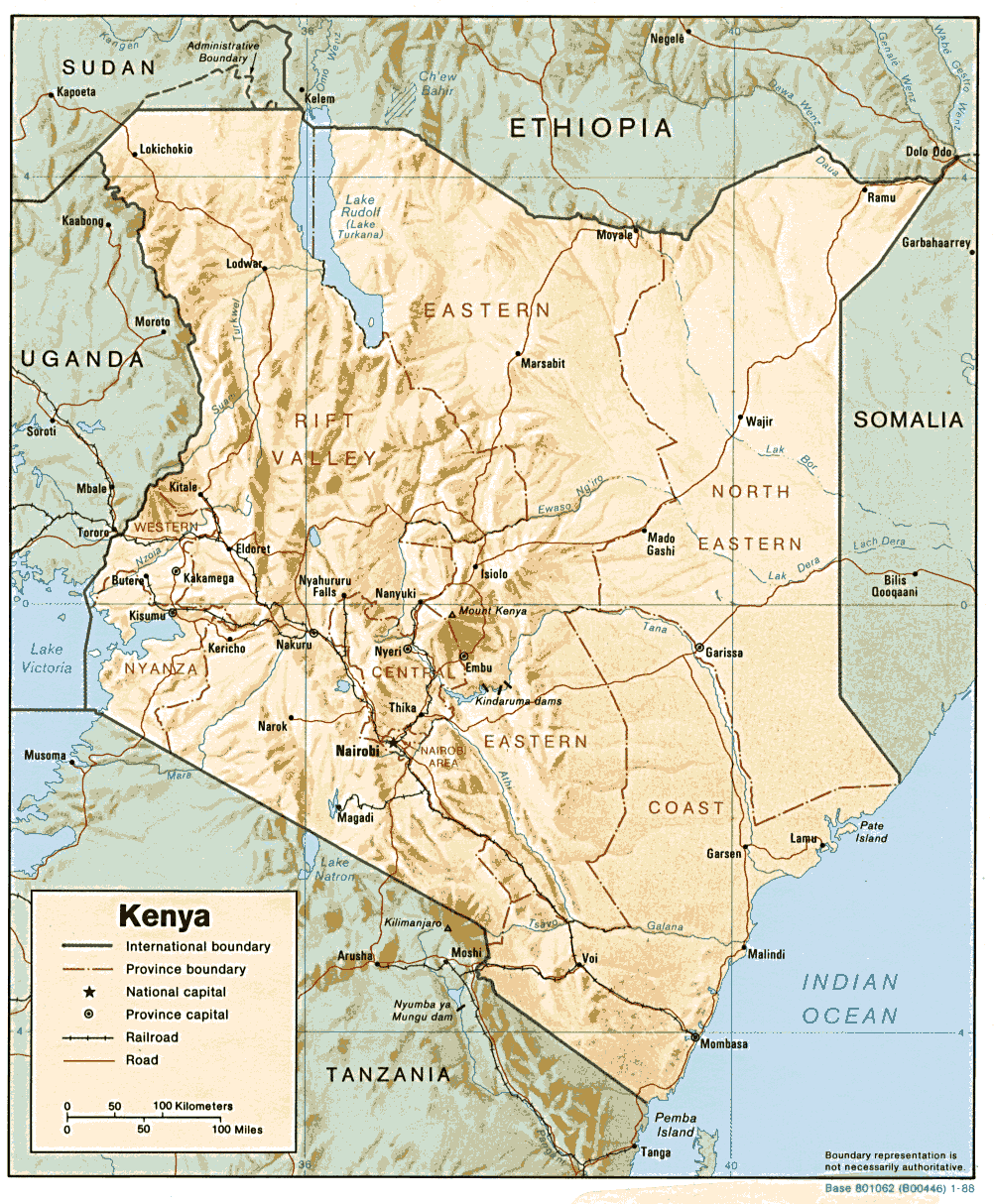
Dropped by a the blog homes of a few of our friends with whom we disagree (but do welcome here for pints of butterbeer and pitchers of chai) and, well, felt rather sad. Wish we were more profound than that, but there we are. Got to thinking again about Bishop Festo and as Bob might say, a different point of view. How would an African bishop walk into a suburban Episcopal parish in the early 80s and completely turn things upside down? But that's what happened - that's how I remember it. The deep friendships between African and American evangelicals - with their Bibles and their Prayer Books in hand - goes back twenty-five to thirty years. It's not overnight. And the deal is, and this is the truth - the Africans saved us. Yes, they did - by pointing us back to the Redeemer that saved them. There would not be an evangelical left in the Episcopal Church if it wasn't for African believers and for men like Bishop Festo. And that is the truth. To God be the glory.


Festo Kivengere on John 17:22

Friday Night at the Cafe


Wonder what John Adams would have thought of the House of Bishops? Ah, but he was a Congregationalist.

The Last Stand of Rowan Williams

Jordan Hylden writes in First Things on the upcoming New Orleans meeting of the House of Bishops with the Archbishop of Canterbury:

Things will come to a point at the September 19-25 meeting of the Americans, when the Episcopal Church’s bishops gather in New Orleans. Williams has been invited to give an address and answer questions. It could be the most important performance of his career as the archbishop of Canterbury.

As has been reported by the press, the Episcopal bishops last spring were given three requests and a deadline by the global Anglican primates. They were asked to stop consecrating actively gay bishops (meaning no more Gene Robinsons), to stop formal blessings of same-sex unions, and to provide space for those who dissent from the regnant liberal theology of the Episcopal Church. The deadline was September 30, so the upcoming meeting will in effect signal definitively whether or not the American church will decide to remain in step with the Anglican Communion or instead detach itself and go its own way.

Williams’ stance at the meeting will inevitably signal whose side he is on. The majority of the Episcopal Church’s bishops do not want to comply with the primates’ requests, as they signaled vociferously last spring. The question is: If they refuse, what if anything will happen to them? Will the American bishops get to come to Lambeth and participate in the other global conferences of Anglicanism no matter what they do, or will refusal mean that they’ll have to sit at home?

It’s an important question, because sitting at home would mean that the American church would no longer have any say in the decision-making bodies of Anglicanism. In effect, it would mean that the Episcopal Church would no longer be a fully constituent part of the Anglican Communion—which, especially when viewed in light of Anglicanism’s history, would be a striking change. Many American bishops who otherwise would support Gene Robinson would at the least be given pause by such a momentous choice.

Of course, it is just this choice that the Americans want to avoid, as, most likely, does Rowan Williams. In many ways Williams is close theological kin to the American church, and it will be extraordinarily difficult for him to prosecute this sort of separation.

But as wrenching as it may be for him, it is probably the only way to keep the majority of Anglicanism together.

Read the whole thing here.

Bishop of Rochester leads thirty signatures voicing support for new Anglican bishops

UPDATE: See VOA Report at the end of this article.

BB NOTE: The Bishop of Rochester, Dr Michael Nazir-Ali, headed a list of more than 30 members of the Church of England's General Synod supporting the consecration of two American clergymen as Anglican bishops. From The Times of London:

"You will represent vibrant and growing Churches in Africa in their love and care for those in the United States who are suffering for their commitment to the faith once delivered to the saints, in the face of a determined capitulation by The Episcopal Church to the forces of contemporary North American culture.

"We see in your ministry a wonderful expression of the Gospel promise that there is neither Jew nor Greek, slave nor free, male nor female, but all are one in Christ Jesus. For African Christians who live in economically poorer countries are taking considerable risks in their relations with powerful institutions in order to care for American Christians in economically privileged countries.

"We see here the universal church responding to the needs of local churches, and the local church responding to the need of the universal church, to find a way to preserve global orthodox Anglican witness and fellowship, that is not impaired by man-made intermediate structures.

"Your pathway is into the unknown. The way is strewn with pitfalls. Only Jesus will keep you in the way. Into his hands we commit you as you lead and teach his people in the American corner of his vineyard."

At the service, attended by ten primates from the Global South bloc of conservative African, Asian and Latin American churches, the two men pledged to serve the international interests of the Anglican Church of Kenya and of the congregations in North America that have rejected the care of their own, liberal bishiops and opted for Kenyan jurisdiction.

Archbishop Nzimbi said: “It is evident that the conflicts in the communion affect us all and we have a responsibility to address the areas that we are able to impact."

Read the whole thing here.

UPDATE: The Voice of America reports:


Thursday, August 30, 2007

The 21st Century Anglican Communion

BBC Reports on American Consecrations in Kenya

UPDATE- The Living Church reports:

Ten Anglican primates or their representatives were reported to have been participants or in attendance at the service, which was estimated to have lasted nearly five hours. Bishop Robert Duncan of Pittsburgh and Bishop Jack Iker of Fort Worth were present, as were Bishop Martyn Minns of the Convocation of Anglicans in North America (CANA) and Bishop Charles Murphy of the Anglican Mission in the Americas (AMiA).

UPDATE FROM THE LONDON TIMES:
The worldwide Anglican Church took a further step towards schism over homosexuality today with the ordination of two American Bishops to pastor to conservative US Anglicans under the jurisdiction of Kenya.

The Right Rev William Murdoch and the Right Rev Bill Atwood were consecrated at All Saints Cathedral in Nairobu by Kenya's Archbishop Benjamin Nzimbi.

The ordinations are valid but are expected to be counted as "irregular" by Lambeth Palace in London, placing the two outside the officially-recognised Anglican hierarchy. Nonetheless, the Archbishop of Canterbury, Dr Rowan Williams, will come under pressure from conservatives to invite the two new bishops to next year's Lambeth Conference.

In a significant indication of how the divisions transcend national church disputes, one leading evangelical English bishop today recognised and welcomed the ordinations. The Bishop of Rochester, Dr Michael Nazir-Ali, headed a list of more than 30 members of the Church of England's General Synod who sent a message to the two new bishops backing their episcopal ministry, even though acknowledging it is "out of the ordinary".

They said: "You will represent vibrant and growing Churches in Africa in their love and care for those in the United States who are suffering for their commitment to the faith once delivered to the saints, in the face of a determined capitulation by The Episcopal Church to the forces of contemporary North American culture.

"We see in your ministry a wonderful expression of the Gospel promise that there is neither Jew nor Greek, slave nor free, male nor female, but all are one in Christ Jesus. For African Christians who live in economically poorer countries are taking considerable risks in their relations with powerful institutions in order to care for American Christians in economically privileged countries.

"We see here the universal church responding to the needs of local churches, and the local church responding to the need of the universal church, to find a way to preserve global orthodox Anglican witness and fellowship, that is not impaired by man-made intermediate structures.

"Your pathway is into the unknown. The way is strewn with pitfalls. Only Jesus will keep you in the way. Into his hands we commit you as you lead and teach his people in the American corner of his vineyard."

At the service, attended by ten primates from the Global South bloc of conservative African, Asian and Latin American churches, the two men pledged to serve the international interests of the Anglican Church of Kenya and of the congregations in North America that have rejected the care of their own, liberal bishiops and opted for Kenyan jurisdiction.

Archbishop Nzimbi said: “It is evident that the conflicts in the communion affect us all and we have a responsibility to address the areas that we are able to impact."

The conflict in the Anglican Church, a communion of 77 million souls with the Church of England's Archbishop of Canterbury as "primus inter pares", has been simmering under the surface during the past decades of revisitionist liberal theology but exploded into schismatic fury after The Episcopal Church in the US consecrated Gene Robinson, an openly gay pastor, as bishop of New Hampshire in 2003.

The Archbishop of the West Indies, Dr Drexel Gomez, who is a leading Global South Anglo-Catholic Primate, said: “The gospel of our Lord is clear in its teaching and must take precedence over our culture. The issue is not primarily one of sexuality, but one which seeks to answer the following question: Which relationship corresponds to God’s ordering of life?”

Read the whole thing here.

BBC Reporting: Kenya's Anglican Church has consecrated two US bishops in a move likely to deepen a bitter row over homosexuality.

Bill Murdoch, of Massachusetts, and Bill Atwood, of Texas, will be answerable to the Kenyan Church, although they will serve in the US.

They left the US branch of the Anglican Church - the Episcopal Church - after it consecrated an openly gay bishop.

...The two Americans were consecrated at a service at All Saints Cathedral in Nairobi by Archbishop Benjamin Nzimbi.

They vowed to "serve the international interests of the Anglican Church of Kenya, to serve clergy and congregations in North America under the Kenyan jurisdiction".

The ceremony was watched by a huge congregation of Kenyans, by archbishops and bishops from across Africa, and by the men's friends and supporters from the US.

Read the whole thing here. The London Times reports here. Rueters has an article here. And the AP has an article here. The Living Church has an article here.

The Desolate City

Lent & Beyond is focusing on praying for the House of Bishops meeting in New Orleans next month. The reason that prayer is the place to turn, as it always has been, is explained well here. At Lent & Beyond they have been praying through a scripture that has been before them from Daniel:

Give ear, O God, and hear; open your eyes and see the desolation of the city that bears your Name. We do not make requests of you because we are righteous, but because of your great mercy. O Lord, listen! O Lord, forgive! O Lord, hear and act! For your sake, O my God, do not delay, because your city and your people bear your Name.” Daniel 9:17-19

We too join in praying for that gathering. We'll be onsite in New Orleans standing watch and praying as well. As mentioned at Lent & Beyond, it's difficult to know what to pray for and how to pray. Perhaps the place to begin is with our own repentance, our own desperate need for Jesus. See Daniel's plea, "We do not make requests of you because we are righteous..." Our authority is not based on our own testimony, but on the testimony of the Lord, "because of your great mercy," as Daniel says. Standing on that truth, we can pray in confidence, not in our own righteousness, but in His. Lord have mercy, Christ have mercy, Lord have mercy.

Wednesday, August 29, 2007

Wednesday Night at the Cafe

Animated American satire about a French Saint martyred by the English and dubbed in German. Honi soit qui mal y pense.

First Report from Kenya

BB NOTE: Bill Atwood is being consecrated a bishop in the Province of Kenya. We know that Bishop Martyn Minns is there and so it Anglican TV's Kevin Kallsen - on the spot and ready to go. Well, almost. Here's his report:

Here is the schedule as best I can tell. Tomorrow the consecrations will be held at the Cathedral. This will occur well before anyone in America wakes up. Therefore I will delay the streaming until 1pm est time.

The service takes four hours. I will probably stream one hour from each service and then post the rest of the videos when I return home. There will be a chat room enabled where you can discuss the service at Anglicantv.

Now the bad news. The Hilton charges $40 per day for internet use! Please consider donating to AnglicanTV. I did NOT budget for such an excessive charge.

BB NOTE: To help Kevin, click here or here. Read the Statement of Archbishop Benjamin Nzimbi of the Anglican Church of Kenya here. Hank Steenstra of the Church of the Redeemer in Camden, North Carolina (under the jurisdiction of the Anglican Church of Kenya) is in Nairobi as well and will be reporting at StandFirm this week. Stay tuned!

Tuesday, August 28, 2007

Reflection

We saw Alan Crippen over the weekend and he was positively beaming about his son. Then we read today's media blitz from the Episcopal Church and the Usual Suspects and we wondered what in the world is going on (so much for B033 - at least the truth is out). Just trying to hold on. So we came across this video - and remembered it's not all about being Episcopalian, or even Anglican. Hold on.

Monday, August 27, 2007

No Direction Home ...

Have just gotten home after a three-hour trek home from work. Had met a friend at the Dubliner on Capitol Hill for a quick supper and talking politics and religion (what else?) and then jumped on the Red Line to begin the Trek Home. That was about 7:30 p.m. All was well, got off at Metro Center, nothing spectacular. Listened to an impromptu men's quartet singing as the Orange Line arrived and went and then as the Blue Line arrived. Got on (how many times have we done this!) and settled down in a seat, preparing to plug in to the trusty iPod. Then came an announcement:

"Attention passengers, we are ...." the driver's voice trailed off.

This was not the usual, but we do often "hold" at a station, never quite sure why (though we do remember one time when we threw, by mistake of course, our Metro Pass onto the tracks at Union Station and the Red Line was halted while the Metro staff manager went down on the tracks to retrieve it - we can still remember the announcement then "Delays on the Red Line in the direction of Silver Spring" as the manager handed me back my Metro pass, my head bowed in guilt), but I took the iPod ear phone out and waited.

"Attention passengers," the driver repeated, and it did sound like she was frustrated, but politely so. "All Blue Line trains will end at Arlington Cemetery due to an emergency situation, this train will end at Arlington Cemetery." Well, that's often the end of the line for some, looked like it would be end of the line for us. A few minutes later that was updated to the Pentagon. But that really would be the end of the line and that wasn't even half way home.

Three hours, one Red Line, one Blue Line, two shuttle buses, and a visit to every station by bus between Crystal City and Springfield, Virginia and we finally made it to the end of the real line. Seems that Metro had a repeat of yesterday's mysterious shut down with the tracks catching on fire and filling the tunnels full of smoke. Well, that's what they said - actually, they never did say, we learned that after calling The Brother the Methodist & Family on the cell phone and they told us. We just kept hearing about an "emergency situation" which had a lot of people looking up at the sky (some things are never forgotten). It was daylight when we left, a lovely summer afternoon. But by the time we got to Springfield, darkness had settled over the Metro, in more ways then one.

Of course, we took some photos along the way.

Having been "unloaded" off at the Pentagon (somehow appropriate), we were smooshed into buses with drivers that had no idea where they were going ("Don't know!" cried the driver, "Don't know where we're going!"). We actually joined a caravan of Metro Buses headed "south" and following a "security" truck with blinking lights. We were packed into the buses, but not sure where we were going. Driver didn't know either. Weird.

We stopped at Crystal City where a riot nearly broke out with angry people who had been stranded outside the Metro having been unloaded but with no shuttle. Kept phone in purse during that melee. Then our Bus Caravan took off and went to Reagan National Airport, but no one was there. In fact, the airport felt deserted. Weird.

We took off for Braddock Road where there was more overflowing crowds and were told to get off at Braddock Road and get on the Metro. But once we did we learned that the Metro was still closed due to the "emergency situation" and there were police - real police with guns and everything, including some with Big Guns - everywhere. The Metro personnel still didn't know what was going on, but the policeman I found sure did and he was really helpful, cheerful and in charge. Wish I took his picture. But instead, was loaded on to yet another Metro Bus and told we were headed for "Points South." New Orleans?

We hit every stop, on both the Blue and Yellow Lines between Braddock Road and Springfield. Three hours had passed and at one point we came to the Van Ness station and the driver started to announce this was the end of the line. The crowded bus yelled no and I think there might have been a hostile takeover if the driver hadn't relented with an "oh."


As we arrived at the Springfield Metro the moon was out and shined over the station like the North Star.
We were like pilgrims on a journey and in time we made it home. Until tomorrow.

A History of Computers

Kevin at Anglican TV has posted a "flashback" to 1991 and his first computer (a Radio Shack Tandy - the less said about that the better, in our family we referred to the first Radio Shack commputer as the the Trash80 and never went back). He asks us to tell us about our first computer.

So we got to thinking over here at our table as we are sitting drinking our chai and looking out a remarkably beautiful day in DC that the first computer we worked on at home was this one. Here's the story:

The screen was black with green letters (no graphics!) as I recall (or something like that) - when the amber version came out it was considered cool, well at least to the geeks.

My brother (Capt. Methodist) took the Apple II with him to Oregon State (heard stories that when he'd take it to a repair shop the techies would take the Apple II in the backroom and everyone would gather around as they opened it up to look at the now-historic board - maybe Steve Jobs or the Great Woz had done this one himself!) and so the Apple IIe was introduced into our household.

I typed my senior thesis in college on the Apple IIe using BankStreetWriter, but only after my father had to practically hide the electric typewriter from me. I was a virtual Luddite in those days, having watched one-too-many episodes of Star Trek and sure that the computers were going to take over the planet and dehumanize humankind (I was studying for my BFA in Creative Writing). I am forever grateful to my father for not giving up on me (in so many ways), but especially at this moment when I found out that I too - the artist one of the family - had been born with a Geek gene (though memorizing Star Trek episodes might have been a clue).

Since I was now on the AppleIIe 24/7, Dad went out and got himself a Kaypro, using WordStar as the word processor. It was the first "portable" computer I'd ever seen, real nifty. But I was still in my "BankStreetWriter" days and the thought of figuring out the massive codes of WordStar seemed daunting. I kept my distance.

From the Apple IIe I entered the world and remember having to learn the early version of the U.S. Senate computers, which were box-like terminals where the user had to type in mounds of code just to get one sentence out. By that time we were working on the 1986 Tax Reform Bill and some new international trade agreement legislation (it's all a blur now), and I was about ready to throw that terminal out the window, only I would have had to barge into Josh's office to get to the window since my desk at that time was outside his door. I can still remember fighting with that Senate terminal and typing up a memo for Josh which would be eventually a speech the Finance chairman would give on the floor. At one point, I had mistakenly typed two "oo"'s instead of two "ee"'s and when I handed the draft speech to Josh and went back to my desk I heard howls of laughter pouring out of his office as he read something like "the 1986 International Trade Agreement bill was doomed ..." not "deemed." That may have been a good moment to haul the terminal out the window, but I'm afraid Josh may have thrown me out with it - if he didn't have such a good sense of humor.

By the time I returned to the U.S. Senate in the 1990s, Windows 3.1 had been introduced. I had spent the intervening years on IBM clones using WordStar (yes, finally learned it) and then the beloved WordPerfect. But now the Windows Revolution was underway and Apple had gone loopy and fired Steve Jobs. It was at this point that I heard about the Internet.

Return to Apple at home with the PowerMac in the later-90's, which was often rather frustrating and at the office we were knee deep in Dell, first Windows 95, then 98, now 2000 (so far Vista has been kept at bay). Yahoo.

But the early Apple doctrination would finally prove successful when Apple came back to its senses and Steve Jobs returned to his post. We have now returned full circle as well (though continue to be bilingual as the office continues madly content with the World of Gates & Company). We continue to beam happily at the MacMini and the PowerBook G4 (as well as our iPod)- and wonder what will happen next? And yes, perhaps computers have taken over the world, just as Star Trek said it would. But our Luddite days are over and all is well.

Sunday, August 26, 2007

BabyBluePodcast: Tory Baucum's First Sermon at Truro


The latest BabyBlue Podcast is now up. It features the first sermon preached by Tory Baucum as the new rector of Truro Church. You can click on the player above or go to iTunes and download it to your iPod or computer. The iTunes Podcast is called BabyBlueOnline.

All I can say is that the Lord answers prayer. Listen.

NOTE: To download the latest version of QuickTime, click here.

Sunday Afternoon with Bob


Where black is the color, where none is the number,
And I'll tell it and think it and speak it and breathe it,
And reflect it from the mountain so all souls can see it,
Then I'll stand on the ocean until I start sinkin',
But I'll know my song well before I start singin',
And it's a hard, it's a hard, it's a hard, it's a hard,
It's a hard rain's a-gonna fall.
B. Dylan (Performance March 2007)

And with a big time tip of the TinFoil to RWB, here's "I Believe in You" from last week (Aug. 19th) on the road in Melbourne, Australia. When asked what he believes in these days, Dylan constantly responds that it's in his songs. If we want to know what he believes, it's in the songs. Great to hear him still singing this one. Thanks, RWB.


Don't let me drift too far,
Keep me where you are
Where I will always be renewed.
And that which you've given me today
Is worth more than I could pay
And no matter what they say
I believe in you.

I believe in you when winter turn to summer,
I believe in you when white turn to black,
I believe in you even though I be outnumbered.
Oh, though the earth may shake me
Oh, though my friends forsake me
Oh, even that couldn't make me go back.

Don't let me change my heart,
Keep me set apart
From all the plans they do pursue.
And I, I don't mind the pain
Don't mind the driving rain
I know I will sustain
'Cause I believe in you.

B. Dylan

Saturday, August 25, 2007

In the News:16-year-old takes over as congregation’s organist

BB NOTE: Great story coming out of Colorado today about Zachary Crippen. We saw Zachary's dad this morning at Truro and he was positively beaming. Finally some good news. Here's an excerpt:
This story is about the young man who brought music back into the lives of the congregation of Grace CANA Church, a group that broke away in March from the Episcopal Diocese of Colorado. The timing wasn’t the best. It was right before Easter, a highly attended service that begs for a church organist. But the organist and most of the choir did not join the breakaway.

Enter Crippen, a master of the keyboard with about eight years of piano lessons to his credit. That’s piano, not organ. He had never touched an organ, but he wasn’t deterred. He stepped into the vacuum and up to the organ — and it took him 10 minutes to figure out how to open it up.

And then he practiced. And practiced some more. And by Easter weekend, he was playing in front of about 1,200 congregants.

“I was nervous, to say the least,” Crippen said. “Easter is one of the biggest services in the year, right up there with Christmas, so there’s a pretty big crowd that day.”

To the Rev. Donald Armstrong, the head of the CANA congregation, Crippen’s Easter gift was more than mere coincidence. “This is really a crucial thing not to have an organist,” Armstrong said. “So I said my prayers, and Zac walked into my office.”

On Easter Sunday, Armstrong hired Crippen as director of music — a paid position. Crippen now spends 30 hours a week coordinating the music and practicing on the church’s organ, which, when it was completed in 1928, was the largest instrument west of the Mississippi.

“I think he’s carrying the water of a regular staff member of a large church, so he has an incredible amount of responsibility for someone who’s only 16,” his father, Alan Crippen said.

That’s not just fatherly pride talking. James Thomashower, executive director of the American Guild of Organists in New York City, says that while there are some child prodigies across the country, most organists have at least a few years of training and experience before they try to tackle a large church organ.

“It’s astounding,” Thomashower said.
Read the whole thing here.

Columbus Revisited: A Laptop to the Rescue

Cafe regular Kevin reminded us this week that even BabyBlue has had access to Bishop Minns' laptop (here's a photo of Martyn Minns at Columbus as he apparently runs the entire Anglican Communion single-handedly from his laptop and cell phone).

Many of you who have been dropping into the Cafe since the very beginning may remember the disaster that fell upon us while at Columbus (no, this other one). We, of course, remember it very well. We were in the depths of despair. We were nearly inconsolable. We were sitting in the bar of the Plaza Hotel contemplating another gin and tonic and watching the grass grow as we stared forlornly at our own beloved PowerBook, sitting in front of us on the table as the glow of the Apple logo reflected into our empty glass and we listened, despairingly, to the sound of the hard drive going crunch, crunch, crunch. It was not a happy moment.

Here's an excerpt from the post:

Wednesday, June 21, 2006
Columbus, Ohio

I had a major disaster last night. I had just taken a photo of Greg from Stand Firm and Jenny from the ACN and plugged the camera into my laptop to download when the whole laptop (I just got it in March) froze up. It's been frozen ever since. All I see is the "Apple" and the sound of something trying to get started on the hard drive (as though the laptop is trying to boot up but is stuck).

Last night I ended up at Max and Erma's over at the Crown Plaza with my laptop and Martyn Minns laptop trying to research what could be done (he has the same type of laptop as mine). We all even prayed over the laptop (NOTE: The Episcopal Church has been writing new prayers at this General Convention for all sorts of activities - do you think they could ask a special prayer for sick laptops? Maybe they could be inclusive and include prayers for both PCs and Macs?).

I worked on it until past 11:00 p.m. and still - all I could get up was the shining Apple logo. I was crushed.
What would I do?

Here we were at the final day of General Convention and I have crashed. My blogging colleagues here in the newsroom have been suffering through similar disasters as their servers explode (I actually thought I saw smoke coming out of Mike and Greg's ears at one point). Now I was joining them in the dungeon of despair. This was devastating.

Martyn and Angela came to my table at Max and Erma's and were so incredibly supportive. Here the church is frozen just like my laptop and theological and political fires are raging and I am in the depths of despair over my laptop. Their kindness - and the kindness of many others meant more to me then - dare I say it - even the laptop being healed, er fixed. People were praying. I knew there must be a way through this.


Then I suddenly remembered.

At the last moment I had decided to take my MacMini to Columbus - the box, the screen, the keyboard, the mouse, the whole chebang. I had planned to do podcasting live from Columbus (I've managed to do one which you can hear by going to the iTunes Music Store and search "podcasts" by typing "BabyBlueOnline"). But the Internet connection was so poor in the hotel it was extremely time consuming - and time is precious here. So I had been thinking that it hadn't really been worth it to lug the whole machine to Columbus.


Until last night.


I had backup!


So here I am - I got to the newsroom early so I could set up the whole rig without too much ribbing from the Pirates (the guy bloggers) in the newsroom. In fact, I may take a photo of it so you can see. MacMini's are cool - don't leave home with it it.

Backup is always a good thing to have, one way or the other. What we can tell you, laptops can be restored (see photo left). They can be better than they ever were. May it be so about other news of fresh disasters.

Community life blossoms

This morning was busy, attended the installation of new members of the Daughters of the King as well as the commissioning of the new officers of the Truro chapter (see photo). Over in the Gunnell House was a gathering of folks discerning ordination, while over in the Education Building was a meeting of the Alpha Course team. Despite the heat (one way or the other), Truro was alive with ministry and people and activity and laughter - and even tears. Later I sat around a table with other members of the Daughters of the King as we shared stories of recent events, laughed together, even wept together and at one point my heart just filled up with thankfulness. What a blessing it has been - and continues to be - to find myself in this community of believers, this cosmopolitan gathering of people from all parts of the globe, some local, some far away, all here to celebrate our life together in Christ.

Today, with the sun shining over the brick walk in expectation for tomorrow when those walks will be filled with people coming to explore who Jesus is and why He died and why He rose again - may that be our heart's desire as well, to meet Jesus, to be thankful for all He has done and all that He will do through us in the power of the Holy Spirit according to His Word.

"I thank my God every time I remember you. In all my prayers for all of you, I always pray with joy because of your partnership in the gospel from the first day until now, being confident of this, that he who began a good work in you will carry it on to completion until the day of Christ Jesus." -Philippians 1:3-6

Choosing What We Believe

BB NOTE: Excellent article over at Anglican Action on making the choice of what we believe. Here's an excerpt. Read the whole thing here.

If progressives want to know why so many orthodox Anglicans feel that they cannot remain in the Episcopal Church, they should look to a large degree at their own words and actions. The attribution of speculated, and damaging, motives to orthodox Anglican leaders; "glee" at seeming progressive victories; insults and statements that the departures are inconsequential -- all of these things, and many more, contribute to orthodox Anglicans feeling that they cannot stay in the Episcopal Church.

The view of orthodox Anglican leaders is so negative and one-sided on the progressive end that people are left with a stark choice. Given that all of us, including godly leaders, struggle with sin daily and have our own weaknesses, are orthodox Christian leaders such as (but not limited to) Minns and Duncan to be respected and trusted? Do they have good ends in mind for the church of God, and for the body of Christ? Or are they nefarious leaders who have been plotting the destruction of one segment of the body of Christ for a decade?

This is not the same question as whether to leave the Episcopal Church. Orthodox Anglicans hold different convictions on that matter, and some are still working through that issue. Rather, the question concerns whether we essentially trust orthodox Christian leaders to have the good of the body of Christ in mind, even if we are not going to follow certain ones in either leaving or staying in (as the case may be) the Episcopal Church. To allude to a choice that Harry Potter must make in J.K. Rowling's latest bestseller, this is a question of choosing what we believe amid competing voices. The times demand this when orthodox Christian leaders are slandered with abandon.

Read the whole thing here.


Geek Report: 17 Year Old "Unlocks" iPhone

We were born with an "inner-geek" and found this story fascinating. A 17 year old-college bound young man named George Hotz spent the summer "unlocking" his iPhone so it can be used with other carriers (like T-Mobile, which is global). The iPhone is connected to the AT&T (Cingular) network and so if one purchases an iPhone, the user has to purchase a cell phone agreement with AT&T in order to actually use the cell phone capabilities in the iPhone. And since AT&T is only in the U.S., the iPhone can only be used in the U.S. Until now.

Read the article here and George's blog here. The blog itself is fascinating to read, even if one doesn't have an "inner geek." My favorite post, though, was this one. Wonder if he has a twin named Fred?

And it's for sale. You can buy it here. Current sale price: $40,900.00

Friday, August 24, 2007

Anglican Church of Nigeria Communications Director Speaks Out

BB NOTE: Communications Director of the Anglican Church of Nigeria, AkinTunde Popoola, speaks out (and he doesn't mince words either) on Pat Ashworth's "article" in the Church Times. The "reporter" would have gained a lot by checking sources before publishing. As the Communications Director says, "Anyone who knows Abp. Peter Akinola knows you can not make him say what he does not mean." And that is the truth. From the Anglican Church of Nigeria:

Abp. Akinola informed his senior staff and the Episcopal Secretary the need to highlight efforts at maintaining unity and the intransigence of the revisionists so that the Nigerian community is left in no doubt about who is ‘walking apart’

Along with his PA in Abuja, work started on the gathering of materials and relevant documents on 6th August, 2007. We used in addition to existing statements and my internet searches, Nigerian Episcopal meeting documents and TECUSA resolutions supplied respectively by our Episcopal Secretary, the Rt. Rev. Friday Imaekhia and a CANA priest, the Rev. Canon David Anderson. The draft of the statement was ready for correction by the primate on 9th August, 2007 who was however unable to correct it as he was about to travel.

Abp. Akinola was in the US and Bahamas between 10th and 22nd August 2007. I sent the draft to him through the Rt. Rev Minns with a request for assistance in getting some online references which I could not easily locate.

I fail to see any issue if amendments are then made on Bp. Minns’ computer. Apart from the fact that they were together during the period of the amendment, the Archbishop like many effective leaders who spend little time glued to a desk often phones me and other staffs to write certain things. Such remain his idea and anyone who knows Abp. Peter Akinola knows you can not make him say what he does not mean.

The publication doubting authenticity is another attempt to divert attention away from the carefully researched document which shows that the revisionists are directly responsible for problems confronting the Communion. Instead of chasing shadows, concerned Anglicans should consider the indisputable scenario highlighted in the document and pray for ways to save our beleaguered Communion.

The Venerable AkinTunde Popoola
Director of Communications
Church Of Nigeria

Read the whole thing here.

Sometimes, you just have to wonder ...


Hebrews 13:2

Thursday, August 23, 2007

Well, guess who knows how to type?

The Church Times has made an important discovery - Martyn Minns is a Bishop in the Anglican Church of Nigeria and he is the Assistant Secretary of the Global South steering committee. He also knows how to type, very well, especially when his primate is in town and has an important letter on his mind.

Oops, The Church Times doesn't mentioned any of that. No, they have other things on their mind, or so it seems.

Check out Greg Griffith's perceptive posting at at StandFirm. He asks some very good questions, too.

Reading the Signs of the Times

by Bishop David Bena

Today as I was driving through the countryside near my home in upper New York State, I noticed the first trees beginning to change color. Some golds and yellows appeared where green used to be. It was a message loud and clear that although the temperature is high as a giraffe today, in just a few months, the temperature will be low as a snake. Although we are in for a beautiful and spectacular autumn, with fall foliage and delicious apples, the inevitable result will be dead leaves and crippling snow storms. So I have decided to enjoy the soon coming autumn and not think about the future numbing winter. Reading the earth and the sky?

Jesus said to the crowds, "...Hypocrites! You know how to interpret the appearance of the earth and sky. How is it that you don't know how to interpret this present time?" (Luke 12:56). Much will be happening in the Anglican Communion over the next few months. Will we be able to "interpret this present time?"

Here is what I am getting at: The Episcopal Church House of Bishops will meet in late September. All the world will be watching. Will the HOB agree to repent and turn back from condoning a very loose systematic theology and an even looser sexual behavior policy? The Primates of the Anglican Communion have given the Episcopal Church HOB until September 30 to turn back. Will they? Recent statements and actions say that they will not. Their statements and actions say that the majority of Episcopal Church bishops are firmly committed to a "multi-truth theology" when studying God and salvation history, and are firmly committed to celebrating gay relationships on a par with marriage and the ordination of those practicing sex outside heterosexual marriage. Unless a miracle happens, the HOB is not going to back down from these positions. What they will do is attempt to give the Anglican world and leadership some assurance that they "are doing the best they can" to both staying in the Anglican Communion and "telling their truth" through a listening process, explaining that their polity does not allow them to comply with the Dar Es Salaam Communiqué. We sometimes call this way of handling the Communiqué as "fudge." Fudging the truth and the facts. In fact, the HOB CAN comply with the Communiqué if it votes that it will. And in fact, the HOB CAN indeed make decisions regarding whom they will ordain and what parameters will be placed on the blessing of relationships. But they will not do this.

While the House of Bishops is meeting in New Orleans, Archbishop Williams and a number of other primates will attend and dialogue with the American bishops. The plan, I'm sure, is to put such pressure on the Archbishop that he will have to accept the "fudge" by stating that the HOB and the Episcopal Church have complied in "most" of the demands of the Primates and so they should be given a pass. He will be pressured to say that the Americans and all other bishops (with a few exceptions, let the reader understand) should be able to sit at the Lambeth Conference in 2008 for a time of listening and understanding one another. This approach has been tried many times and found wanting by those who wish to clearly speak the Scriptures and the historic teachings of Anglicanism. I somehow think the Archbishop knows this in his heart. So let us pray for the Archbishop, that he sees the fudge and its vacuousness, that he refuses to accept it, and that he speaks the Truth on behalf of the Primates of the Anglican Communion, that the HOB has NOT complied with Dar Es Salaam.

Whatever happens at New Orleans, and whatever the Archbishop may or may not say about the HOB meeting, the Primates of the Anglican Communion will probably meet soon after and thoughtfully analyze the HOB statement - Comply? Not comply? and since the Archbishop of Canterbury is but one of the thirty-something Primates, he must join them as they form an opinion. It will be interesting to see how this all goes.

Interpreting this present time? We are at a New Reformation, brothers and sisters. This age can be compared with the times of the sixteenth century. Those of us in CANA are attempting, with a spirit of humility, to stand firm in our biblical faith, the faith of Anglicanism. We are saying, "this corruption of theology and behavior has been tolerated long enough in our Communion. We can no longer abide it. We need to reform our Communion by returning to Anglican biblical formation, and by moving with the Holy Spirit into world evangelization based on the Word of Jesus and the Works of Jesus.

But Reformations are messy, aren't they? And we are in a mess. The Episcopal Church, with its huge endowments (dead people contributing to what, if they were alive, would probably not!) is using millions of dollars to sue for the properties of disaffected Episcopalians. They have set a "NO NEGOTIATIONS" policy and advised all bishops to follow that policy. The attempt is apparent - destroy those who oppose the current trends of the Episcopal Church, and intimidate any others who wish to oppose them. To this, we can only say, "Here we stand; we can do no other." Let the New Reformation proceed!

By the time we meet at the First CANA Convocation Council November 1-3 at Epiphany, Herndon, Virginia, much of this will have played out. Let's be in fervent prayer as we prepare. While you pray, select your delegates and make your airline reservations to join us in Virginia. It will be autumn. We'll know that because we can interpret the earth and sky. But will we be able to interpret this present age?

Your Brother in Christ,
Bishop David Bena

Suffragan for CANA

Wednesday, August 22, 2007

What about Bob?

Now what about Bob? Why do Xers like him so much? Like, right now? Why do the Boomers think he betrayed them (not once, but several times)? What is the median age at Dylan concerts these days? For us Xers (even barely Xers) is it because we can't remember the 1960s (by the time we might have become aware, Bob was off the road in Woodstock). Of course, a lot of Boomers can't remember the 60's either, but for different reasons. But Bob was actually "off site" when the "60's" were actually "happening" - and so were we.

Bob Dylan is 66 this year (too old for the Boom even) but we're thinking that perhaps he is actually the prefigured Classic Xer. Think about it. He was at the peak of his prophetic period when he had an unfortunate trip on his motorcycle ("I was hurt," was all Bob wrote in his autobiography, Chronicles, about the infamous crash, "but I recovered.") and stayed home for eight years and made music in his basement. Sounds classic Xer-ish. No wonder he's "time out of mind."

But then, he was so much older then, he's younger than that now. And of course, he's still trying to find himself.

GenX?

Check out Brad Drell's interesting post on the Episcopal Crisis and the Generation Gap. Since BabyBlue is, indeed, a GenXer (as is Kendall Harmon, and most, if not all, the gang at StandFirm as well as Brad himself - and of course, well, Bono - but that's a different story) and that most (except for the fellow U2 fan and Mac-User Sarah Dylan Breuer) of the vocal TEC progressives are Boomers, well - what can we say, except pass the pork chops and apple sause.

Learn more on GenX at Wiki. And check out Brad's post here.

Who ya gonna serve?

Possibly the best interpretation of this Dylan song. And see who gets to his feet first for what became a standing ovation. From the Kennedy Center Honors, Washington, D.C. 1997.

Thanks for RWB (who is finally back from vacation) for not only pointing us to this new addition from the awesome rankflv, but also to the scripture the song is based on:

And if it seem evil unto you to serve the LORD, choose you this day whom ye will serve; whether the gods which your fathers served that were on the other side of the flood, or the gods of the Amorites, in whose land ye dwell: but as for me and my house, we will serve the LORD. Joshua 24:15

Getting past the sleeping dragons ...

Jerry Bowyer writes on the Christian symbolism of the Harry Potter series. Finally, having gotten by those sleeping dragons, the truth is out. Excerpt Bowyer's article:

...From the very beginning, I've believed that Hogwarts is the literary representation of the Christian Church. Towered over by stone spires, filled with living icons of great men and women from the past, Hogwarts is a place where ancient books are studied to relearn great wisdom from the past. Hogwarts was founded by four great wizards over a thousand years ago who were united in the belief that their knowledge should be passed on. Like the four evangelists in early church literature, each has its own seals and symbol and its own special focus of virtue. Many of those wonderful names, such as Godric Gryffindor, Rowling revealed in a recent interview were, taken from medieval Christian saints.
Eventually the initial unity of the four Hogwarts founders was shattered by a disagreement over whether to include people of outside lineage, and the houses remain divided up to the last chapter of the last book. The students live in different "houses," coming together as a school only for a shared meal in the great hall. While the students speak English, much of their study devoted to learning phrases in Latin.

That's why Susan knew that I wouldn't be surprised if the ritual of entry into Hogwarts turned out to be a baptism. After all, the head of the school is the founder of the Order of the Phoenix. The phoenix, as you remember, is the mystical bird that dies in a fiery ordeal and is resurrected from the ashes.

Susan's not the only one in the treasure hunt: "Dad, what's the Hebrew word for snake? Dad, what does Ascendio mean? Dad, are unicorns symbols of anything? Dad, what does Dumbledore mean? Dad, can I borrow your Latin/English dictionary?"

"Nachash. I rise. Yes, unicorns symbolize Christ, because they're pure and they come only to the virgin. Its an Anglo-Saxon word that means bumblebee, a symbol of wisdom. Yes, it's the red hardback on the bottom shelf in the upstairs library."

Mercy's been reading and re-reading Jane Austen ever since she learned that Austen was Rowling's favorite author. Susan borrowed my copy of Christian Symbols in Art last evening. Gracie and I sit in the back of the church together and (in whispers) try to reverse translate the liturgy back into the original Latin. The whole family watches Dickens together (Rowling's other favorite author) on DVD - repeatedly.

On the other hand, Rowling, in spite of meeting thousands and thousands of children, has never had one of them thank her for introducing them to witchcraft. Many children have, however, picked up on the political and religious themes in the books.

It's perfectly evident to me that the Potter books are a 'gateway drug,' so to speak, to three millennia of great literature. Why else would Rowling have had the first book translated, at her own personal expense, into ancient Greek and Latin? Is there a lucrative market for what we used to call 'the sacred languages'? Look at the sales ranks of the books on Amazon, and you'll see that these translations are a labor of love. Love of what? Love of learning. Why else would Rowling put so much Latin into these books? Why all the myriad of literary references, from "Guinevere" Weasley (daughter of Arthur) to a tattling little cat named Mrs. Norris? (Read Austen's Mansfield Park for more.)

Rowling studied the classics at St. Michaels, a school founded almost two centuries ago by William Wilberforce (of Amazing Grace fame). There, like Hermione (which is close to a word that means 'she interprets' in Greek) she read voraciously and absorbed whatever she could.

Rowling made a bet which, if it had been stated explicitly, would have been rejected by every large publisher in the Western world: She wagered her labor and reputation on the proposition that children were hungry for the good stuff. That they had eaten their fill of literary junk food, and wanted the stories, the words and phrases, the atmosphere and the 'feel' of the greatest stories every told. Happily for us, Rowling kept her mouth shut and walked her manuscript past the sleeping dragons ...

Read the whole thing here.

Anglican Watch: Provincial secretaries to meet in Hong Kong

BB NOTE: First Spain, now Hong Kong. Looks like The Old Apparatus is busy getting ready for September 30. Wonder who is paying for this meeting? They can get the Provincial Secretaries together in the Far East, but can they get the Primates together after September 30? Hmm ... Let's keep an eye on this, okay?

AUGUST 21, 2007 -- From Aug. 23 to the 30th, the Hong Kong Anglican Church will host an informal meeting of 40 chief administrators from provinces of the worldwide Anglican Communion. The general secretaries represent different provinces, or member churches, of the Anglican Communion, with Archdeacon Michael Pollesel representing the Anglican Church of Canada.

"The aim is to bring together as many provincial secretaries from around the world as possible," said Archdeacon Pollesel. Much like the recent consultation in El Escorial, Spain, this event focuses on fortifying cross-communion conversations. Archdeacon Pollesel said the purpose is "to get to know one another, to get to know their respective churches, where they work, to talk about the differences and the similarities."

General secretaries wear different hats in different provinces. Some are lay people, others are bishops, and their election processes and authority differ. In Canada, Archdeacon Pollesel is the chief operating officer of General Synod (the church's national office), where he supervises day-to-day operations, shares the church's work with Canadians, and manages the a staff of about 100.

The conference will cover broad issues affecting all general secretaries, like relationships with primates, interacting with secular authorities and the 2008 Lambeth conference. The secretaries will also give updates on their provinces and learn about the work in Hong Kong. "I'm hoping that we spend some time on the millennium development goals," said Archdeacon Pollesel, "Because I think something like that is a way of bringing the communion together with some really identifiable mission objectives."

Read the whole thing here.

Tuesday, August 21, 2007

I'm Not There


UPDATE: Here's an excerpt from an article on the upcoming film from yesterday's New York Times:

August 21, 2007
Dylan Movie to Open Like a Rolling Premiere
By JOHN ANDERSON

Imagine you’re a film distributor, handling an experimental movie by one of the country’s most iconoclastic directors. The subject is an enigmatic occasional recluse who is being portrayed by four actors, an actress and a 13-year-old boy. Where do you open that film?

If you’re very lucky, you get to book it at Film Forum, perhaps the most exclusive art-house cinema in Manhattan.

Now what do you do with a movie that stars Cate Blanchett, Richard Gere, Christian Bale and Heath Ledger; whose subject is Bob Dylan; and whose director is the Oscar-nominated Todd Haynes?

Same answer. Same film. Which is what’s making the planned Nov. 21 release of “I’m Not There,” Mr. Haynes’s rumination on Mr. Dylan’s lives and times, something of a curiosity.

In addition to Film Forum, the film’s distributor, the Weinstein Company, will be opening the movie in just three other theaters, one more in New York and two in Los Angeles, giving it the kind of debut that might be afforded a Mexican documentary. Even “Velvet Goldmine” — the previous Weinstein-Haynes collaboration, about the British glam-rock scene of the 1970s, which starred an unknown Jonathan Rhys Meyers — began in 85 theaters in 1998.

But Harvey Weinstein, the company’s co-chairman, said the slow rollout was the best way to nurture an unconventional, nonlinear movie like “I’m Not There,” in which the above-mentioned stars play Mr. Dylan at particular stages of his life. Shot in styles that correspond to each Dylan epoch, “I’m Not There” sometimes looks like “A Hard Day’s Night,” elsewhere like “McCabe and Mrs. Miller,” with Mr. Dylan’s life being imbued with mythic American qualities.

“With a movie like this you have to build it,” said Mr. Weinstein, who founded the company with his brother, Bob, two years ago after an acrimonious split from the Walt Disney Company saw them relinquish control of Miramax. “I don’t think you can go out on 500 screens. The reason for Film Forum is you go where the best word of mouth is on the movie. I like the movie; I think it’s adventurous. The audience is going to have to work — work in a good way.”

Mr. Weinstein said that a similar approach had worked for two of Miramax’s biggest successes. “Good Will Hunting” opened in New York and Los Angeles and eventually brought in nearly $140 million at the domestic box office, while “Chicago” began the same way and grossed $170 million. Those films had larger openings, however: “Good Will Hunting” (with the rising stars Ben Affleck and Matt Damon) in 7 theaters, “Chicago” in 77.

“I’m not saying this movie’s going to come anywhere near those,” Mr. Weinstein said, “but I have a tendency to start small and go big. If we threw this movie out wide, I don’t know what it would do. I think we have to start somewhere.”

The “somewhere” means Film Forum, “a real cathedral of cinema” according to Mr. Haynes’s longtime producer, Christine Vachon, which has presented the premieres of work by Ingmar Bergman, Jean-Luc Godard, Hal Hartley, Claude Chabrol, Spike Lee and Lars von Trier, among many others. But rarely does it get star-laden films like “I’m Not There.” And for it to agree to have another theater share a New York premiere is a rare move.

“We did it with ‘Saraband,’ ” said Karen Cooper, Film Forum’s director, referring to Mr. Bergman’s last American release. “Lincoln Plaza opened it the same day, and I don’t think either of us were happy. I thought the same crowd that lined up to see ‘Scenes From a Marriage’ would want to see ‘Scenes From a Divorce.’ I was wrong.”

Ms. Cooper said that she was offered shared openings all the time and regularly turned them down. But she said that she and Mike Maggiore, Film Forum’s programmer and publicist, decided the Haynes film was so remarkable that they would not mind sharing it with Lincoln Plaza. In Los Angeles, “I’m Not There” will open at the Westside Pavilion and ArcLight Cinemas.

Conventional movie-business wisdom says that if a film fails to catch fire at its opening theater, it will not move much farther. But Mr. Weinstein said there was “not a chance” he would not take this film into more theaters and cities, regardless of its fate on the coasts. “I’m going to play every major city in the United States with this movie,” he said. “I’ll play 100 cities, at least.”

He said he also planned to position Ms. Blanchett, who plays Mr. Dylan during his “Blonde on Blonde” phase, for an Oscar. (Mr. Bale corresponds to “The Freewheelin’ Bob Dylan,” Mr. Ledger to “John Wesley Harding.”)

“I may be jumping the gun,” Mr. Weinstein said, “but if Cate Blanchett doesn’t get nominated, I’ll shoot myself.”

Read it all here.


Wait for the LORD;
be strong and take heart
and wait for the LORD.
Psalm 27

Monday, August 20, 2007

40 Days


LORD, you have searched me out and known me;
you know my sitting down and my rising up;
you discern my thoughts from afar.

You trace my journeys and my resting-places
and are acquainted with all my ways.
Indeed, there is not a word on my lips,
but you, O LORD, know it altogether.

You press upon me behind and before
and lay your hand upon me.
Such knowledge is too wonderful for me;
it is so high that I cannot attain to it.

Where can I go then from your Spirit?
where can I flee from your presence?
If I climb up to heaven, you are there;
if I make the grave my bed, you are there also.

If I take the wings of the morning
and dwell in the uttermost parts of the sea,
Even there your hand will lead me
and your right hand hold me fast.

Psalm 139:1-9

Updated: A Most Agonizing Journey towards Lambeth 2008

BB NOTE: We were with Archbishop Akinola late yesterday afternoon with others from Virginia and it was an extraordinary time to hear from the Archbishop himself, as well as ask him questions and spend time in conversation with him. He is an extraordinary man, one who has an incredible sense of humor as well as a sharp mind and a big heart. That is the man I know. These words are his. When you meet him it is clear that he is passionately committed not only to our Lord Jesus Christ, but to the Church and the Anglican Communion. Last night he reminded us, among other things, that he is not leaving the Anglican Communion (and plese take note of that). The journey he recounts here begins in Kuala Lumpur, a meeting I remember hearing so much about ten years ago, as well as the historic document that came from that gathering and how it came before General Convention in Philadelphia in 1997. It had been in response to this presented by Bishop Spong of Newark that outlined where The Episcopal Church was indeed headed (I remember both documents laid out side by side in the House of Bishops in 1997, and that was ten years ago). Denver 2000 was a shock to the progressives that what they wanted didn't happen on their timetable and so cooked up the ingenious plan (make no mistake about it - remember who Gene Robinson's predecessor was) to elect Gene Robinson and time it so that confirmations would have to be conducted at General Convention 2003, thereby assuring that this statement would become the policy of The Episcopal Church, something all ready in place in practice, but with the consecration of the Bishop of New Hampshire became officially sanctioned of The Episcopal Church - and without one change to either the liturgy or the canons - and of course, ignoring the teachings of Scripture, the pleas from all the instruments of the unity in the Communion, and the House of Bishop's own theological committee itself.

Here Archbishop Akinola reminds us where we've been and how we got to where we are today, now forty days before the Dar es Salaam deadline.


A Most Agonizing Journey towards Lambeth 2008

[Corrected Version]

I therefore, the prisoner in the Lord, beg you to lead a life worthy of the calling to which you have been called, with all humility and gentleness, with patience, bearing with one another in love, making every effort to maintain the unity of the Spirit in the bond of peace. (Eph. 4:1,3)

We have been on this journey for ten long years. It has been costly and debilitating for all concerned as most recently demonstrated by the tepid response to the invitations to the proposed Lambeth Conference 2008. At a time when we should be able to gather together and celebrate remarkable stories of growth and the many wonderful ways in which our God has been at work in our beloved Communion as lives are transformed new churches built and new dioceses established there is little enthusiasm to even meet.

There are continual cries for patience, listening and understanding. And yet the record shows that those who hold to the “faith once and for all delivered to the saints” have shown remarkable forbearance while their pleas have been ignored, their leaders have been demonized, and their advocates marginalized. We made a deliberate, prayerful decision in 1998 with regard to matters of Human Sexuality. It was supported by an overwhelming majority of the bishops of the Communion. It reflected traditional teaching interpreted with pastoral sensitivity. And yet it has been ignored and those who uphold it derided for their stubbornness. However, we have continued to meet and pray and struggle to find ways to maintain the unity of the Spirit in the bond of peace.

The journey started in February 1997 in Kuala Lumpur. It was here, during the 2nd Encounter of the Global South Anglican Communion that a statement was issued in which concern was expressed about the apparent setting aside of biblical teaching by some provinces and dioceses. The statement pleaded for dialogue in ‘a spirit of true unity’ before any part of the Communion embarks on radical changes to Church discipline and moral teaching. [ ]

Sadly, this plea, and several similar warnings, have been ignored and ten years later, in February 2007, the Primates of the Anglican Communion met in Dar es Salaam, Tanzania, and experienced an agonizing time trying to repair the Communion that has been so badly broken. Their earlier prediction at the Primates Meeting at Lambeth Palace in 2003, that rejection of the faith committed to us would tear “the fabric of our Communion at its deepest level,” has proven to be accurate. In Dar es Salaam the Primates proposed, as one last attempt to restore unity, a period of seven months for those who have brought our Communion to the brink of destruction to reconsider their actions and put a stop to the harmful actions that have so polarized our beloved church. [ ]

With about seven weeks to go, hope for a unified Communion is not any brighter than it was seven months or ten years ago. Rather, the intransigence of those who reject Biblical authority continues to obstruct our mission and it now seems that the Communion is being forced to choose between following their innovations or continuing on the path that the church has followed since the time of the Apostles.

We have made enormous efforts since 1997 in seeking to avoid this crisis, but without success. Now we confront a moment of decision. If we fail to act we risk leading millions of people away from the faith revealed in the Holy Scriptures and also, even more seriously, we face the real possibility of denying our Saviour, the Lord Jesus Christ.

The leadership of The Episcopal Church USA (TECUSA) and the Anglican Church of Canada (ACoC) seem to have concluded that the Bible is no longer authoritative in many areas of human experience especially in salvation and sexuality. They claim to have ‘progressed’ beyond the clear teaching of the Scriptures and they have not hidden their intention to lead others to these same conclusions. They have even boasted that they are years ahead of others in fully understanding the truth of the Holy Scriptures and the nature of God’s love.

Both TECUSA and ACoC have been given several opportunities to consult, discuss and prayerfully respond through their recognized structures. While they produced carefully nuanced, deliberately ambiguous statements, their actions have betrayed them. Their intention is clear; they have chosen to walk away from the Biblically based path we once all walked together. The unrelenting persecution of the remaining faithful among them shows how they have used these past few years to isolate and destroy any and all opposition.

We now confront the seriousness of their actions as the year for the Lambeth Conference draws near. Sadly, this Conference is no longer designed as an opportunity for serious theological engagement and heartfelt reconciliation but we are told will be a time of prayer, fellowship and communion. These are commendable activities, but this very Communion, however, has been broken by the actions of the American and Canadian churches. The consequence is most serious because, even if only one province chooses not to attend, the Lambeth Conference effectively ceases to be an Instrument of Unity. The convener’s status as an instrument or focus of unity becomes seriously challenged. Repentance and reversal by these provinces may yet save our Communion. Failure to recognize the gravity of this moment will have a devastating impact.

Scorned Opportunities

Following the 1997 warning, the 1998 Lambeth Conference issued Resolution 1.10 that affirmed the teaching of the Holy Scriptures with regard to faithfulness in marriage between a man and a woman in lifelong union and declared that homosexual practice was incompatible with Biblical teaching. At their meeting in Porto, Portugal, in March 2000 the Primates reaffirmed the supremacy of Scripture as the “decisive authority in the life of our Communion.” [ ] [ ]

The General Convention of the Episcopal Church USA responded in July 2000 by approving Resolution D039 acknowledging relationships other than marriage “in the Body of Christ and in this Church” and that those “who disagree with the traditional teaching of the Church on human sexuality, will act in contradiction to that position!”

The Convention only narrowly avoided directing the Standing Commission on Liturgy and Music to begin preparation of official rites for the blessing of “these relationships … other than marriage.” [ ]

In 2001, the Primates’ meeting in Kanuga, North Carolina issued a pastoral letter acknowledging estrangement in the Church due to changes in theology and practice regarding human sexuality, and calling on all provinces of the Communion to avoid actions that might damage the “credibility of mission in the world” [ ] In April, 2002 meeting at Canterbury the Primates further issued a pastoral letter recognizing responsibility of all bishops to articulate the fundamentals of faith and maintain the Church truth. [ ]

In what appeared to be deliberate defiance the Diocese of New Westminster in Canada voted in June 2002 to approve the blessings of same-sex unions with the active encouragement and enthusiastic support of the Bishop, Michael Ingham. [ ] Later that year ACC-12 meeting in Hong Kong in October 2002 approved a resolution [34] urging dioceses and bishops to refrain from unilateral actions and policies that would strain communion. [ ]

The following year ECUSA met in General Convention in Minneapolis in July/August 2003. Among their many actions they chose to reject a Resolution [B001] affirming the authority of Scripture and other basic elements of Christian faith [ ] while approving the election as bishop [C045] someone living in an unashamedly sexual relationship outside marriage. [ ]

The Primates’ meeting specially convened at Lambeth Palace in October 2003 issued a pastoral statement condemning ECUSA’s decisions at General Convention describing them as actions that “threaten the unity of our own Communion as well as our relationships with other parts of Christ’s Church, our mission and witness, and our relations with other faiths, in a world already confused in areas of sexuality, morality and theology and polarized Christian opinion.” They also declared that if the consecration proceeds “the future of the Communion itself will be put in jeopardy” and that the action will “tear the fabric of our communion at its deepest level, and may lead to further division on this and further issues as provinces have to decide in consequence whether they can remain in communion with provinces that choose not to break communion with the Episcopal Church (USA).” They also called on “the provinces concerned to make adequate provision for Episcopal oversight of dissenting minorities within their own area of pastoral care in consultation with the Archbishop of Canterbury on behalf of the Primates.” [ ] ECUSA responded the following month by proceeding with the consecration of Gene Robinson thereby tearing the fabric of our Communion and forcing Nigeria along with many other provinces to sever communion with ECUSA.

Earlier, in June 2003, we in the Church of Nigeria had cut our links with the diocese of New Westminster and sent a clear warning of reconsidering our relationship with ECUSA should Gene Robinson be consecrated. [ ] As always, we were ignored.

During 2004 there was a growing number of so-called ‘blessings’ of same-sex unions by American and Canadian priests even though the Windsor Report released in September 2004 reaffirmed Lambeth 1.10 as the official teaching of the Communion. It also reaffirmed the authority of Scripture as central to Anglican Common Life. The Windsor Report also called for moratoria on public rites of same-sex blessings and on the election and consent of any candidate to the episcopate living in a same-sex union. [ ]

One consequence of this continuing intransigence by ECUSA was the alienation of thousands of faithful Anglicans who make their home in the USA. The attempts by the Primates to provide for their protection through the Panel of Reference proved fruitless. So the desire of these faithful Anglicans for alternatives for their spiritual home led to many impassioned requests to the Church of Nigeria and a number of other provinces within the Global South. The Standing Committee of the Church of Nigeria (CofN) recognizing this urgent need during their meeting in Ilesa in March 2004 and as a result initiated a process for the provision of pastoral care through the formation of a Convocation within the USA.

The Province of Nigeria made the conscious decision to initiate CANA in the light of the following: -

1. The undisputed alienation among Anglicans in North America created by the actions of TEC despite warnings from the Instruments of Communion.
2. The need for pastoral care and oversight for alienated Anglicans in North America in the light of the Primates Communiqué October 2003. “The provinces concerned to make adequate provision for Episcopal oversight of dissenting minorities within their own area of pastoral care in consultation with the Archbishop of Canterbury on behalf of the Primates.”
3. TEC’s establishment of churches in the diocese of Europe.
4. The consecration and appointment of Bishop Sandy Miller as a Bishop of the Province of Uganda called to serve in the United Kingdom.

As a matter of courtesy +Cantuar was duly informed of our intentions.

During the African Anglican Bishops Conference (AABC) in October 2004 the Primates present released a statement that among other things urged the Episcopal Church USA and the Anglican Church of Canada to take seriously the need for “repentance, forgiveness and reconciliation enjoined on all Christians by Christ.’’ It called on Episcopal Church USA and the Anglican Church of Canada to move beyond informal expressions of regret for the effect of their actions to a genuine change of heart and mind. [ ]

Although the Primates in February 2005 at their meeting in Dromantine, Northern Ireland, advised the withdrawal of both ECUSA and the ACoC from the ACC [ ] the continued influence of these churches on the Communion and their renewed efforts to make others adopt their intransigent line continue to frustrate any genuine reconciliation attempts. The agonizing journey towards unity and faith seemed unending.

The obvious reluctance of the Archbishop of Canterbury and the unwillingness of the other Instruments of Unity to effect discipline on those who had rejected the mind of the Communion prompted the Church of Nigeria to effect a change in her constitution during a General Synod held in Onitsha in September 2005. This constitutional change not only protects the Church of Nigeria from being led into error by any Church in the Communion but also makes full constitutional provision for the Convocation of Anglicans in North America (CANA). [ ]

The Third Anglican South-to-South Encounter in Egypt October 2005 issued a very strong indictment of ECUSA and the ACoC and called for a common “Anglican Covenant” among churches remaining true to Biblical Christianity and historic Anglicanism. [ ]

Ignoring all the calls for repentance, homosexual unions and nominations for episcopacy continued in the USA with the Archbishop of Canterbury expressing “deep unease” with such nominations in California in February 2006. [ ]

A much-awaited ECUSA General Convention in 2006 proved to be a disappointment as resolutions expressing regret for the harm done to the communion were rejected as well as one that tried to emphasize the necessity of Christ for salvation. Approved were resolutions promoting homosexual relationships as well one apologizing to homosexuals for the Anglican Communion following Biblical principles. A pledge to include openly homosexual persons was requested “of our sister churches in the Anglican Communion and Anglican Communion bodies as evidence of the apology”. Finally someone who does not regard homosexual behaviour a sin, and does not consider Jesus the One way to the Father, was elected as Presiding Bishop. [ ] The agony of a frustrated communion was visible worldwide except among those already prepared to embrace this dangerous path departing from the faith.

Nigeria needed no further prodding to proceed with the election in June 2006 and the August 2006 consecration of the Rt. Rev. Martyn Minns to give Episcopal oversight to CANA. The Nigerian House of Bishops also declared a reluctance to participate in the 2008 Lambeth Conference with an unrepentant ECUSA and Canada. [ ]

The Global South Anglican Primates meeting in Kigali, September 2006 recognizing that ECUSA appears to have no intention of changing direction and once again embracing the ‘faith once delivered’ said in their communiqué: “We are convinced that the time has now come to take initial steps towards the formation of what will be recognized as a separate ecclesiastical structure of the Anglican Communion in the USA . . . . . . . We believe that we would be failing in our apostolic witness if we do not make this provision for those who hold firmly to a commitment to historic Anglican faith.” [ ]

The Anglican Communion Primates meeting in Dar es Salaam in February 2007 reaffirmed the 1998 Lambeth resolution and called on ECUSA (now TEC) to consider definite actions, which could heal the communion as well as reassure those who have been alienated of adequate pastoral care. By June 2007, the House of Bishops and the Executive Committee of TEC indicated unwillingness to comply but expressed a desire to remain part of the Communion they have hurt so much. As the deadline approaches, we fail to see how these positions can be reconciled. The situation has been made even more complicated by the decision, made earlier this year, to extend invitations to the Lambeth Conference to those responsible for this crisis with no call to repentance, whilst rejecting bishops who have stood firm for the Faith.

All journeys must end someday

“We are surrounded by such a great cloud of witnesses, let us throw off everything that hinders and the sin that so easily entangles, and let us run with perseverance the race marked out for us.” (Hebrews 12:1)

These past ten years of distraction have been agonizing and the cost has been enormous. The time and financial resources spent on endless meetings whose statements and warnings have been consistently ignored is a tragic loss of resources that should have been used otherwise. It now appears, however, that the journey is coming to an end and the moment of decision is almost upon us. But this is not a time to lose heart or fail to maintain vigilance. It would be an even greater tragedy if while trying to bring others back to the Godly path, we should miss the way or lose the race.

• We want unity but not at the cost of relegating Christ to the position of another ‘wise teacher’ who can be obeyed or disobeyed.
• We earnestly desire the healing of our beloved Communion but not at the cost of re-writing the Bible to accommodate the latest cultural trend.

As stated in “The Road to Lambeth” [ ] “We Anglicans stand at a crossroads. One road, the road of compromise of biblical truth, leads to destruction and disunity. The other road has its own obstacles [faithfulness is never an easy way] because it requires changes in the way the Communion has been governed and it challenges [all] our churches to live up to and into their full maturity in Christ.”

The first road, the one that follows the current path of The Episcopal Church USA and the Anglican Church of Canada, is one that we simply cannot take because the cost is too high. We dare not sacrifice eternal truth for mere appeasement; we cannot turn away from the source of life and love for a temporary truce.

The other road is the only one that we can embrace. It is not an easy road because it demands obedience and faithfulness from each one of us. It requires an unequivocal acceptance and commitment to:

a. The Authority and Supremacy of Scripture.
b. The Doctrine of the Trinity
c. The person, work and resurrection of Jesus the Christ
d. The acknowledgement of Jesus as Divine and the One and only means of salvation
e. The Biblical teaching on sin, forgiveness, reconciliation, and transformation by the Holy Spirit through Christ.
f. The sanctity of marriage.
g. Teaching about morality that is rooted and grounded in the Biblical Revelation.
h. Apostolic Ministry

These are not onerous burdens or tiresome restrictions but rather they are God’s gift, designed to set us free from the bondage of sin and give us the assurance of life eternal.

It is our hope and fervent prayer that in the coming months all those in leadership will be directed towards the restoration of true unity in the Body of Christ by an unconditional embrace of the One who says to all who will listen, “If you love me, you will obey what I command.”

John Bunyan, author of Pilgrim’s Progress, describes the Christian life as a journey from the City of Destruction to the Celestial City. On his journey, numerous decisions and many crossroads confront Pilgrim. The easy road was never the right road. This is our moment of truth.

This day I call heaven and earth as witnesses against you that I have set before you life and death, blessings and curses. Now choose life, so that you and your children may live and that you may love the LORD your God, listen to his voice, and hold fast to him. (Deuteronomy 30:19,20a)

+ Peter Abuja

The Kuala Lumpur statement on Human Sexuality available on http://www.globalsouthanglican.org/index.php/comments/the_kuala_lumpur_statement_on_human_sexuality_2nd_encounter_in_the_south_10/

Communiqué of the Primates meeting in Dar es Salaam in February 2007 available on http://www.anglicancommunion.org/acns/articles/42/50/acns4253.cfm

Lambeth 1998 resolution 1.10 text is available http://www.anglicancommunion.org/windsor2004/appendix/p3.6.cfm

Communiqué of the Primates meeting in Porto in March, 2000
http://www.anglicancommunion.org/acns/acnsarchive/acns2075/acns2094.html

Text of Resolution D039 from General Convention 2000 can be found
http://www.episcopalarchives.org/cgi-bin/acts_new/acts_resolution.pl?resolution=2000-D039

Communiqué from the Primates meeting in Kanuga, North Carolina in March 2001
http://www.anglicancommunion.org/acns/acnsarchive/acns2400/acns2410.html

Communiqué from the Primates meeting in Canterbury in April 2002 http://www.anglicancommunion.org/acns/articles/29/50/acns2959.html

Diocese of New Westminster policies on Same Sex Blessings can be found here
http://www.samesexblessing.info/cnurse/DotNetNuke/Default.aspx?tabid=75

Resolutions from ACC-12 meeting in Hong Kong in October 2002 http://www.anglicancommunion.org/acc/meetings/acc12/resolutions.cfm

Test of Resolution B001 rejected by General Convention 2003
http://www.episcopalarchives.org/cgi-bin/acts/acts_resolution-complete.pl?resolution=2003-B001

Text of Resolution endorsing the election of Gene Robinson as Bishop of New Hampshire http://www.episcopalarchives.org/cgi-bin/acts/acts_resolution-complete.pl?resolution=2003-C045

Communiqué from the Primates meeting in Lambeth Palace in October 2003
http://www.anglicancommunion.org/acns/articles/36/25/acns3633.html

Statement from Church of Nigeria breaking Communion with the Diocese of New Westminster http://www.anglicancommunion.org/acns/articles/34/50/acns3455.html

The full text of the Windsor Report is available here
http://www.blogger.com/www.anglican.org.nz/Resources/windsor2004full.pdf

Statement from the Primates gathered at the first African Anglican Bishops’ Conference is available here http://www.anglicancommunion.org/acns/articles/39/00/acns3906.cfm

Communiqué from the Primates meeting in Dromantine in February 2005 http://www.anglicancommunion.org/acns/articles/39/00/acns3948.cfm

Statement issued on 15th September 2005 describing actions of the General Synod is available here: http://www.blogger.com/www.anglican-nig.org/Onitsha2005_pressls2.htm

Communiqué from 3rd South to South Encounter held in October 2005 text available here: http://www.globalsouthanglican.org/index.php/comments/third_trumpet_communique_from_3rd_south_to_south_encounter/

Article describing reaction by Archbishop Rowan to California election is found in Church of England Newspaper, February 24th, 2006

Episcopal News Service describing the election is here http://www.episcopalchurch.org/75383_76174_ENG_HTM.htm

Minutes of the Church of Nigeria House of Bishops meeting June 2006

Communiqué from the Primates meeting in Kigali, Rwanda, in September, 2006 http://www.globalsouthanglican.org/index.php/comments/kigali_communique/

Complete text of the Report “The Road to Lambeth” is available here:
http://www.globalsouthanglican.org/index.php/comments/the_road_to_lambeth_presented_at_capa/

House of Bishops September Meeting Schedule

StandFirm has the meeting schedule for the September House of Bishops meeting up. Here's what they have:

Wednesday, September 19th

6:30 p.m. Community Dinner (invited guests will be present)

Thursday, September 20th

8:30 a.m. Eucharist with the Presiding Bishop as celebrant and preacher
9:30 a.m. Conversation with Archbishop of Canterbury and invited guests
2:00 - 4:00 p.m. Previous session continued
7:30 p.m. Community Service - Archbishop of Canterbury will deliver homily

Friday, September 21st

8:30 a.m. Bible Study with the Archbishop of Canterbury
9:30 a.m. - 12 noon Conversation with invited guests
2:30 p.m. Millennium Development Goals with Paul Farmer
5:00 p.m. Eucharist
6:30 p.m. Provincial Dinners

Saturday, September 22nd

Work Day

Sunday, September 23rd

Worship service
5:00 p.m. Reflections on the day (Facilitator: Gus Newport)

Monday, September 24th

9:00 a.m. Morning Prayer and Bible Study
9:45 a.m. General Meeting of HoB with reports on various matters
5:00 p.m. Eucharist
7:30 p.m. Class Dinners

Tuesday, September 25th

9:00 a.m. Morning Prayer and Bible Study
9:45 a.m. Business Session (to include Covenant conversations and report from Presiding Bishop)
2:30 p.m. Business Session, if necessary
4:00 p.m. Reflections from the Presiding Bishop
5:00 p.m. Eucharist
7:00 p.m. Closing Dinner

Sunday, August 19, 2007

Truro welcomes new rector!

Big weekend at Truro. Tory Baucum begins his new ministry as rector of Truro (he will be formally installed in October by his predecessor, Bishop Martyn Minns with Bishop Sandy Millar, Missionary Bishop in the Diocese of London, preaching). But this is his first official weekend and after hearing his first sermon last night at the Saturday night service, to say that I'm thrilled is an understatement. Welcome to Tory and Elizabeth and their family!

Saturday, August 18, 2007

Christopher Hitchens runs into Rowan Williams in Georgetown

It's true. You just never know where you'll find your news. From Vanity Fair:

June 10, Washington, D.C.: It's been weeks on the road, and after a grueling swing through Canada I am finally home. I tell the wife and daughter that's it: no more god talk for a bit—let's get lunch at the fashionable Café Milano, in Georgetown. Signor Franco leads us to a nice table outside and I sit down—right next to the Archbishop of Canterbury. O.K., then, this must have been meant to happen. I lean over. "My Lord Archbishop? It's Christopher Hitchens." "Good gracious," he responds, gesturing at his guest—"we were just discussing your book."

The archbishop's church is about to undergo a schism. More than 10 conservative congregations in Virginia have seceded, along with some African bishops, to protest the ordination of a gay bishop in New England. I ask him how it's going. "Well"—he lowers his voice—"I'm rather trying to keep my head down." Well, why, in that case, I want to reply, did you seek a job that supposedly involves moral leadership?

BB NOTE: Christopher Hitchens is an award-wining journalist and author (and yes, he's not particularly fond of God, but it is our opinion that God is awfully fond of him). Hitch is one of our favorite writers which - if he knew - would probably really annoy him.

Friday, August 17, 2007

Archbishop of Canterbury will preside at "ecumenical service" in New Orleans, Sept. 20

BB NOTE: TLC reports that the "Archbishop of Canterbury to Begin U.S. Visit With Ecumenical Celebration" with the Diocese of Louisiana on September 20. What really catches our attention in this article, though, is that "10 archbishops from the Anglican Communion" will also participate in the service, which means they will also be in New Orleans for the TEC House of Bishops meeting (which also begins on September 20th). Who are the 10 Anglican Archbishops?

We are also somewhat curious about what is included at an ecumenical service? We sort of got the feeling that the Presiding Bishop's investiture was rather ecumenical. Wonder if there will be any Processing of the Smudgers this time?


From The Living Church:

8/17/2007

The Archbishop of Canterbury and the Bishop of Louisiana will celebrate the “Resiliency of Spirit” at a special ecumenical service Sept. 20 in New Orleans.

“We are humbled that the archbishop has accepted our invitation to visit and touch the mission of renewal and restoration on the Gulf Coast,” said the Rt. Rev. Charles E. Jenkins, Bishop of Louisiana.

The dioceses of Louisiana and Mississippi were devastated by Hurricane Katrina on Aug. 25, 2005. Following an unprecedented domestic grant from Episcopal Relief and Development and individual donations from Episcopalians throughout the United States, the Diocese of Louisiana established a comprehensive humanitarian service ministry to assist with recovery and rebuilding of the New Orleans area.

In addition to Bishop Jenkins and Archbishop Rowan Williams, the service celebrating those efforts also will include ecumenical leaders from around the state, 10 archbishops from the Anglican Communion, and members of the House of Bishops of The Episcopal Church, which is scheduled to meet in New Orleans Sept. 20-25. Following the service, Archbishop Williams will participate in the first two days of the bishops’ convocation.

Read the whole thing here.

TLC Reports on the Camp Allen Meeting of the Windsor Bishops who request clarity from the Archbishop of Canterbury

TLC ace reporter, Steve Waring, reports on last week's meeting of the Windsor Bishops at Camp Allen. What is interesting to note from Steve Waring's report is that the Episcopal bishops who publicly support the Windsor Report, received a briefing on the Primates Communique from someone other than the Presiding Bishop. The other piece of news in this report is that the Windsor bishops expect that there will be consequences if the House of Bishops does not agree to honor the Dar es Salaam Communique.

U.S. Bishops Ask Archbishop of Canterbury for Clarity
8/16/2007

Bishops who have made a public commitment to support the Windsor Report have asked the Archbishop of Canterbury to be clear and articulate in explaining what the consequences will be if the House of Bishops fails to give the assurances sought by the primates.

Seventeen diocesan bishops and one bishop suffragan from The Episcopal Church received an extensive briefing on the primates’ communiqué from the Rev. Canon Gregory Cameron, and shared with him their hopes for the meeting in September between the Archbishop of Canterbury and the House of Bishops during a conference held Aug. 9-10 at Camp Allen near Houston.

Canon Cameron is deputy secretary general and director of ecumenical affairs for the Anglican Consultative Council. He also has served as the Archbishop of Canterbury’s secretary at recent primates’ meetings and wrote the final draft of the primates’ communiqué. The Most Rev. Rowan Williams is scheduled to attend the first two days of the bishops’ meeting Sept. 20-25 in New Orleans.

During the Texas meeting the bishops decided not to issue a public statement and agreed not to discuss meeting details. This is the fifth time that “Windsor bishops” have met at Camp Allen to consider the Windsor Report and The Episcopal Church’s response to it. At previous meetings the bishops have issued statements and The Living Church was assured by several participants at the Aug. 9-10 gathering that the overall goals and objectives remain consistent with what has been previously published.

From The Living Church.

Thursday, August 16, 2007

New BabyBlue Podcast: The Journey (there and back again)


The latest BabyBlue Podcast is now up. You can click on the player above or go to iTunes and download it to your iPod or computer. The iTunes Podcast is called BabyBlueOnline.

The Empty Chair


Wednesday, August 15, 2007

Inclusiveness and Canon Law: Muggle-borns need not apply?

Here's a recent BabyBlue posting at ThinkingAnglicans where there's been a sudden turn against what we might call the "Muggle Borns" in the Northern Virginia parishes. We post in response:

Remember, the Episcopal Church initiated "The Episcopal Church Welcomes You" campaign - which emphasized that the Communion Table welcomed all baptized Christians (unlike the Roman Catholics). The emphasis then was on baptism, not confirmation (which has always been the case in Virginia where, for the first two hundred years of the church there was no bishop and so Morning Prayer was observed for Sunday mornings and there were no confirmations). The Church emphasises that to be a member, one needs to be baptized and to take communion at least three times a year - canon law deems this sufficient to be a "communicant."

To hold an office in the church and to designate how many delegates are sent to Annual Council, one must be a confirmed Episcopalian. But membership does not require confirmation - and that is canon law, my friends.

Hmmm ... on the other hand, perhaps "real" church members are not really what is defined in "canon law" and, like the recent election of the Bishop Coadjutor of the Diocese of Virginia, "canon law" is, in practice, guidelines - which can be followed or overlooked depending on the circumstances. Or could it be that some canon law is more equal than others? It may be that The Episcopal Church, in practice, follows the same standards regarding canon law as it does biblical theology.

Currently there is a movement now underway in the Episcopal Church to move away from baptism as a requirement for receiving communion (and where we get the word "communicant" or to "be in communion."). If non-baptized people are now welcome at the Communion Table at the Episcopal Church, then the membership is open to any who have "a faith" - what ever that faith may be (see recent news from Seattle, Washington, to see how this was applied there to even the clergy).

But as this practice is contrary to "canon law" - may we now assume that "canon law" is not law after all, but, indeed, guidelines - to be followed or not followed "as may be best for us"?

Why would there be such an outcry here about members of the churches in Northern Virginia who have came into the Anglican Communion through the "inclusive" welcome of The Episcopal Church?

Am I reading this correct that some fear that the churches in Northern Virginia were somehow "less pure" because they had Protestants and Catholics in their memberships? Is that like being "Muggle-born?"

Or can we then, perhaps, infer that some are more "included" then others, and some canon law is more equal than others?

Read what's going on over at Thinking Anglicans.

BB, a Muggle-born


Tuesday, August 14, 2007

Yippeee! Bob Dylan coming to Columbia, Maryland, September 28

The concert has just been added to his "Never-Ending Tour." He's coming to the Merriweather Post Pavilion in Columbia, Maryland on September 28.

Or as Dylan says,

"Everybody get ready -
lift up your glasses and sing
Everybody get ready
to lift up your glasses and sing ..."


UPDATE: BabyBlue has secured her tickets. The last time we were at Merriweather Post Pavilion was over twenty years ago to hear John Denver. Ah, but we were so much older then ...

Monday, August 13, 2007


Letter from the Anglican District of Virginia regarding outcome of TEC/DoV lawsuit hearing last Friday, August 10th

The following letter was sent to all the ADV churches following the hearing on Friday, August 13.

As you may have heard, we had a preliminary hearing on Friday, August 10, in court, at which the court heard arguments on our demurrers and pleas in bar. (Our demurrer asserted that even if everything The Episcopal Church claims is true, they still would have no case. The plea in bar argued that vestry members are immune from suit for actions taken in an official capacity as volunteers).

After extensive argument over the plea of statutory immunity, the court was prepared to rule but suggested that the parties work out an agreement. After recess, the Diocese of Virginia and The Episcopal Church agreed to dismiss all of the vestry members and rectors as defendants without prejudice and the individuals agreed to honor any determination of the court regarding the plaintiffs’ property claims, subject to their rights of appeal of any adverse ruling.

“We are appreciative that after all these months, our volunteer vestry members and our pastoral leadership are no longer named defendants in lawsuit filed by the Diocese and The Episcopal Church,” said Tom Wilson, Senior Warden of The Falls Church, and Chairman of the Anglican District of Virginia Board of Directors.

As to the ownership of the property, the court stated that it was making a very narrow ruling. The court found that, at this preliminary stage in the litigation, the complaints filed by the Diocese and The Episcopal Church state a sufficient claim to an interest in the property for those claims to proceed to trial where The Episcopal Church and the Diocese will have to put on actual evidence to support their allegations. The court emphasized that it was not making a determination as to any rights, but simply that the complaints alleged enough to get The Episcopal Church and the Diocese past a preliminary motion to dismiss.

However, before those claims proceed to trial, the court has scheduled a hearing later this year to determine whether or not the claims filed by the Virginia churches under the Virginia Division Statute preempt the property claims of The Episcopal Church and the Diocese. If the court rules in favor of the churches under the Virginia Division Statute, that finding will be dispositive (which means that there would be no reason to proceed with the property claims made by the Diocese and The Episcopal Church).

What does all of this mean? Our legal team will be parsing every sentence of Judge Bellows’ rulings for some time, but we should keep in mind that these are preliminary skirmishes in a long battle. Since football season is about to begin, I can’t help but use a couple of analogies…

Our demurrer was, frankly, a long shot. Our legal team has told us that, as a practical matter, it is very rare for a judge to dismiss an entire case at this preliminary stage, particularly one with such national visibility. But it was worth a try. Think of it as a long incomplete pass.

We can think of the plea in bar as a touchdown – very good news, but it is still the first quarter of the game. And we must remember that our trustees are still named as defendants, although no claim of personal liability is asserted.

We still have a long way to go, and we still need prayer! We appreciate your support, encouragement and prayer throughout this process.

Jim Oakes
Vice Chairman
Anglican District of Virginia

From the Anglican District of Virginia.

PM UPDATE: The ADV has issued this press release this evening. You can read it all here.

Canterbury suspends Lambeth Deadline; Telegraph reports only a couple hundred out of the 800 invites have responded

We learned, after the Australian bishops said they would not respond until after the Episcopal Church answers the Primates Communique, that Canterbury had postponed the Lambeth deadline for bishops to respond to their invitation to the conference next year. Today we learn from the London Telegraph that "Only a couple of hundred of the 880 Anglican bishops invited to next year's Lambeth Conference, one of the most critical gatherings in the Church's history, have replied by the deadline set by the Archbishop of Canterbury." Hmm ...

The Telegraph also reports that "The Rt Rev Michael Scott-Joynt, the Bishop of Winchester, said in a recent interview that more than half of the Church of England's bishops would also wait until next month before deciding whether to attend."

The September 30th countdown continues. Read the Telegraph article here.


Tip of the TinFoil to StandFirm.

Sunday, August 12, 2007

Listen to a great live discussion on Dylan's current tour in Wellington, New Zealand


Here was the setlist:

1. Cat's In The Well
2. It Ain't Me, Babe

3. Watching The River Flow

4. Lay, Lady, Lay

5. Rollin' And Tumblin'

6. When The Deal Goes Down

7. Honest With Me

8. Tangled Up In Blue

9. Spirit On The Water

10. Highway 61 Revisited

11. My Back Pages

12. Stuck Inside Of Mobile With The Memphis Blues Again

13. Nettie Moore

14. Summer Days

15. Ballad Of A Thin Man

(encore)

16. Thunder On The Mountain

17. Blowin' In The Wind

Breaking News: Lutherans make history in closing hours of assembly

Read it all here.

It sounds like the Lutheran-version of a "local option." If there is no discipline, then there is nothing wrong.

Why does that sound so familiar?

Saturday, August 11, 2007

Saturday Night at the Cafe

Friday, August 10, 2007

A Very Good Day

BB NOTE: Just back from an afternoon in the Fairfax Circuit Court. Here's the update of what happened this afternoon. Thank you for your prayers - the Lord is good.

After extensive argument over the plea of statutory immunity, the court was prepared to rule but suggested that the parties work out an agreement. After recess, the Diocese of Virginia and the Episcopal Church agreed to dismiss all of the vestry members and rectors as defendants without prejudice and the individuals agreed to honor any determination of the court regarding the plaintiffs’ property claims, subject to their rights of appeal of any adverse ruling.

“We are appreciative that after all these months, our volunteer Vestry members and our pastoral leadership are no longer named defendants in lawsuit filed by the Diocese and the Episcopal Church,” said Tom Wilson, Senior Warden of The Falls Church.

As to the ownership of the property, the court stated that it was making a very narrow ruling. The court found that, at this preliminary stage in the litigation, the complaints filed by the diocese and TEC state a sufficient claim to an interest in the property for those claims to proceed to trial where the TEC and the diocese will have to put on actual evidence to support their allegations. The court emphasized that it was not making a determination as to any rights, but simply that the complaints alleged enough to get TEC and the diocese past a preliminary motion to dismiss.

However, before those claims proceed to trial, the court has scheduled a hearing later this year whether or not the claims filed by the Virginia churches under the Virginia Division Statute preempt the property claims of TEC and the diocese. If the court rules in favor of the churches under the Virginia Division Statute, that finding will be dispositive (which means that there would be no reason to proceed with the property claims made by the diocese and TEC).

Be joyful always; pray continually; give thanks in all circumstances, for this is God's will for you in Christ Jesus. I Thessalonians 5:17-18

LATER: It was an interesting day. Had gotten into the Trusty Turcel and was heading down I-66 when suddenly the engine just quit, just quit right there in the middle lane going 55 mph on an interstate. Traffic was merging toward me from the right, including of course the giant eighteen wheelers and me in the little Turcel from the last century. But somehow we glided - no engine running - over to the breakdown lane and officially broke down.

So I was fresh from that thrilling moment when I walked into the court room this afternoon. I was thinking that the last time I was in a courtroom was during a school field trip when I was twelve years old. I got there late enough that the only seats left were in the jury box, which proved to be an excellent location to watch the proceedings.

I was also thinking that the last time I'd seen some of the folks in the room was at the Diocesan Annual Council meeting in January - if only from across the room. But I remembered many other meetings when it was across a dinner table at Shrine Mont during a weekend meeting of diocesan leadership in what feels like a lifetime ago. But I shook hands with a few of them - wishing that there was a better way (and there had been a better way) than this.

I saw a certain chancellor from 815 and the least said about that the better.

The lead counsel from 815, Heather Anderson, was not present in person but by teleconference. Her daughter I believe is in the hospital and I would encourage us all to pray for her daughter's healing. No litigation should keep us from praying for one another and so tonight we do lift up Heather's daughter for complete healing and to comfort Heather and her family and give them peace.

I walked out from the courtroom, down the staircase and found myself walking with the lead counsel from the diocese - the hearing had gone so late that everything was locked up including our cell phones. I lost my head and thanked him for making the deal to take me and other Vestry members and rectors off the lawsuit. "There must be a better way to do this," I said to him and he nodded, perhaps only politely, perhaps not, as we collected our cell phones from the sheriff on duty.

Afterwards, I joined a group of friends over at a local pub and as I looked around the table, I was reminded that these friends were a gift, a real gift, and one I am truly thankful for. It is an odd place to be tonight, to be both glad and sad, all together, mixed into one.

bb

More on the Virginia 20 and the TEC/DoV Lawsuits

From here.

Loudoun Episcopal rectors have been at the forefront of the split in the Episcopal church since 2006 when the Rev. Phil Ashey of the South Riding Church and Clancy made history by being the first and second congregations in Virginia to leave the mainstream Episcopal Church and realign with the Anglican church in Uganda. The congregations disagreed with the 2003 consecration of V. Gene Robinson as the world's first open homosexual Episcopal bishop. Also, Ashey and Clancy alleged at the time that some Episcopal churches had been denying the divinity of Jesus.

Jim Oakes, vice chairman of the churches of the Anglican District of Virginia, an association of Anglican congregations in Virginia, gave the following response: "We are sorry that Bishop Lee would seek to make such a public announcement when the clergy are no longer under his jurisdiction. The clergy he seeks to depose include a bishop-elect in the Province of Uganda, as well as a number of other ordained men and women who have faithfully carried out their pastoral duties as priests in the Church....This announcement from the Diocese of Virginia is like an employer trying to fire someone who has already quit."

Nixon of the Church of the Holy Spirit in Ashburn echoed Oakes. "It's a little bit like saying, 'You can't quit; I'm firing you.' I quit a year and a half ago," Nixon said. "The only thing this does is that it says I can't have the same benefits that other priests do or other health care and pension benefits.

"He has the power to do that and that bothers me, yeah. I wish he hadn't felt it necessary to do that. We were partners in ministry for many, many years, and I don't see the need for him to deprive me of assets. What's up with that?"

Nixon said Ashey of South Riding was not on the list because he was the first priest to leave.

"Lee dealt with him under a different canon. That one deprived him of his orders in one step. Lee received such poor press for that, he decided to go another route with the rest of us," Nixon said.

"I wish they would stop suing my friends," he added. "It's ridiculous. We had a long process worked out over years and at the last minute the bishop pulled the plug."

White of the Church of Our Saviour at Oatlands said his congregation voted 131-4 to leave the American Episcopal Church and join a diocese of the Anglican Communion Province of Nigeria.

In a two-page prepared statement, White wrote, "We are among many who are loyal to the wider Communion and the teaching and practice of Christian Church throughout history. We are loyal to a higher authority than whoever had the most votes at recent meetings of national or diocesan entities...Of course I am still a priest in holy orders. I'm just serving in a different diocese of the Anglican Communion."

White said the bishop's decision would "be appealed and appealed," with the first trial taking place Nov. 19, three days before Thanksgiving. These trials, White emphasized, would deal only with real estate issues and in no way would concern canon law. The appeals will be made in Fairfax Circuit Court under the jurisdiction of Judge Randy Bellows.

"Moving against individual clergy who have already left the Episcopal Church anyway is simply ecclesiastical, routine," White said. "Attacking the properties of whole parishes of lay members is quite different, vindictive, [meant] to intimidate. It's only when church executives have lost their spiritual authority that they have to resort to secular courts and rule by threats."

Read the whole thing here.

Thursday, August 09, 2007


Pastoral Ministrations continue for all past or present members of Anglican District of Virginia Churches

Fairfax, VA (August 9, 2007)---The Rt. Rev. David Bena, Suffragan Bishop of CANA, issued today a strong affirmation that “requests for pastoral ministrations for all members, past or present, will be courteously honored by the clergy of the Anglican District of Virginia.” This includes requests for weddings, funerals, and other special services in ADV churches.

“We stand firm on the foundation of the gospel of Jesus Christ that all Christians who are or who have been members of our churches receive the pastoral ministry set forth in the Book of Common Prayer," Bishop Bena said.

In fact, ADV member churches have already made facilities available for a number of special pastoral services – including funerals - and will continue to do so. Several of these services have been conducted by both Episcopal and Anglican priests together. “We are grateful for the leadership and pastoral example of these priests,” said Bishop Bena. “They have shown remarkable Christian unity in these troubled times.”

For more information, call the Anglican District of Virginia office or the rector of any of the ADV churches.

Bishop David Bena reports on the ACN Annual Conference


Report from the Anglican Communion Network Annual Conference

By the Rt. Rev'd David Bena

On July 31-31, 2007, it was my privilege to represent CANA at the Anglican Communion Network Annual Conference at the Cathedral of St. Vincent in Fort Worth, Texas. Representatives of the Episcopal Church Network Dioceses, the Deans of the Convocations (including our own Bishop Elect Guernsey), and members of Common Cause gathered for inspired worship, excellent bible study, legislative sessions, and good Christian fellowship.

The best thing the Network representatives accomplished was to ratify the Common Cause Documents. What is Common Cause, you ask? To simplify it, I'll just say that it is a loose confederation of orthodox entities in North America, assembling to cooperate and coordinate ministry together. CANA is a partner (we will be asked to ratify the Common Cause Documents at our First CANA Convocation Council meeting on November 1-3), as are the Anglican Mission in the Americas (AMIA), the American Anglican Council, Forward in Faith in North America, the Anglican Network of Canada, the Reformed Episcopal Church, the Anglican Province of America, as well as the Anglican Communion Network. The bishops of these entities will meet for a first ever Common Cause Bishops Assembly in late September, to be followed, I'm sure, by an assembly of clergy and laity at some future date.

These are exciting times as we forge ahead in the grace of God to establish a safe place where orthodox Anglicans can worship, evangelize, plant churches, and organize for world mission. Check out the Anglican Communion Network website for a summary of what happened in Fort Worth: http://www.acn-us.org.

Bishop Bena, Suffragan Bishop, Convocation of Anglicans in North America (CANA), is the former Suffragan Bishop of the Diocese of Albany.

Wednesday, August 08, 2007

DOV releases "Hijack By Forces" letter two days before hearing

BB NOTE: We've highlighted the lovely bits. Wonder why Patrick would write such a letter? It's curious, very curious. And we'll just leave it at that.

To the Clergy and Lay Leaders of The Diocese of Virginia
August 8, 2007

Dear Friends:

Many of you have written, called and sent e-mails of support in recent months. I am grateful for all that you do in support of the mission of the Church to be the hands and feet of Christ at work in the world. Our aim is to help preserve the integrity of the Church so that you can continue to do that as Episcopalians in The Diocese of Virginia and to make sure that future generations will be able to say "The Episcopal Church Welcomes You."

Clearly The Episcopal Church faces challenges as our church is beset by groups and individuals determined to hijack the legacy of our ancestors and make off with the inheritance we are honor bound to protect, preserve and pass on to future generations. We face opposition from groups that are not only leaving The Episcopal Church but are now also steering a new course away from the Archbishop of Canterbury. It is very telling that Dr. Ephraim Radner, one of the founders of the Anglican Communion Network, one of the realignment groups, has resigned and distanced himself from the mission of that group.

Closer to home, this is an important week in The Diocese of Virginia's defense of its heritage and stewardship of its future. On Friday, August 10, The Diocese of Virginia and The Episcopal Church will appear in Fairfax Circuit Court to defend our claim to Episcopal Church property against non-Episcopal groups that are trying to appropriate our churches for their own uses. This Friday, those groups will press technical and procedural claims that the Diocese and the Church have failed to state a case. In other words, they will try to have our case dismissed. Naturally, we oppose their actions. Later, in November, the court will hear arguments on the lawsuits, styled as petitions, filed by the Nigerian congregations that started this dispute. The Diocese and The Episcopal Church are named as defendants in that action.

Someone recently remarked to me how sad it is that we find ourselves in court at this time. The situation we find ourselves in is regrettable and unfortunate. Nevertheless, we must protect and preserve our heritage for future generations. The truth of this came home poignantly to me in a call I received from an older woman whose congregation and property have been hijacked by forces outside The Episcopal Church. She called because she is concerned she may not be able to be buried in an Episcopal service by an Episcopal priest in the cemetery of her Episcopal Church, sacred ground where her family and ancestors are buried. It is in stories such as hers that our requirement to preserve, protect and pass on the legacy of our church ancestors has real meaning. Those of us in this generation with the responsibility of stewardship are working tirelessly to that end.

We cannot know how these matters will play out in the days, weeks, months and years ahead. We know it will take time and, even when the courts decide, the work of repairing relationships and rebuilding congregations will be in front of us for some time to come. But that is the work we are called to at this time, and it is an honor to serve you, our bishops and this diocese in these challenging days.

Faithfully,

Patrick N. Getlein


Tip of the TinFoil Hat to RS. Go Gryffindor!

Tuesday, August 07, 2007

A Journey from ConCom to FedCom?

There and back again.

We find ourselves this evening sitting here in the newest coffee establishment in Dupont Circle (see photo).

I've been thinking (sometimes rather irreverently) about the current "conversation" going on over at StandFirm between what Sarah Hey has described as the Conservative Communion folks (ConComs) and the Federal Communion folks (FedComs). The ConComs are those who are working within the current Episcopal Church structures while the FedComs are working outside those structures. I find myself somewhere in between. I have been a ConCom for over twenty years. How did I become a ConCom and how do I now find myself in a FedCom boat?

In around 1984 I went to an organization meeting of The National Organization of Episcopalians for Life. For the next seven years I worked as the editor of The NOEL News and learned not only about political and theological advocacy, but more and more about the wider church beyond the walls of Truro Church in Fairfax.

Every year NOEL would take part in the annual March for Life in Washington, D.C. and it was at those annual gatherings that I met more and more Episcopalians from all over the country - high church, low church, evangelicals, Anglo Catholics, and charismatic versions from the Episcopal Church and my scope over what it meant to be Anglican grew wider.

Then in the summer of 1994, Diane Knippers invited me to come to my very first General Convention. My job was to make lunch each day for the "team" - then consisting of a deputy from Virginia (John Guernsey), a deputy from Pittsburgh (Jim Simons), a priest from Chicago, two staff members from IRD, and a smattering of others who's names I never learned. I'd make the sandwiches at the rented condo fifteen miles outside of Indianapolis and then drive in and meet everyone in a corner of a hall and hand out the sandwiches. That was my job.

Before General Convention ended, though, I was drafting testimony, attending hearings, testifying at those hearings, monitoring the House of Bishops and witnessing that the wider church, one far more reaching than what I knew back in Virginia or in NOEL was - to put it mildly - shocking. I still remember heading for the afternoon meeting of the House of Bishops, pleasantly waving from the escalator at my former rector, now the Bishop of Central Florida, as I saw him heading into the House of Bishops and then turn to see the newly-retired Bishop of Utah, still in his purple shirt, passionately kiss his male partner on the escalator next to me.

By the time I finally returned to the House of Bishops meeting, it was coming to an end and John Howe was over at the trashcan ceremoniously emptying out the contents of his official General Convention Bishop Binder.

That fall I was in London and attended my first Alpha Course at Holy Trinity Brompton, an Anglican parish in Knightsbridge, London. How far away Indianapolis and General Convention seemed to me by then, now surrounded by hundreds and hundreds of young Christians my age who were enthusiastically embracing Jesus and the heart of Anglican Christianity. It was a robust Christianity, where questions could be asked - but not to stop there, that questions could be answered through the reading of Scripture, through worship, through prayer and in fellowship. It was a dynamic and exhilarating experience as this parish was alive for Christ, filled to the brim with life and love and worship of the risen Lord Jesus. Indianapolis began to fade away.

But not for long.

While I did get more and more involved with Alpha as it was introduced to North America (one of the first Alpha Conferences was held at Truro in 1995) I was also getting more involved in the wider Church, sometimes blending the two together - working to bring Alpha to Episcopal audiences at General Convention, but still doing much of the same things I did in Indianapolis - though people were now spared my sandwich lunches. I was writing more now, doing more media, and began to build an e-mail list to send reflections of the day to those who were praying for the future of the Episcopal Church back home.

So Philadelphia 1997 followed and with it the election of new a Presiding Bishop. Now the orthodox were growing, the circle widening. Anglo Catholics were now joining Evangelicals, an alliance that was not only historical, but miraculous. I can remember sitting on the floor of a room in the late hours after a long day of legislative sessions, listening to speakers give their reflections of the day and what was next and where we were going. In the midst of it all was still a great sense of humor, and the camaraderie was what made these gatherings special. We might be in a foxhole together, but at least it was with fun people - and they didn't have to eat my sandwiches anymore.

Following Philadelphia, leaders in Virginia from all theological and political spectrums were invited by the Bishop of Virginia to join what turned out to be a seven-year listening process on sexuality, where a real dialogue was taking place in discussing where the Church should stand on issues of sexual identity and marriage. The group was named after a Diocesan Annual Council Resolution, R-7. This group would prove to be a watershed gathering, seven years in the making.

Denver followed in 2000, and then Minneapolis in 2003 and finally Columbus in 2006. I spent much of my time for all those meetings in the newsroom - starting with just a handful of religion writers in Philly to a mass of international and national media by the time we got to Minneapolis in 2003. I had drafted testimony and testified at more hearings than I can now remember, staying up until the wee hours talking and planning and writing and researching - hours and hours of learning, realizing that we were twenty years behind those who were bent on taking the Episcopal Church in a Brave New Direction.

In Denver there seemed to be a ray of hope, that somehow the Church might (if not quite turn around) slow down from its relentless march off the theological cliff. I can remember being devastated after that General Convention ended when foxhole comrades left to join what was then First Promise and later became the Anglican Mission in America (AMiA), shouting over the phone at Diane Knippers how upset I was that these friends who had walked so closely with us at Denver were now giving up and we'd only just started! There was so much more to do. We had slowed down the imperial march. How could they give up now? I was deeply troubled - how could we continue without them? There are times now that I hear the echo of my own voice then, seven years ago, when I read Ephraim Radner or others in ACI today.

It was clear to me at Denver 2000 that change couldn't happen on the national level until it happened on the local level, so I became involved in the local region in the Diocese of Virginia. I had just finished my first three-year term on the Truro Vestry and began to get more involved in what is called Region VII, one of the fifteen regions that make up the Diocese of Virginia. Region VII encompasses the section of the diocese in Northern Virginia where churches were renewed, traditional, and progressive. The region was a microcosm not only of the Diocese of Virginia, but in many ways of the national church. I was elected as Secretary and began to get to know the leaders in the region, as well as in the Diocese. If we could just figure out how to do it at home, perhaps then we could figure out how to do it nationally.

As we approached Minneapolis in 2003, though, it became clear that what the leaders now in AMiA saw coming seemed closer to the truth. Any hope we may have had to foster a reversal of what TEC (then called ECUSA) saw as spirit-led destiny of "full inclusion" was slipping away. Anyone who stood in opposition or lacked enthusiasm for full-inclusion was doomed. I still couldn't believe it. The progressives had found a way to go around the usual liturgical revisions and writing new canons by forcing General Convention to affirm the election of the bishop of New Hampshire, Gene Robinson. It was ingenuous - a brilliant way to move fast in an arena that was the progressives home territory.

I had arrived in Minneapolis a week after the convention had started and was met by a member of our team at the airport who told me that things were not going well. She was devastated by what she'd seen all ready in the open hearing and within a few years after Minneapolis, she would depart the Episcopal Church to "cross the Tiber" to Rome. She wouldn't be the first.

I was sharing a hotel suite with a team from Truro including Diane Knippers, recently diagnosed with an advanced form of cancer. Ironically, she was often the one most upbeat. After each day of General Convention a small group of us would reconvene at the hotel for Compline and prayer and I felt like I was going to need to learn everything I could from Diane in whatever time there was left to her in this life.

The affirmation of the election of Gene Robinson as bishop of New Hampshire, a masterful political stroke by the progressives to take Denver back and spin it around, was unforgettable. While the General Convention erupted in massive celebration, I can still see the bishops of the Anglican Communion Network (ACN) standing in the hallways outside the House of Bishops, their faces grim and sober. The inability of the Episcopal Church leadership to fathom how this would affect the rest of the Communion, the lack of caring about what anyone else thought, the gleefulness that this was, as the Rev. Susan Russell put it to a hoard of captivated national and international media, "Easter Day!" was striking and unforgettable.

That evening I went to a gathering at a local pub of the delegation from the Diocese of Virginia (I was an elected officer of Region VII) and was greeted by my bishop, Peter James Lee, at the door.

He was wearing his trademark blue and white pinstripe summer suit complete with bow tie, looking more like a gentleman at a Charlottesville Country Club then a bishop. "Hello Mary," he greeted me pleasantly, as though this was just another lovely summer day.

"Hi Bishop Lee," I said, shaking his hand. He asked me how I was. "I've been better, to tell you the truth," I said cautiously, and then went ahead and asked him why he voted to affirm the election of Gene Robinson as bishop of New Hampshire. "Don't you understand what this is going to do?" He either didn't know or didn't care. I still don't know the answer to that.

The next morning I was awakened by the radio news on the hour at 6:00 a.m. with its lead that the Archbishop of Canterbury was calling the Primates of the Anglican Communion together for an emergency meeting, following the events of the Episcopal Church General Convention in Minneapolis. "Oh my goodness," I can remember saying out loud, calling out to the other team members in the suite. "Canterbury understands." I was so surprised by his swift response. More e-mails and responses were coming from Anglican primates and bishops from all over the globe, but it was as if the rest of the Anglican Communion did not exist to those gathered at General Convention. Now I sometimes wonder what happened to Rowan Williams understanding. He does still care, doesn't he?

That fall was the first "Plano" gathering, moved to Dallas because so many showed up, thousands and thousands of orthodox Episcopalians coming together for the first time from all over the country to pray and worship and listen to one another as we thought through next steps. It was an incredible gathering from every facet of the church.

But still I wasn't ready to give up on the Episcopal Church. I went home and was elected Lay President of Region VII in the Diocese and determined not to give up, to find some way for Virginia to take the lead away from the edge of the cliff. For the next two years I worked hard to find ways of building bridges between the progressives and the evangelicals in the region, as well as the Diocese. The coalition of rectors and wardens began to meet together and the Reconciliation Task Force was formed. I made new friends in unexpected places. I was reelected to the Truro Vestry. I wasn't ready to give up or give in. I certainly couldn't leave.

I was now a delegate to the Annual Council of the Diocese of Virginia and working with others to find ways for us to hold on to the members of our parishes who were deeply distressed by what had happened at General Convention, not only in the actions that were taken, but by the theological wasteland that was revealed when those actions were attempted to be justified by Episcopal leaders. The chasm was widening and it was becoming harder and harder to bridge it, most of all because there were so many in the Diocese of Virginia who refused to believe that there was any problem.

The release of the Windsor Report helped reveal that the problem was severe, but for many in the Diocese it still wasn't clear what the purpose of the Anglican Communion was except to provide a way for Virginia to stay connected to the Mother Country and allow the Bishop to have tea with the Queen every ten years. And while parishes throughout Virginia had been involved in Dioceses in Africa in mission, it was one thing for Virginians to go over "there" and help out. It was quite another for Africans to turn around and come over "here" and tell Virginians what they thought or believed. The division was growing.

Meanwhile in Region VII we were focusing on the Task Force on Reconciliation report, inviting speakers at our Council meetings to discuss aspects of reconciliation in an attempt to find it amongst ourselves. But the more we focused on reconciliation, the more we began to recognize how far apart we all were, how deep the divisions really were. While we had a great turnout for our council meetings, each one illustrated more and more that the divisions among us were profound and that we were, as the Reconciliation Report had accurately described, at a Level 5 division. How could we move forward without tearing each other apart?

The Virginia coalition of rectors and wardens continued to grow, adding new members at each of its monthly meetings. By the summer of 2005, it was clear that the evangelical parishes were facing crisis - and by September of that year, twenty rectors and other clergy met with Bishop Lee to try to share their hearts that the crisis in the Episcopal Church was real and it was local and it was worsening. Bishop Lee responded finally by creating his Special Committee, appointing the members personally and selecting as its chair his own chancellor. That special committee was meant to be his voice and the voice of the diocese to find a way forward amicably and as a witness to the larger church. It was announced while some of us were up in Pittsburgh at the Hope & Future Conference in November 2005.

The Bishop's Special Committee continued to meet and slowly began to make progress, beginning to design together what would become the Protocol for Departing Churches. Under the leadership of the Diocese of Virginia chancellor, with the former Standing Committee president, chair of the Reconciliation Task Force, rector of one of the oldest and largest parishes in the diocese, former Chancellor for the Diocese of Virginia, and a parish trustee, together they all worked diligently and tirelessly to help find a way forward that would be a witness to the larger church. But it was hard - and sometimes very painful - work.

But by the time General Convention in Columbus came in 2006 it was looking bleak. The pronouncements made by the friends who had joined AMiA after Denver were looking quite accurate now, five years later. It seemed more and more that the Episcopal Church was convinced that they indeed were doing a New Thing and this New Thing was good. To oppose this New Thing was to oppose cultural and spiritual progress and enlightenment. And yet, I went to Columbus still hopeful that we might be able to find someway back, someway to change the course.

I went, having been elected twice as Region VII president, having been to countless diocesan and regional council meetings, coalition meetings and vestry meetings, having met personally with the bishops - sometimes in very frank and transparent conversations.

I had also lost my mentor and friend, Diane Knippers. I had tried to learn everything I could from her, to see how she was able to stand firm for the faith and still keep her sense of humor and her hope, to the very end. She had dedicated her life to the renewal of the Episcopal Church and I wanted to honor her memory and dedicate myself to follow her example, something I still wish I could do better. Her courage, her optimism, her intellect, and her grace are burned into my memory and whenever I get discouraged I ask myself, now what would Diane say right now? I may not get it right, but I ask the question and sometimes that has kept me from going over the cliff myself, if only sometimes just barely.

Columbus saw the birth of this blog and meeting a whole new amazing crop of folks, others in my own generation - some new to the cause and others long-time veterans. There was John Guernsey and Jim Simons, still working tirelessly around the clock, faithful and still with their humor intact. But it was clear by the end of General Convention 2006 that the divisions were too deep, that what was now The Episcopal Church (TEC) was headed in a different direction than its Anglican roots. What were we going to do?

For over twenty years I was a ConCom. In December 2006 I began to envision another way, to choose being Anglican over being Episcopalian, to begin to grasp that to be Anglican may not mean being Episcopalian. But for right now I am still both, Episcopalian and Anglican. I'm in a lifeboat, looking for shore.

Not long before General Convention in Columbus, I was reaffirmed an Anglican by the former Archbishop of Canterbury, Lord Carey. It was important to me that - as much as I might be tempted to do something different - I was committed to remain Anglican.

As some may see with my sometimes irreverent humor, I am not always inclined to be "religious." There are times when I feel like I want to throw off all the denominational encumberings and just be a follower of Jesus and forget about being Episcopalian, Anglican, or another denomination. To lead a simpler life, a non-religious life, to just be a Christian. Why care what happens to a tiny denomination where the leaders sometimes say the most unbelievable things. Just when you think you've heard it all, you find out that the earth is the body of God and that no one wants to live in a tiny little box and Jesus is our Mother. I get discouraged by religious leaders relentless attachments to their own "deathly hallows."

I don't supposed I ever dreamed I'd be thinking about attending a hearing this Friday or that my name would be on a lawsuit that also contained the church and diocese I loved so much, for so long. I'm taking the September 30th deadline seriously because I've learned over the years that these Anglican leaders mean what they say and say what they mean, especially those who have known persecution. They aren't interested much in religion either, or positions of power - but in Jesus Christ and Him crucified. "Therefore I have been crucified with Christ, it is no longer I who live, but Christ who lives in me," is the testimony of their lives. Even after all the mean, mean, mean things that TEC leaders hurl at them, they will not give up their joy.

When I feel tempted to toss in the towel I think of them and realize that if they don't give up, why should I?

Yes, I still care about this church, the Episcopal Church and its place in the Anglican Communion, returning to its roots, where Ridley and Latimer and then Cranmer gave their lives in witness to the truth of Jesus Christ and a Church founded on Him. I still care for the people in it, for those now outside it, and for those who are seeking ways to remain in it. To see what is happening to this Episcopal Church is one of the saddest things I've ever known.

There are times when I do feel like we are at Dunkirk and we are trying to get as many in the lifeboats as we can, to not just sail away but to rescue as many as we can as we sail back home. There are many who would perish and others that would flee. There are times when I shudder at the apparent friendly fire and pray that we keep our own powder dry and remain fixed on our Redeemer, who is the one who saves us. Our trust remains in Jesus, who will save us all, if we but ask.

O Gracious Father, we humbly beseech Thee for Thy holy Catholic Church; that Thou wouldest be pleased to fill it with all truth, in all peace. Where it is corrupt, Purify it; where it is in error, direct it'; where in any thing it is amiss, reform it. Where it is right, establish it; where it is in want, provide for it; where it is divided, reunite it; for the sake of Him who died and rose again, and ever liveth to make intercession for us, Jesus Christ, Thy Son, our Lord.

Amen.


Later: I have been thinking tonight, as I have been reflecting on the past, that it is indeed a fact that the whole testimony is a miracle. That we've come this far is a miracle. We shouldn't even have all gotten along for minute - and yet we have, not through our own strength and inginuity, but through the power of the cross of Jesus, that in our weakness, He makes us strong. Hallelujah.

I can remember a meeting in Denver, where the gathering of the orthodox were split into two sides - one side of the room were the Evangelicals and the other side of the room were the Anglo Catholics. I think there was some amazement that at least we were all in the same room, though there was an invisible line going through it. Each had their own host of computers and technicians and each would huddle in little knots of conversation, but neither would cross into the other's territory. And rarely did everyone speak.

Well, it started that way, but it didn't end up that way. As more and more deputies poured into the room while General Convention continued, it wasn't long until people were spilling into all the areas of the room, there was simply no more room, and after a while any attempt to have "separate quarters" was finished. The knots broke up. Techs came by and fixed everyone's computers. All our paper got jammed in the copiers and we'd laugh and start over. That is the last time I saw that invisible line. From then on, Anglo Catholics and Evangelicals walked together and we were so busy we didn't even realize the miracle that had taken place in our midst. By Columbus we were all never quite sure who was what.

I can remember another time when a delegation from Ft. Worth stood together for a mini briefing. They were all standing in a circle, listening very intently to someone giving them a briefing. As I moved closer, I realized it was the Rev. Allison Barfoot who was standing in the middle, talking quickly and decisively and they were standing around her, taking notes, nodding their heads, unified. As they all walked on to return to the House of Deputies, their questions answered, I don't think anyone realized what had just happened.

I can remember another time there was a room in Columbus filled to capacity and it was fairly intense. It was the night before B033 was to come up and there was a lot of conversation about where to go, what to do. It was lively, there were flipcharts and markers flying all over the place, some were sitting on the floor nearly under the table with their laptops typing madly, others whispering into their cell phones from corners of the room, others gulping coffee forgetting that the wee hours of the morning would soon be upon us, and lots of rather colorful language. But in the end, as everyone poured out their thoughts and feelings, unity began to happen - all the folks in the room began to turn to one another, encourage one another ("great idea, put that down!"), and then laugh together and before we knew it, there was unity. We poured ourselves back into prayer and thanksgiving. It was suddenly simple. How did we get there? How did that happen? Well, there were thousands at home praying - and miracles happened right in our midst.

I remember sitting at a table for dinner across from Bishop Keith Ackerman as he was having a joyous conversation with a woman priest from Florida, laughing together like old friends - which they are. How is it that we can hold some pretty signficant differences on theology, and yet love and care for one another when it really matters? How is that we forget about ourselves and our own wants and look to meet another's need? How is that the Holy Spirit brings to us healing when we least expect it?

I cannot describe the pain I felt standing by Diane Knippers bedside when she died, completely shocked that she was gone the moment that a Church, when we all really needed her. What was the Lord thinking? And yet all around me were people who loved her and loved each other so dearly that I knew that her greatest legacy was found here, with the ones she loved, not in her accomplishments - which were many, but in the people.

That is what matters. The people - Jesus gives us each other for times like this, in times like this. He picks them, we live with them. Whether we are FedComs or ConComs or PomPoms - we have each other. Tonight I see all ready how the TEC progressives are turning on the ConComs at ACI on the Bishop-Deputies list and my heart goes out to all those guys, still slugging away in the trenches, not giving up. No more slinging arrows, not tonight, not tomorrow, not next week or even next year. We're all on the same side, perhaps in different boats, different colors, some love Calvin, some love Wesley, some love Augustine, some love Aquinas, some lift up their hands, and some bend the knee, some prefer Rite I and some prefer Rite II and some prefer 17th century Cranmer, but all are headed in the same direction - towards the cross of Jesus Christ, for by His stripes we are healed.

Monday, August 06, 2007

Steve Wood delivers sermon to the Diocese of South Carolina at the 2007 Special Convention for the Election of a Bishop

An excellent sermon by Steve Wood, rector of St. Andrew's, Mt. Pleasant. This sermon was given to the clergy of the Dicosese of South Carolina at the 2007 Special Convention for the Election of a Bishop. The Rev'd Mark Lawrence was the nominee for election and was re-elected. Bishop Salmon presided. Take time to listen to the whole thing.


Now to him who is able to do immeasurably more than all we ask or imagine, according to his power that is at work within us, to him be glory in the church and in Christ Jesus throughout all generations, for ever and ever! Amen. -Ephesians 3:20-21

Communiqué of House of Bishops of Church of the Province of Jerusalem and the Middle East

An excerpt from The House of Bishops of the Church of the Province of Jerusalem and the Middle East which met in Iran on the occasion of the installation of Bishop Azad Marshall and issued a communiqué which includes these two statements:

We are committed to pray and support Archbishop Rowan Williams in keeping the unity of the Communion at this difficult time. We recognize the importance of maintaining our faith and the unity of the Church of Christ especially in this region where we face many challenges.

We accept and affirm the recommendation made by the Primates in their last meeting in Dar-es-Salaam and we fully endorse their communiqué.

We greet all the churches in the Anglican Communion in the name of our Lord Jesus Christ, and in the fellowship of the Holy Spirit to the glory of God the Father.

Read the whole thing here.

Coalition of the PomPoms


Sunday, August 05, 2007

Sunday Afternoon at the Movies

PCUSA Legal Documents Revealed: Shows that PCUSA is following same legal strategy as 815 against local churches that vote to separate

Big time tip of the tinfoil to Greg at StandFirm here. Original article is here. This is the same playbook as 815 is following against the Virginia churches. Just this past week, Mayo House, the HQ for the Diocese of Virginia, managed to put together a loyalist faction at one of the Virginia churches (now also the main office for CANA) in Herndon, VA.

Here's an excerpt

The Presbyterian Church (USA) has selectively disseminated two "privileged and confidential" documents by denominational lawyers calling on presbyteries to use draconian measures when claiming local church property.

The tone of the documents is reflected in the words they use to describe the parties: the "true church" – meaning those who submit to the government and decisions of the PCUSA – versus the "schismatics" – meaning those who believe the denomination has abandoned its Biblical and Reformed roots. One recommendation for presbytery representatives is to portray themselves as the aggrieved party embattling the ungodly – "keep the presbytery in a 'defensive' secular legal posture. (Let the schismatics seek Caesar's help.)"

That proposal is interesting in that most litigation in church property disputes is begun by presbyteries filing civil complaints and congregations having to defend themselves.

'Spiritual language'
The documents also suggest that presbyteries use "spiritual language" in staking their claims to local church property.

They call for aggressive administrative and/or legal measures designed to intimidate dissenting congregations from attempting to leave the denomination with the property paid for by their members.

The documents suggest that if the presbytery learns that a congregational majority is inclined to leave the denomination, it should look for a "loyal minority" in the congregation and declare it the "true church" with rights to the property.

If a loyal minority cannot be found, denominational lawyers suggest that the presbytery can simply declare the congregation dissolved and take the property.


Read the rest here. Mind you, this is the largest Presbyterian denomination in the United States. It is astonishing to see the same legal strategy being used - though how they will be able to maintain that they are also hierarchical like the Roman Catholics is beyond us, much as we still can't fathom how TEC seems to think that it is also Roman Catholic-style hierarchy (wasn't that one of the major points of the Reformation - to not create the Roman Catholic style hierarchy - this was certainly true for the church in Virginia, of which my own family has been part of since John Washington sailed over from England and married Nathaniel Pope's daughter, Anne in 1658, and, oh, but nevermind). Looks like not only do we have Ridley and Latimer spinning away, but now we have Knox and Calvin too. Wonder how the Methodists and Lutherans are doing?

There are moments when we wonder if there is something more going on, where these parishes and churches are seeking to remain grounded on the faith of their founders and not hoodwinked into capitulating to the latest cultural fad and fancy - which, when we go a bit deeper, turns out to be not so new after all, but very very old (someone get Mr. Arius on the phone). We find, for example through the Alpha Course, that these voting churches are closer kin than we are with our own denominations. Only last weekend we went to a wedding in Prince George's County, Maryland where the Baptist minister used the Book of Common Prayer marriage liturgy to perform the wedding. And it was Jesus-centered Gospel preaching wedding of "amens" and "that's right" and we felt right at home.

The same thing happens as Anglicans abroad. We find we are more "at home" in churches in Africa and Asia and Australia and in parts of the UK, then we are here in the States. What's up with that? And yet the denominational leaders, in freefall, turn to the courts and legal strategies to keep their power, their "deathly hallows."

Here's more - and doesn't this look very familiar:

Among the recommendations
Quotation marks indicate verbatim statements that are used in PCUSA arguments.
  • Lawsuits against dissenting congregations should pejoratively identify them as schismatics, even in the titles of the complaints. One document gave this suggested example of a complaint title: "Presbytery of Middle Wyoming v. The Schismatic and Purported Covenant Presbyterian Church of Landsburgh."
  • Take steps to secure local church property by filing affidavits in public court "for the purpose of warning all persons the title to the real property is in dispute." "Moreover, send a letter to all banks and other institutions that hold accounts for the particular church." That letter would claim the presbytery has jurisdiction over the church; inform bankers and other institutions about the denomination's property trust clause; and direct them to release no assets or change their title pending notice from the presbytery.
  • "Put the presbytery's and the local church's insurance companies on notice." The purpose is to prevent the dissenting congregation from using its insurance coverage to pay attorneys' fees in a property dispute.
  • When necessary, change the locks and "secure" the property.
  • Try to get the case before a judge whose religious affiliation (specifically, Presbyterian, Episcopalian, Methodist and Roman Catholic) would make him sympathetic to the property claims of hierarchical denominations. "For a judge from an Episcopal system (Catholic and Episcopalian), it is very helpful to say, 'The presbytery is the bishop.'" The recommendation warns against going before a Baptist judge.
  • Keep the original church name and corporation within the PCUSA to ensure that the local congregation's endowments and future estates will be secure.
  • "If case law is favorable to your presbytery, file a motion for summary judgment as soon as practicable. It is not helpful to allow the schismatics to develop a record."
Make sure to read the entire article. It does make for interesting - and very familiar - reading. Question: The Presbyterians are asserting that they are now hierarchical - which is absurd. Why is it we went through that whole business of the Reformation only to all want to be Roman Catholics now? No wonder the new pope looks happy. Perhaps all that Reformation business was much ado about nothing after all. Guess we'll leave it to the U.S. Courts to decide if the Reformation was real or if is memorex.

Saturday, August 04, 2007

Saturday Night at Cafe: Gilbert & Sullivan


So we've got pitchers of butterbeer and chai, and we've baked a few cream pies and flipping stacks of pancakes (with blueberries on the side). The David Blue Memorial Pinball Machine has gone silent and even Hagrid has found a table (by the door, though, just in case). Bowls of popcorn are on the table - and if you know the lyrics (and we know many of you do), sing along. It's Saturday night at the Cafe and life is short.

South Carolina re-elects Mark Lawrence as Bishop of the Diocese of South Carolina

Read about it TitusOneNine. As we recall, this is the second time the Diocese of South Carolina elected Mark Lawrence to be their new diocesan bishop. Last time Via Media, protomoted by 815, led a lobbying campaign to defeat the Standing Committee consents (and it was close), finally defeating his election by a technicality that the PB blamed on the canons (see here and here). Since then we've discovered the the Diocese of Virginia's consent process did not follow the canons (some canons apparently being more equal than others) - which was not known until the Diocese of San Joaquin finally made public their inquiry to 815 when the national church ignored their requests.

Last time, ENS - the communications office of 815, actively promoted rejecting Mark Lawrence as bishop. In "Episcopal Forum calls for caution in consent process," 815 promoted efforts to reject the South Carolina bishop-elect. This was a follow-up to an earlier article 815 used to promote Diocesan Standing Committees to reject Mark Lawrence as a bishop in "Via Media group asks bishops, standing committees to refuse consent to South Carolina bishop-elect."

Now the people of the Diocese of the South Carolina have bravely re-elected Mark Lawrence and it will be interesting to watch Via Media and 815 this time. One thought is that they will stay silent, hoping to make South Carolina a "loyalist diocese" and promoting dissension from within.

Read more here.

The Summer of '07


There is a light that shines upons us
There is a heaven, it's where I'm longing to be
Would you please come talk to me

There is a darkness that falls upon us
There is a blindness that makes me hunger for You
Will you lead me through?

Summer of Love, so full of pain
Summer of Love, was God to blame

There is a song I have been singing
It brings the healing, that's what I'm longing to see
Would you please come fall on me

You probably know that I love a Saviour
His name is Jesus, and I am living to be
Just a faithful one to Thee

Summer of Love, so full of pain
Summer of Love, was God to blame

Martin Smith/Stuart Garrard 2007; Dedicated to JWH.

Commentary: O Brother, Where Art Thou?


The original draft was posted by BabyBlue at Preludium.

The Virginia clergy are all residents and priests (and bishop-elect) in good standing in the provinces of Uganda and Nigeria (some are resident in Uganda and some in Nigeria through CANA). Their orders continue to be recognized in the Global South provinces, some dioceses in the Church of England, and at least five dioceses in The Episcopal Church (there are more, in fact - these five represent both Anglo Catholics and evangelical bishops).

Bishop Lee did not follow the canons, he chose a canon that would not include an ecclesiastical trial where these clergy could defend themselves, or have other sitting diocesan bishops speak on their behalf, including bishops in the Church of England and the Global South and the Episcopal Church itself.

But that would not help 815's case in discovery for the November civil trial at the Fairfax Court House. No, it would not. And that is what is driving Bishop Lee's unfortunate actions. It's all about the lawsuits. Pretty, isn't it?

In addition, it was a staged public act of humiliation designed not to punish these clergy - because the act has no meaning, the clergy continue to be ordained clergy in good standing in their Anglican Communion provinces - but to frighten other Virginia clergy (and other TEC clergy) from doing the same thing.

What it ended up doing, however, was illustrate that the division is deepening not only in the Anglican Communion, but in the Episcopal Church itself.

When we have one diocesan bishop pronouncing a defrocking of twenty clergy in one fell swoop, while other sitting diocesan bishops reject that pronouncement - we have division.

We could also go into the fact that this was an administrative disaster. One priest who was inhibited never left TEC (he voted no) but wanted to remain at The Falls Church with John Yates blessing (it was The Falls Church's way of reaching out to those who wanted to remain in the Diocese of Virginia). But that would have been charitable and Bishop Lee inhibited that priest anyway, even though that priest immediately told Bishop Lee he had voted no. Bishop Lee did not lift the inhibition and now his press flak is saying that this priest had changed his mind. That's a complete fabrication. Make no mistake about it.

The list of clergy defrocked by Bishop Lee includes two members of the Diocese of Virginia Executive Board, the Diocesan Chair of the Church Planting Committee, a former Dean, a long-time Deputy representing the Diocese of Virginia at General Convention (and chair of the General Convention Committee on Evangelism), members of the Diocesan Task Force on Reconciliation and the Bishop's own Special Committee that produced the Protocol for Departing Churches. One of the clergy on Bishop Lee's list is his wife's own cousin. Wonder what Thanksgiving will be like at their house?

No one has abandoned the Communion. Note that Bishop Lee's statement uses the capital "C" for the Communion of the Episcopal Church? He seems to think, with advice no doubt from 815, that the Episcopal Church is a Communion unto itself. Which frankly is how its been behaving for years. It's just not true. And that is why we are in this state of crisis.

The Episcopal Church is not a Communion unto itself. It is a province in a Communion. None of these clergy have abandoned the Communion, none of them have become Roman Catholic priests or Baptist ministers or Jewish or Muslim. They are and continue to be Anglican clergy, residents of the provinces of the Anglican provinces of Uganda and Nigeria, recognized by Anglican bishops in Communion with the Archbishop of Canterbury in the Global South, England, and the United States - all of which recognize that these priests are in good standing in the provinces in which they now reside.

bb

Friday, August 03, 2007

Tommy Macken Bids Farewell


Tommy Makem (1932-2007) of the Clancy Brothers has died.


Thursday, August 02, 2007


Episcopal Dioceses do not recognize Bishop Lee's deposing of Virginia Anglican Clergy

BB NOTE: What these five TEC sitting Diocesan Bishops do in this statement (with their unifying voice representing both Anglo Catholics and Evangelicals inside the Episcopal Church) is to make it very clear that Bishop Peter Lee does not speak for all Episcopal bishops or their dioceses or for the entire Episcopal Church.

Episcopal Bishops will continue in ministry with Virginia priests

Pittsburgh, PA -- A decision by Bishop Peter Lee of the Episcopal Diocese of Virginia to declare 21 priests to have “abandoned the communion of this Church,” will not have force in much of the Anglican Communion or in a number of Episcopal dioceses.

The Rt. Rev. Keith Ackerman of the Episcopal Diocese of Quincy, the Rt. Rev. Peter Beckwith of the Episcopal Diocese of Springfield, the Rt. Rev. Robert Duncan of the Episcopal Diocese of Pittsburgh, the. Rt. Rev. Jack Iker of the Episcopal Diocese of Fort Worth and the Rt. Rev. John David Schofield of the Episcopal Diocese of San Joaquin have issued the following statement:

“In conscience we must remain in relationship and ministry with these priests, and the many others who have had this canon used against them, because of their determination to stand with mainstream Anglicanism. As bishops, we ordain priests for the whole church. Surely we overstep our bounds when we attempt to decide for the whole church that a priest’s ministry is ended because he is no longer under our authority.

“Because these Virginia priests are priests in good standing in the Provinces of Uganda and Nigeria, respectively, the deposition is, in fact, of no effect. Each is recognized as a priest in good standing of the Anglican Communion. Therefore, we welcome them to exercise their sacerdotal ministries in our Dioceses. Though we continue to work and pray for a charitable disengagement, actions such as this only make our relationships with each other more difficult and divided.”

O Brother, Where Art Thou?

Bishop Lee, who has no jurisdiction over clergy in another Anglican province, attempts to scare other clergy in his own diocese. "You'll be next!' He also apparently declares, by this action, that he is no longer in communion with the Anglican Church of Uganda and the Anglican Church of Nigeria.

August 2, 2007

Yesterday, in an official act observed by two presbyters of The Diocese of Virginia and with the advice and consent of the diocesan Standing Committee, the Rt. Rev. Peter James Lee took the required canonical action to remove from the priesthood clergy inhibited by him on January 22, 2007. Those clergy were inhibited following a determination by the diocesan Standing Committee January 18 that they had abandoned the Communion of The Episcopal Church. The possibility of such a determination was explained by the Bishop in a December 1, 2006 letter to the clergy and leadership of the now-former Episcopal congregations. By this action, the former Episcopal clergy are “released from the obligations of Priest or Deacon and … deprived of the right to exercise the gifts and spiritual authority conferred in Ordination.”

In addition to losing their capacity to officiate in Episcopal churches or in any manner as Episcopal priests, the former Episcopal clergy lose their capacity to contribute to pension plans begun during their time as Episcopal priests and any other benefits of service as Episcopal priests or employees of Episcopal churches or institutions. Pension benefits accrued to this point will remain payable.

Those removed from the ordained ministry of The Episcopal Church are:

The Rev. Robin Adams
The Rev. George Beaven
The Rev. Mark Brown
The Rev. Marshall Brown
The Rev. Neal Brown
The Rev. Jeffrey Cerar
The Rev. Kathleen Christopher
The Rev. Richard Crocker
The Rev. Ramsey Gilchrist
The Rev. Jack Grubbs
The Rev. John Guernsey
The Rev. David Harper
The Rev. David N. Jones
The Rev. Marion D. Lucas III
The Rev. Herbert McMullan
The Rec. Clancy Nixon
The Rev. Robin Rauh
The Rev. Valerie Whitcomb
The Rev. Elijah White
The Rev. Frederick M. Wright
The Rev. John W. Yates II

Of the 21 clergy determined to have abandoned the Communion of The Episcopal Church and subsequently inhibited by Bishop Lee in January, only one has made a good faith retraction and has had his inhibition lifted. The Rev. Nicholas Lubelfeld “has declared his loyalty to the doctrine, discipline and worship of The Episcopal Church” wrote Bishop Lee in the notice lifting Mr. Lubelfeld’s inhibition. Mr. Lubelfeld has accepted a call to serve as priest associate of Church of Our Redeemer in Aldie, Va., serving under the supervision of the Rev. John Sheehan, rector of that church.

In making his retraction, Mr. Lubelfeld sent a letter to Bishop Lee dated June 30 in which he states his “intention to remain a member of The Episcopal Church and of the clergy of The Diocese of Virginia.” In that letter he also states, “I did not and do not intend to renounce or be disloyal to the doctrine, discipline or worship of Christ as The Episcopal Church has received them.” He further states “I have not sought or received admission into any religious body not in communion with The Episcopal Church, or in any way severed my ties with The Episcopal Church.”